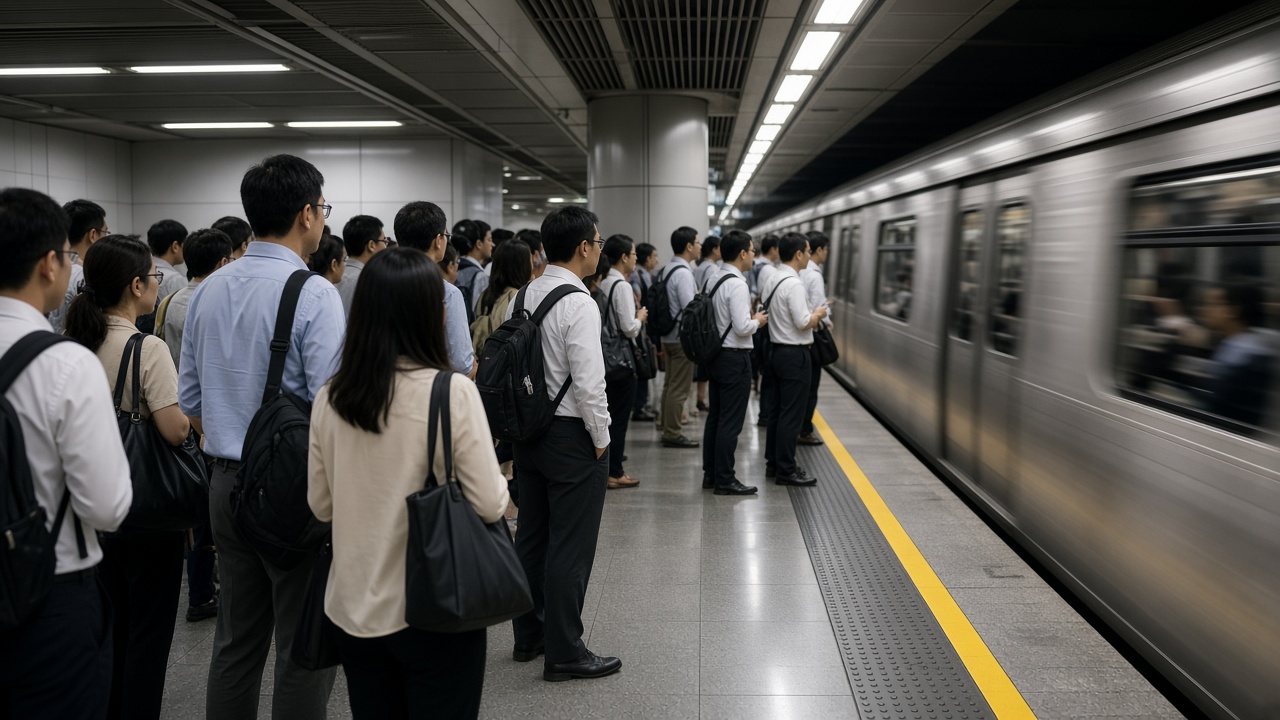
A technical fault on an East-West Line train between Buona Vista and Outram Park stations disrupted Singapore’s morning peak on Wednesday, triggering crowding that commuters said lasted well beyond the roughly 25 minutes SMRT needed to restore normal service.
Timeline of the hold
Passengers and social media posts placed the start of the delay near 7:50 a.m., with service recovering by about 8:15 a.m. AsiaOne reported that the incident involved the train itself rather than operator error, describing it as an isolated equipment problem on the ageing cross-island line that carries workers from western housing estates into the central business district.
Even a short stoppage on the core segment between Buona Vista and Outram can back up trains across the network because eastbound and westbound services share tight headways during rush hour. Riders at Queenstown and Redhill said trains sat at platforms for extended periods, while Lakeside station saw queues to enter the fare gates as downstream congestion built.
Crowding far from the fault point
Commuters posting on Reddit described missed meetings and platforms that felt unsafe when every pause added another train’s worth of passengers. One rider wrote that a stall at Queenstown made them late for a morning appointment; another argued that a 10-minute delay could produce a large platform backlog because of limited standing space at older stations.
Effects showed up farther west as well. A passenger at Jurong East reported waiting about 15 minutes for a train as new arrivals kept filling the platform, and another said an eastbound service sat at Chinese Garden for five to 10 minutes with no immediate explanation over the public address system. The pattern—holds at multiple stops after a single fault—is common on radial MRT lines when controllers space trains to avoid bunching near the failure.
Alternatives under strain
Several users noted that ride-hailing fares spiked during the disruption, a recurring complaint when rail incidents coincide with road congestion and haze-related caution outdoors. Buses along parallel corridors can absorb only a fraction of East-West Line volume during peak, which is why operators treat even sub-thirty-minute faults as major incidents worthy of public advisories.
SMRT and the Land Transport Authority typically publish incident summaries after morning peaks; riders on Wednesday were left inferring causes from station announcements and app alerts. For a city that markets rail reliability as a competitive advantage, the episode was a reminder of how tightly coupled the network is: one train fault in the city core can define the commute for tens of thousands of passengers who never passed Buona Vista.
What riders can expect
Unless follow-up inspections find a systemic defect, commuters should assume Wednesday’s event will be logged as a single rolling-stock fault with no line-wide shutdown. Still, engineers often increase monitoring on neighbouring trains after equipment failures during peak. Riders who rely on tight transfer windows may want to build buffer time on East-West Line mornings until SMRT releases a formal fault report.