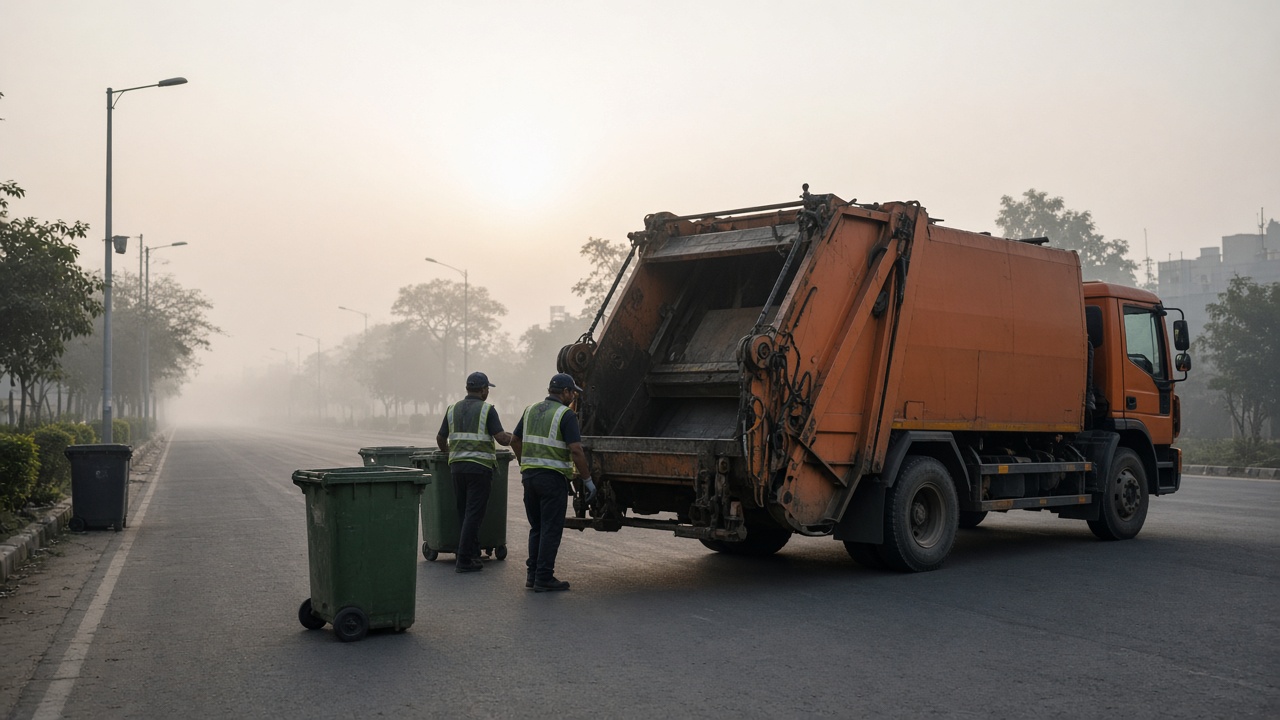
HCLTech began piloting a Gujarati speech-and-chat assistant for Surat Municipal Corporation’s solid-waste helpline, letting residents report missed collections through WhatsApp voice notes that stay on servers inside Gujarat.
The bot triages complaints by ward, bin ID and last pickup timestamp pulled from the corporation’s fleet GPS feed. Human agents receive only cases the model cannot close automatically, a design meant to cut hold times during monsoon-related backlog weeks.
Local language, local compute
Surat generates more than 2,000 tonnes of municipal solid waste daily; helpline volume spikes after festivals when informal dumping rises. Earlier IVR flows were Hindi-English only, frustrating traders in the textile markets who prefer Gujarati.
HCLTech hosts the acoustic models on a sovereign cloud partition in Ahmedabad, citing MeitY preferences for citizen-service AI. Audio is deleted within 24 hours unless the caller opts into a callback queue.
Accuracy and limits
Engineers trained the model on anonymised transcripts from 2024–25, plus synthetic Gujarati prompts for dialects common in Varachha and Udhna. The system still struggles with code-mixed Gujarati-English phrases; those cases escalate immediately.
Officials stressed the assistant does not schedule private haulers or accept payments—only municipal routes. Any message mentioning fees is blocked and routed to a manual compliance queue, echoing recent central warnings about fake sanitation charges.
Scale path
If the six-week pilot hits accuracy targets, Surat will extend the bot to bulk-waste pickup for commercial establishments. Other Gujarat cities have inquired through the Urban Development Department, but HCLTech said it will not replicate the stack until Surat publishes an open metrics dashboard.
For India’s AI desk, the story is a grounded contrast to headline-grabbing large-language-model demos: a narrow municipal task, vernacular interface, and onshore data residency—exactly the combination state governments say they want before signing statewide contracts.
Governance and privacy
Surat published a data protection notice on its citizen portal explaining retention limits and how to request deletion of voice logs. Activists welcomed the transparency but asked for ward-level performance metrics, not only aggregate resolution rates.
HCLTech engineers said they avoided general-purpose chat models for open-ended conversation, instead using constrained intents mapped to municipal ticket types. That reduces hallucinated promises—such as falsely scheduling bulk waste pickup on holidays.
Similar pilots in Indore and Pune stalled last year over procurement disputes; Surat’s advantage was a single-vendor pilot budget approved under the Smart Cities mission with clear success criteria.
If accuracy holds, the corporation may route commercial hazardous-waste inquiries through the same stack, though that module requires integration with Gujarat Pollution Control Board permits not yet digitised.
Ward councillors received weekly dashboards showing average closure times per neighbourhood, a transparency move meant to reduce informal payments in manual ticketing. Early data indicated Varachha wards closed complaints 18 hours faster than industrial zones where GPS on trucks is patchier.
Municipal unions asked for guarantees that the bot would not replace permanent helpline staff, only reduce repeat calls; HCLTech and the corporation signed a memorandum specifying staffing floors through FY27.