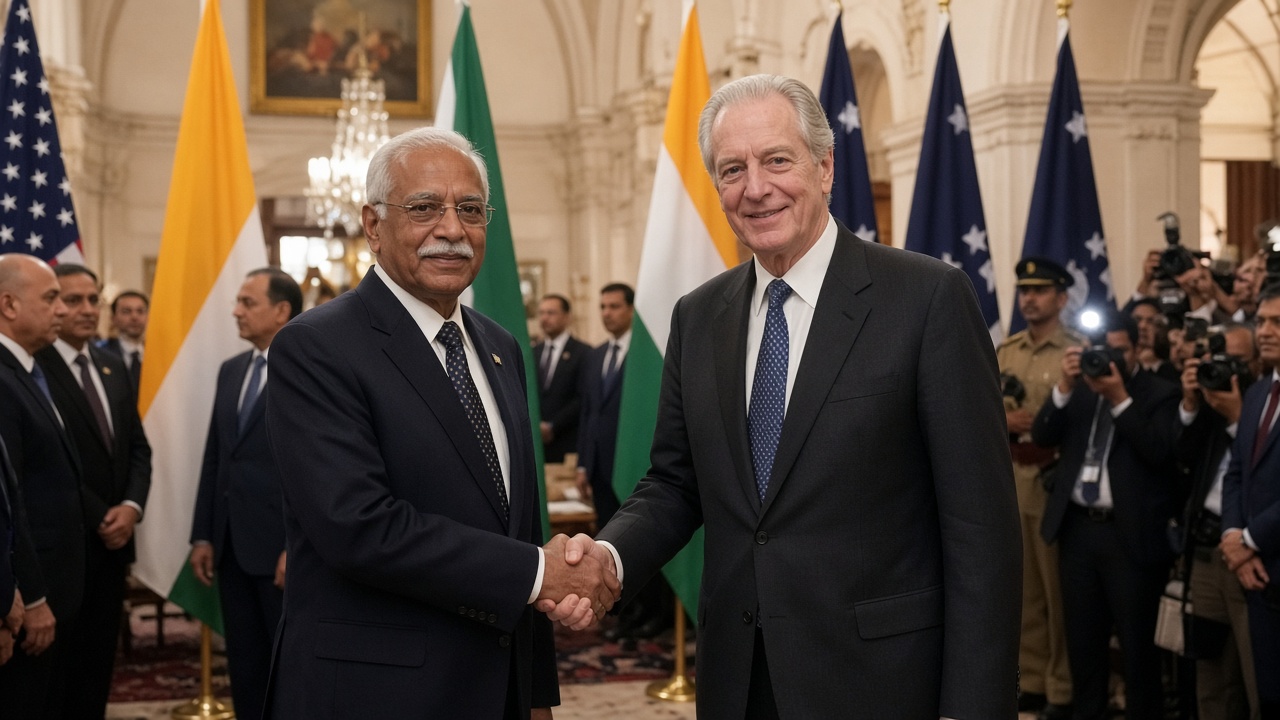
Prime Minister Narendra Modi and Poland's Donald Tusk pledged deeper defence, space and nuclear cooperation in New Delhi on Thursday, unveiling a Defence Industry Dialogue and a target to double two-way trade by 2030 even as lawyers on both sides finish a pact on exchanging classified information.
Tusk arrived on Wednesday for a three-day visit accompanied by roughly 100 chief executives, the largest Polish business delegation India has hosted under the strategic partnership the countries proclaimed when Modi travelled to Warsaw in 2024. The two leaders reviewed progress on that action plan and framed Thursday's meetings as a push to convert diplomatic goodwill into factory floors and joint research.
Defence dialogue and pending secrets agreement
A joint statement said Modi and Tusk welcomed outcomes from the eighth India-Poland Joint Working Group on Defence, which met in Warsaw in September, and agreed to keep military-to-military exchanges on a regular cadence. They proposed the new Defence Industry Dialogue to encourage business-to-business ties, including technology partnerships, co-development and co-production where both governments approve.
Both sides stressed the importance of an agreement on mutual protection and exchange of classified information, saying they hoped to sign it soon. India's foreign ministry said the leaders also pointed to the India-European Union security and defence partnership signed in January as a wider umbrella for collaboration on cybersecurity and emerging technologies.
Trade, energy and historical ties
Beyond defence, the statement set a goal of doubling bilateral trade by 2030 and urged early signing and ratification of the India-EU free trade agreement concluded earlier this year. Modi invited Polish firms to expand manufacturing in India, while Tusk pitched Poland as a gateway for Indian companies entering Central and Eastern Europe.
The leaders highlighted cooperation on agriculture, critical minerals, pharmaceuticals and digital infrastructure, and noted an India-Poland business forum held on the sidelines of the visit. They also recalled humanitarian links: Poland's gratitude for the "Good Maharaja" memorial in Warsaw honoring an Indian ruler who sheltered Polish children during World War II, and India's appreciation for Polish help evacuating more than 2,000 Indian students from Ukraine during Operation Ganga.
What comes after the summit
Agreements on culture, science and higher education are expected to follow, along with an accord between the National Archives of India and Poland's state archives. Officials said a counterterrorism dialogue would add another security channel, though timelines were not announced.
For India's defence planners, Poland offers European engineering expertise and a NATO-adjacent market at a moment when New Delhi is diversifying suppliers beyond traditional Russian kit. For Warsaw, India represents export opportunities in armoured vehicles, aerospace components and dual-use electronics, provided the classified-information treaty clears legal review. Tusk's delegation travels next to other Indian cities before departing on 23 October, with industry matchmaking sessions expected to test whether the dialogue produces contracts or remains a communique-level promise.