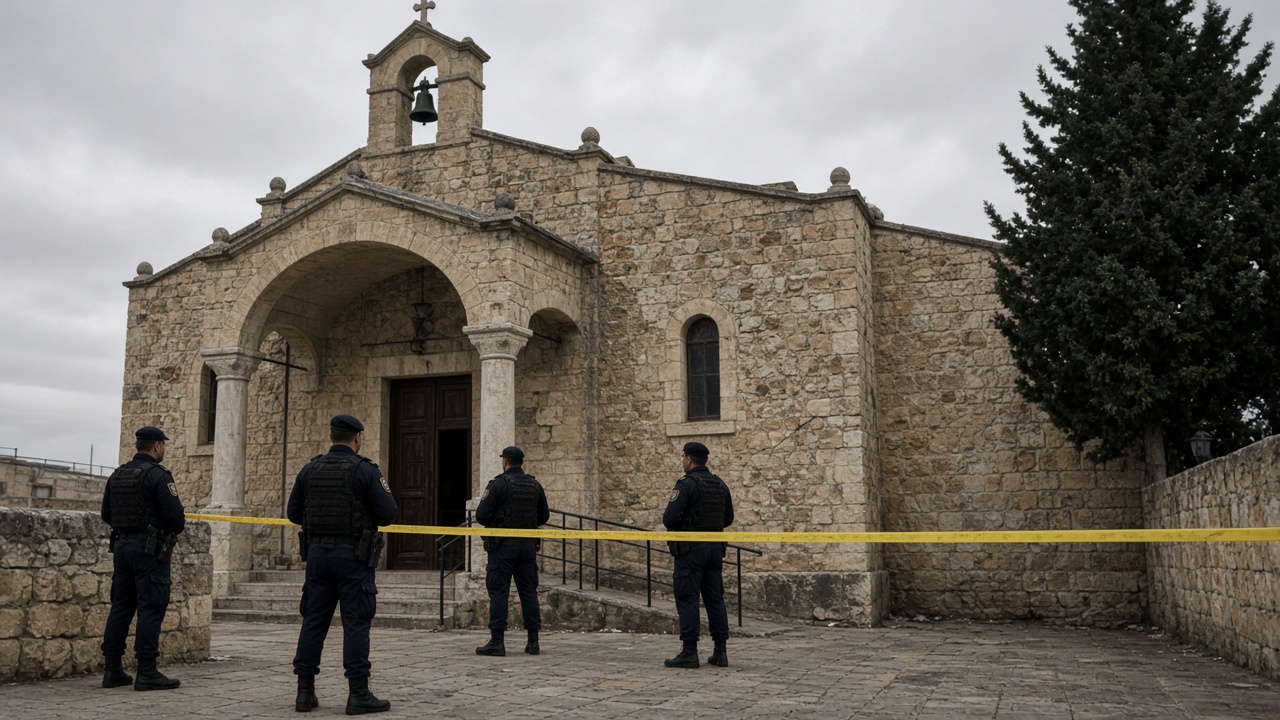
Three gunmen killed seven people and wounded at least 34 others on Friday when they opened fire inside a Greek Orthodox church in Hamoud, a Christian village in Jordan’s Karak governorate south of Amman, during a funeral service that drew between 150 and 200 mourners, according to Jordanian security officials and witnesses quoted by international news agencies.
Director of the Public Security Directorate Obaidullah Al-Maaytah told reporters that 27 of the wounded were hospitalized. Interior Minister Mazen al-Faraya described the shooters as a “group of extremists” and said security forces were pursuing them. No group had claimed responsibility by late Friday.
What witnesses and video show
Survivors told broadcasters they heard an explosion as the funeral procession began, after which masked men entered the church and fired for several minutes. State television station Al-Mamlaka reported that two suspects arrived in a vehicle, exited and opened fire before fleeing; other accounts described three attackers.
CCTV footage verified by the BBC appears to show three armed men approaching the church grounds, retreating briefly, then returning together before entering. Funeral attendee Khaled al-Mdanat told BBC Arabic the shooting lasted about 15 minutes while worshippers tried to hide or flee.
Officials revised the death toll twice during the day, briefly reporting six fatalities before returning to seven. Jordan’s government spokesperson attributed the confusion to the chaotic scene inside the stone church complex.
Official response
King Abdullah II said authorities would “confront the terrorist act that targeted Karak with the harshest penalties.” The attack is a rare mass casualty event against Christians in Jordan, a majority-Muslim kingdom that has long presented itself as a stabilizing force in a volatile region.
Security forces deployed around the church and along roads leading to Karak, a governorate known for Crusader-era castles and a mixed religious history. Hospitals in the area activated mass-casualty protocols, and the interior ministry urged residents to share any information about vehicles or men seen near Hamoud before the attack.
What happens next
Investigators are combing the church and surrounding lanes for ballistic evidence and additional camera angles. Jordanian officials have not identified suspects publicly; regional intelligence services often coordinate on cross-border manhunts when weapons or fugitives may have moved toward neighboring territories.
Church leaders in Amman scheduled emergency meetings with cabinet officials to discuss protection for upcoming services. Western governments issued statements condemning the violence and offering forensic support, though Jordan has not requested outside troops.
For Jordan’s security establishment, the priority is twofold: capture the gunmen quickly to prevent copycat attacks, and keep communal tensions from spilling into street confrontations in Karak or in Amman’s urban churches, where Friday evening prayers were expected under heavier police presence.