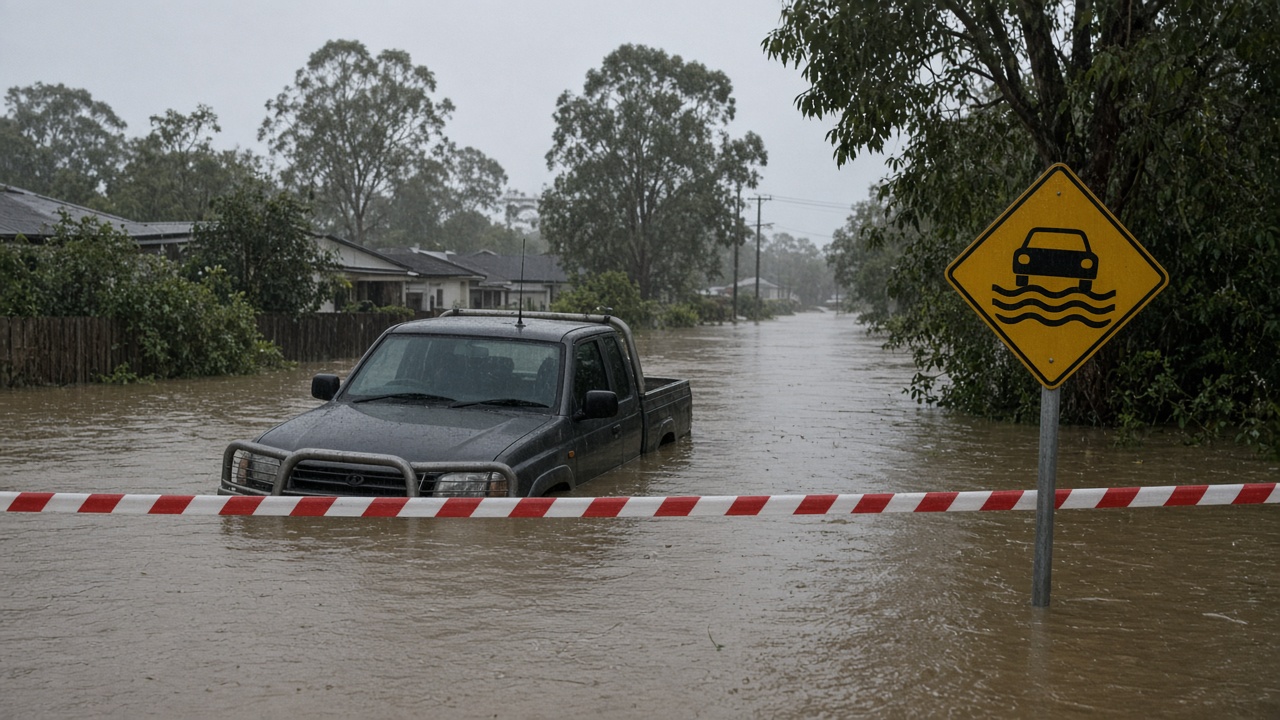
A driver walked away from a grey four-wheel-drive ute on Buchanan Road in Morayfield on Thursday only after ABC reporter Will Murray and bystander Daniel Hainey swam to the sinking vehicle and forced open a rear door less than four minutes after the ute first entered water that looked shallow from the kerb.
Murray and camera operator Liz Pickering were filming flash flooding north of Brisbane when the ute drove past a “road flooded” sign into what appeared to be a calm sheet of water. Within about 30 seconds the vehicle was stranded and floating; within three minutes the bonnet was underwater and the driver could not reverse out. Murray stayed on a Triple Zero call while Hainey joined him in the current to reach the passenger-side rear door, which gave way on a hard pull and let the driver climb free an instant before the roof went under.
Why the vision is circulating
ABC published the sequence on Saturday morning as south-east Queensland faced another day of storm warnings after a week of record October rain. The footage shows no dramatic torrent at first contact — a pattern Peden told the broadcaster makes floodways deceptive. “You can never know the velocity and the depth of the water,” she said, noting that air trapped in the cabin briefly keeps a ute buoyant until water floods electrics and the shell drops.
Queensland Fire and Emergency Services have repeated the “if it’s flooded, forget it” message through a season that has already delivered more than 400 millimetres to some Sunshine Coast towns this month. Murray said he handed the phone to Pickering while he entered the water; Peden cautioned that bystander rescues sometimes end in additional drownings and urged callers to alert emergency services rather than assume they can replicate the Morayfield save.
Storms still building over the weekend
ABC meteorologist Tom Saunders reported Saturday that central and south-east Queensland could see more severe thunderstorms with heavy rain and flash flooding, while a separate band stretches from South Australia through Victoria into Tasmania. Nambour has already logged its wettest October on records stretching to 1896, and Coffs Harbour on the New South Wales north coast passed 339 millimetres by Friday afternoon.
Bureau of Meteorology briefings this week have emphasised saturated catchments, meaning modest totals can still close low-lying roads like the Morayfield crossing. Transport authorities left warning signs in place after the rescue, and local residents told the ABC the same dip floods whenever Brisbane’s northern suburbs catch a slow-moving storm cell.
Charges, culpability and the driver
Police have not released the driver’s name or said whether traffic offences will be considered; Queensland law treats driving into closed floodways seriously when signage is visible. Murray’s account makes clear the driver attempted to reverse before the ute spun in the current, suggesting misjudged depth rather than a deliberate stunt.
For emergency planners, the Morayfield clip is a timing lesson: Peden said occupants may have only a short window once water reaches window height. For viewers sharing the video, the practical takeaway is to treat any flooded road as unknowable, even when the surface looks still — and to let trained crews handle extraction unless, as happened here, seconds clearly remain before submersion.