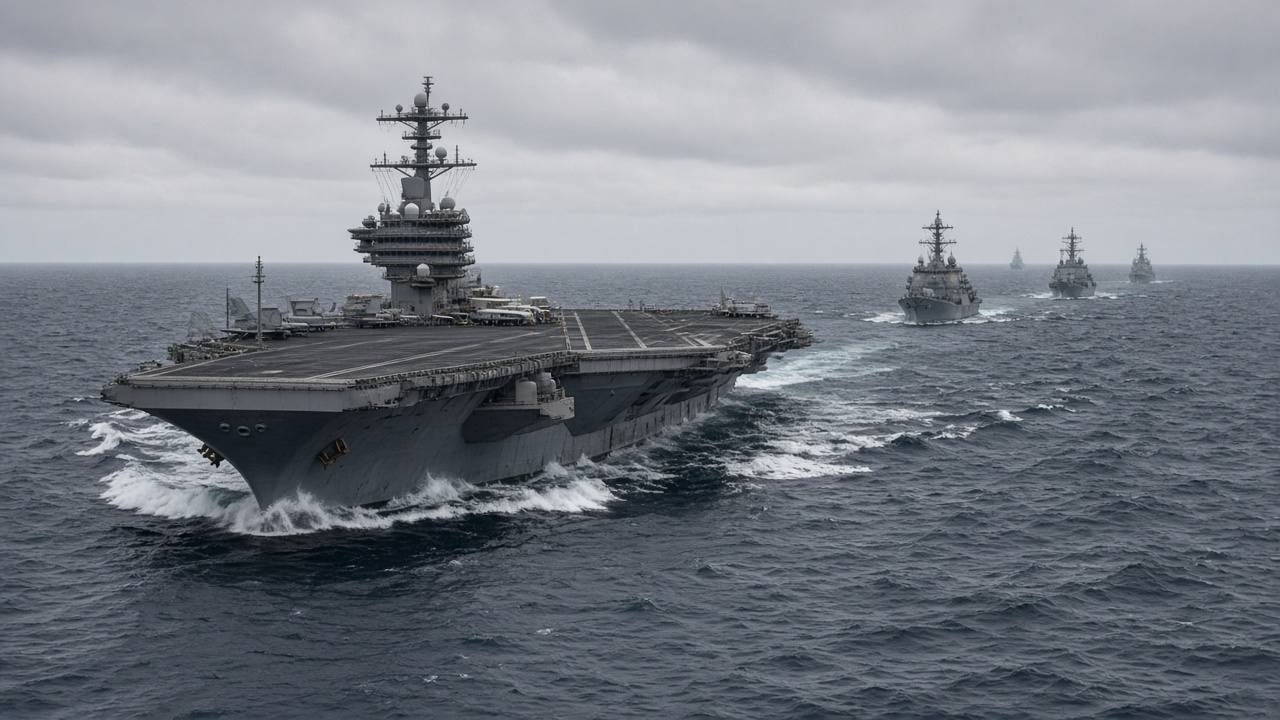
Defense Secretary Pete Hegseth said the United States carried out its first nighttime strike on an alleged narcotics boat in the Caribbean early Friday, killing all six people aboard, and hours later ordered the USS Gerald R. Ford carrier strike group to U.S. Southern Command in a sharp expansion of the Trump administration’s counter-drug campaign off Latin America.
What Hegseth disclosed about the strike
In a post on X, Hegseth said the attack occurred in international waters on a route U.S. intelligence associates with drug trafficking. He said the vessel was “known by our intelligence to be involved in illicit narcotics smuggling” and was “carrying narcotics,” and he alleged it was operated by Tren de Aragua, a Venezuelan gang the U.S. has designated a terrorist organization. An unclassified video attached to his message showed the boat being hit and exploding.
Hegseth described the operation as the administration’s tenth strike against suspected trafficking boats in recent weeks. U.S. officials have said earlier attacks in the Caribbean and eastern Pacific have killed at least 43 people combined. The Pentagon has not released independent evidence tying each vessel to a specific cartel or proving narcotics were on board at the moment of each strike, and legal scholars have questioned the use of military force against non-state actors in peacetime.
Carrier deployment to Southern Command
Later Friday, Chief Pentagon Spokesman Sean Parnell said Hegseth directed the Gerald R. Ford Carrier Strike Group and its embarked air wing to the Southern Command area of responsibility. Parnell said the move supports President Donald Trump’s directive to dismantle transnational criminal organizations and “counter narco-terrorism in defense of the Homeland.”
The statement said the added force would “bolster U.S. capacity to detect, monitor, and disrupt illicit actors and activities” in the Western Hemisphere and augment eight other U.S. vessels already assigned to the region, alongside submarine and fighter assets Washington has moved toward Venezuela in recent weeks. Reuters reported the Ford group was in the Mediterranean when ordered south and would need roughly a week to reach Caribbean waters.
Regional and political context
The escalation comes amid rising tension with Venezuelan President Nicolás Maduro’s government, which Washington accuses of shielding traffickers. Maduro and his allies have called the boat strikes acts of aggression. Congressional Democrats have demanded briefings on the legal authority for the killings, while Republican leaders have largely backed the administration’s framing of the boats as military targets in a drug war.
Trump has described the campaign as a “war on drug cartels” and linked it to protecting the U.S. homeland from fentanyl and cocaine flows. Critics note that most fentanyl entering the United States crosses the southwest land border, not open Caribbean waters, and that destroying small boats far offshore may do little to change wholesale supply.
What happens next
Military officials did not publish a timeline for the Ford’s arrival or say whether carrier aircraft would participate directly in future strikes. Southern Command is expected to use the strike group for surveillance, interdiction support, and as a visible deterrent while smaller platforms continue the boat attacks Hegseth has publicized on social media.
Lawmakers return to Washington with the government still shut down, and the boat campaign is likely to feature in funding fights over defense and homeland security. Allies in the Caribbean and South America have been largely silent publicly, but several governments have privately asked U.S. diplomats whether the carrier move signals preparation for broader action against Venezuela.