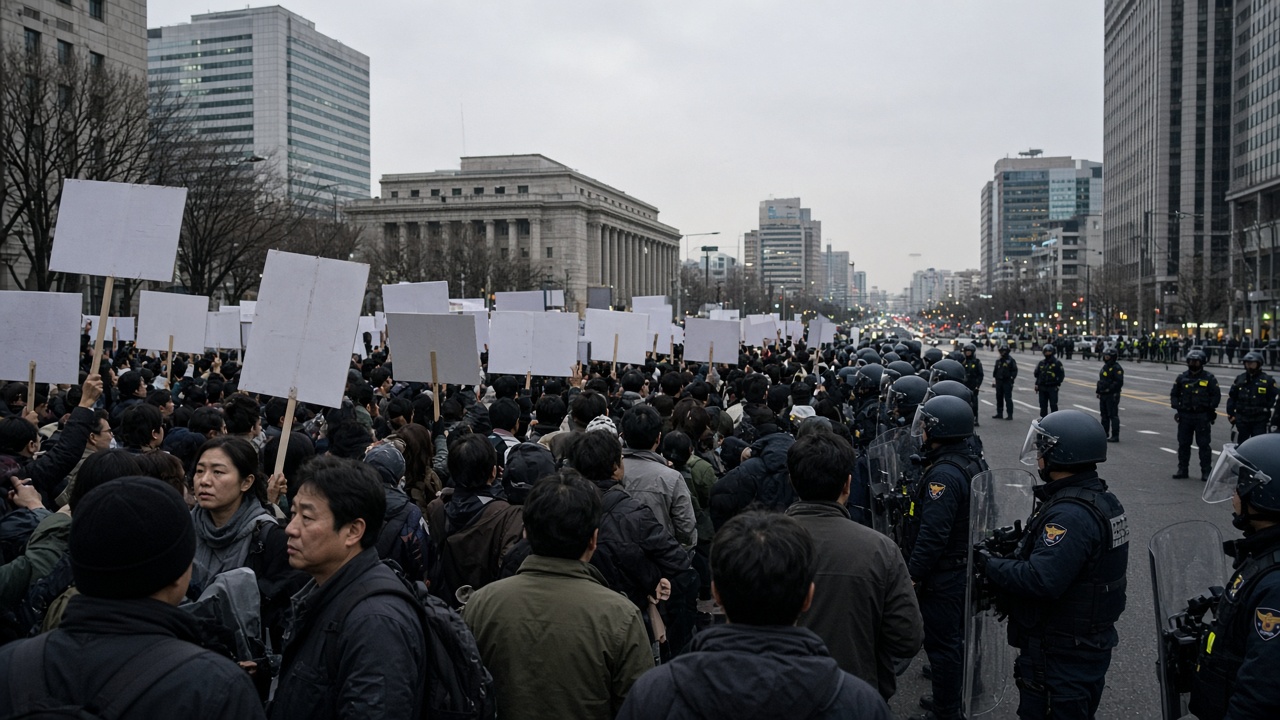
More than a thousand demonstrators marched through central Seoul on Saturday to protest U.S. President Donald Trump’s upcoming visit for the Asia-Pacific Economic Cooperation summit, framing the trip as a threat to Korean workers, climate commitments, and diplomacy with North Korea.
Who marched and what they demanded
Reuters video from the rally showed crowds in Gwanghwamun Square carrying banners opposing Trump’s “America first” trade agenda and renewed demands for higher host-nation payments to keep U.S. troops in South Korea. Organizers from progressive labor federations and civic coalitions said they wanted President Lee Jae Myung to resist any deal that raises medicine prices or weakens industrial subsidies during bilateral talks expected next week in Gyeongju.
Police kept a heavy cordon but reported no major clashes as the march moved toward the U.S. embassy district. Protest leaders said additional demonstrations are planned for the day Trump lands, when he will join Chinese President Xi Jinping and other leaders for APEC sessions in the historic city east of Seoul.
Trump, Kim, and the summit calendar
The rally unfolded as Trump told reporters aboard Air Force One that he would be “open 100 percent” to meeting North Korean leader Kim Jong Un while in the region, but a senior U.S. administration official said Friday that such a session is “not on the schedule” for this trip. South Korean Unification Minister Chung Dong-young had earlier said signs from Pyongyang suggested a “considerable” chance of a encounter and urged both capitals not to let the opportunity slip away.
North Korea fired short-range ballistic missiles earlier in the week, a reminder that any Trump-Kim handshake would occur against a backdrop of continued weapons tests and stalled denuclearization talks. Lee, who campaigned on improving inter-Korean relations, is balancing those hopes with a security alliance that depends on U.S. extended deterrence.
Domestic politics around the visit
Lee’s government is also navigating a housing-market backlash after First Vice Land Minister Lee Sang-kyeong resigned Saturday over remarks that falling prices would help buyers, a comment critics called tone-deaf while Seoul apartment values keep climbing. Opposition parties said Lee should use Trump’s visit to secure exemptions from U.S. tariffs on Korean autos and chips, not offer new concessions on bases or trade.
Business lobby groups, meanwhile, are pressing for clarity on semiconductor subsidies and energy imports, issues likely to surface when Lee and Trump hold a bilateral on the APEC margins. Protesters argued those negotiations should be public, accusing the Blue House of preparing “secret deals” with Washington.
Security and logistics
Thousands of police and military personnel are deploying along the route from Seoul’s airports to Gyeongju, where ancient sites will host leaders under tight cordons. U.S. and Korean officials have coordinated airspace closures and maritime restrictions for Trump’s helicopter movements, and the National Police Agency warned motorists to expect rolling traffic bans through Tuesday.
For Saturday’s marchers, the immediate goal was to register dissent before cameras turn to handshake photo ops. Organizers vowed to keep pressure through the summit, even if no Trump-Kim meeting materializes this week.