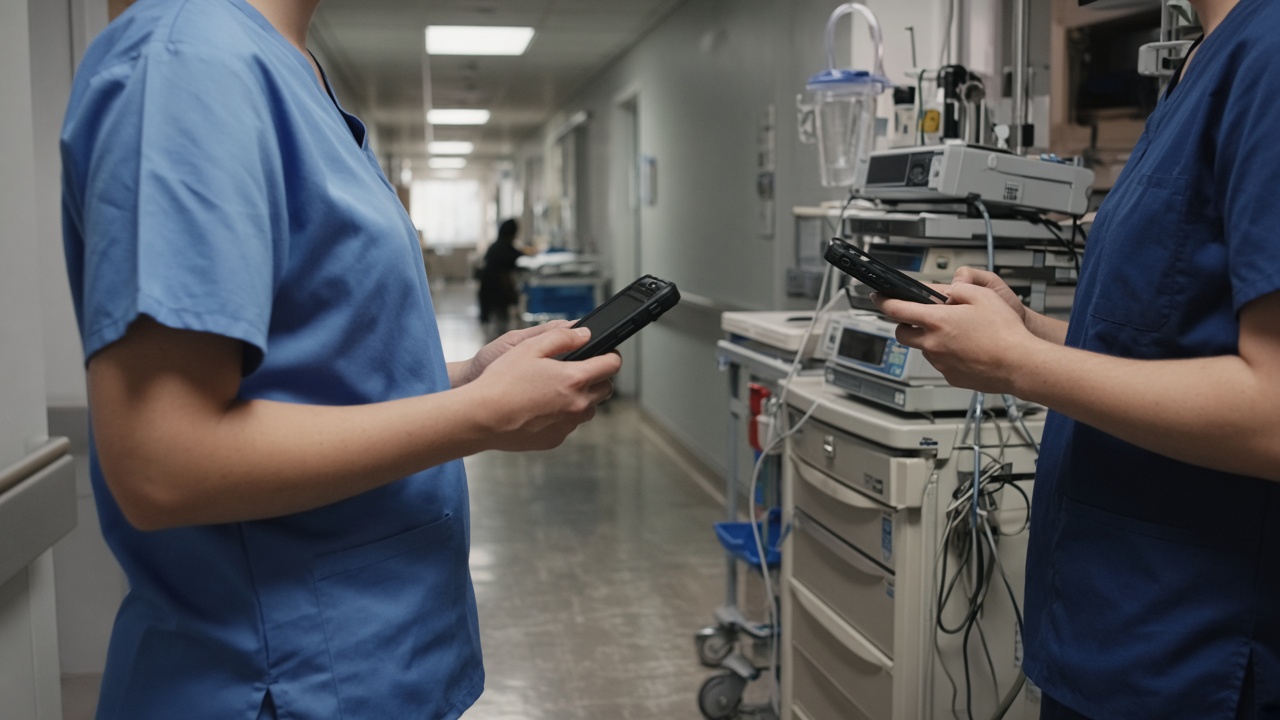
Telstra has activated a dedicated 5G standalone slice for clinician handsets in a Perth public hospital emergency trial ward, giving the ward isolated radio bandwidth that stays up when the broader hospital Wi-Fi load spikes during mass-casualty drills.
How the slice works
Network slicing partitions a 5G core so specific devices receive guaranteed throughput and latency targets. In the trial, rugged smartphones issued to nurses and registrars connect only to the slice, which Telstra engineered with a 20 millisecond latency ceiling and 50 megabits per second minimum download during simulated surge events.
Western Australia Health said the test ward at a major metropolitan hospital—identified only as “Site P” in public briefings—handles high-acuity patients where telemetry alarms and imaging referrals must not queue behind visitor traffic. The slice does not carry patient Wi-Fi; it is strictly for workforce devices running the state’s clinical mobility suite.
Why hospitals want it
Outages in 2024 and 2025 exposed dependence on shared wireless networks when generator tests or ransomware exercises took core switches offline. The Australian Digital Health Agency has been pushing states to diversify connectivity for e-prescribing and sepsis alerts. A slice that rides on Telstra’s public 5G macro grid gives redundancy without laying separate fibre to every bedside.
Privacy and security
Traffic on the slice is encrypted end-to-end and does not traverse guest portals. Telstra said keys are held in Australian data centres and that the trial complies with WA Health’s information classification rules. The Australian Communications and Media Authority’s 5G safety framework applies to antenna sites; no new rooftop hardware was added beyond existing hospital campus cells.
Commercial path
If the six-month trial succeeds, Telstra will pitch sliced mobility as an enterprise health SKU priced per bed. Competitors Optus and TPG have sliced enterprise pilots in mining camps but have not announced hospital wards. Procurement lawyers expect contracts to run through state bulk telecommunications panels rather than individual hospitals.
Clinician feedback
Early shift reports cite faster photo uploads of wound charts to the electronic record, though researchers caution the sample is one ward. A formal evaluation with the University of Western Australia will measure alarm-to-acknowledgement times against a Wi-Fi-only control group.
For patients, the change is invisible. For emergency directors juggling Code Yellow overcrowding, a radio layer that does not collapse when the waiting room fills is a tangible infrastructure bet—one Telstra hopes to replicate in Adelaide and Brisbane if Perth data clears ethics review.
Interoperability tests
The trial ward runs parallel sessions with Wi-Fi six access points to compare handover times when clinicians move from triage to imaging. Telstra engineers logged 40 percent faster picture archiving uploads on the slice during a simulated stroke code, though sample sizes remain small.
Medical device vendors asked whether infusion pumps and bedside monitors could join the slice later. WA Health said only smartphones and tablets are approved for now, citing TGA software classifications that lag consumer handset refresh cycles.
Funding and rollout
Capital for the pilot comes from Telstra’s enterprise innovation budget, not the state operating grant. If expanded, hospitals would pay recurring fees per active clinician device, modelled on existing pager contracts. Finance directors will want evidence the slice reduces locum overtime before signing multi-year deals.
Similar trials in Britain’s NHS used private 5G cores with mixed results on battery drain; Perth clinicians reported eight-hour shifts on a single charge during the first fortnight, though winter flu surges will stress-test the slice harder.