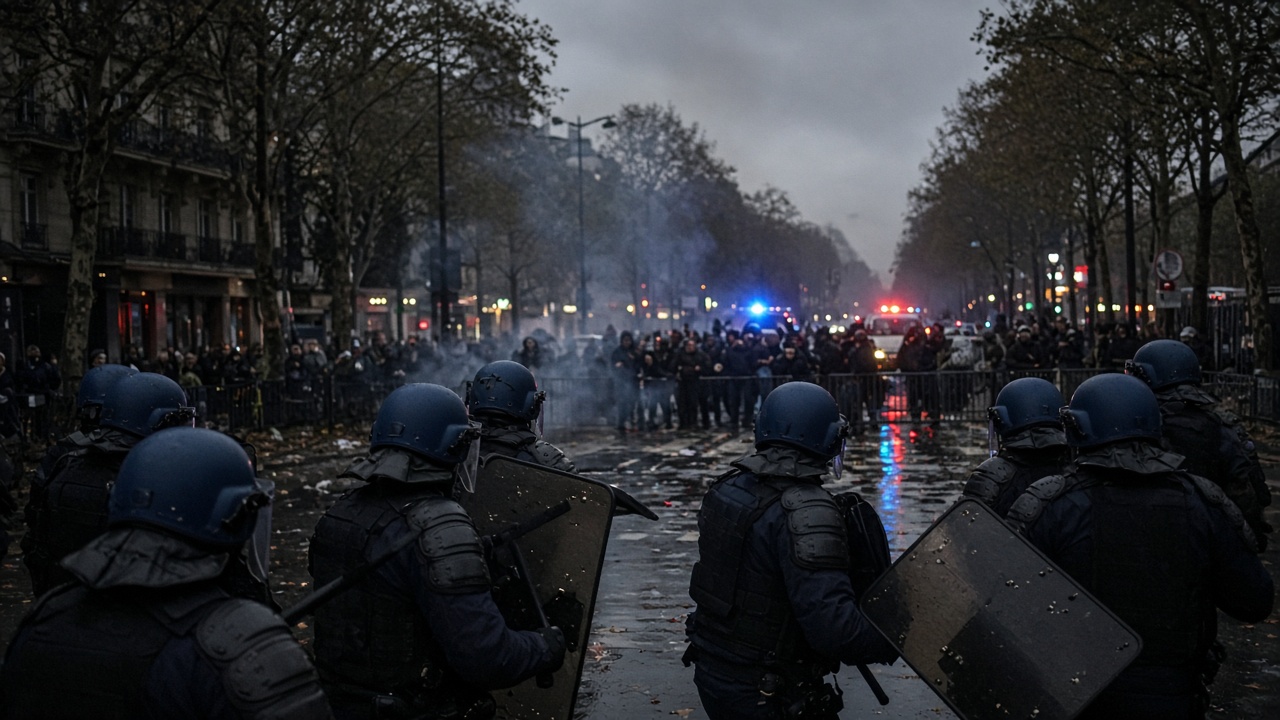
French police arrested more than 1,300 people on Saturday after nationwide demonstrations over the cost of living and school conditions ended with tear gas, water cannon and street fires in several cities, the interior ministry said, capping a second tense weekend of protest politics for Emmanuel Macron’s government.
The ministry estimated that 410,000 people marched, while unions put turnout closer to 800,000. Most rallies stayed peaceful through the afternoon, officials said, but skirmishes broke out after dark in Paris, Marseille, Lyon, Bordeaux, Toulouse and Rennes as officers confronted groups described by Interior Minister Laurent Nuñez as radical activists mixed into union-led marches.
Paris march turns confrontational
In Paris, a column that police said drew at least 110,000 people moved from Porte d’Italie toward Porte de Vincennes before riot units moved in. The ministry said 142 people were arrested in the capital, fewer than half the total detained in Paris on the same day a week earlier, when looting and arson convulsed parts of the city.
Journalists on the ground reported tear gas and water cannon used against several hundred masked youths after the main union procession dispersed. Nuñez told reporters that “several thousand radical activists” had gathered at the rear of the march, including about 500 people authorities had already identified as prior rioters. Police also said they seized metal balls, fireworks, slingshots and imitation weapons in pre-march searches that yielded 135 arrests before the largest demonstrations began.
Security build-up after last week’s riots
Authorities deployed about 70,000 police and gendarmes nationwide, 10,000 more than the previous Saturday, after acknowledging they had underestimated the scale of unrest on 17 October. That earlier wave, which unions said drew roughly 550,000 people, left more than 2,500 arrests and widespread damage to shops and public buildings.
Macron had decreed this weekend that only demonstrations organized by recognized trade unions would be permitted, part of a strategy to separate student-led anger over classroom conditions from opportunistic violence. Fast-track courts have already jailed hundreds of people on vandalism and looting charges from prior nights.
Beyond Paris
In Marseille, protesters set barricades alight and threw projectiles at police, according to local media accounts confirmed by national broadcasters. Officials in Bordeaux reported damage to shop fronts after boards were ripped away. The ministry said 53 officers were injured across the country on Saturday.
Not every gathering turned hostile. In Orléans, Marine Le Pen held a campaign rally for the 2027 presidential race that drew about 13,000 supporters without major incident, while a separate anti–National Rally demonstration in the same city proceeded peacefully, according to police estimates.
What protesters want
The movement began in mid-September with secondary-school students protesting staff shortages, aging buildings and overcrowded classrooms. Teachers, parents and unions have since joined, broadening the grievance list to inflation, fuel costs and inequality. Nuñez said two people were seriously injured on Saturday, including one person in Toulouse and another in Clermont-Ferrand, though he did not detail either case.
Macron, who visited the Paris suburb of Trappes on Friday after a racist shooting there, has framed the unrest as a test of whether France can channel legitimate economic anxiety into politics rather than street chaos. With parallel demonstrations reported in Portugal, Italy and Spain over housing and living costs, European capitals are watching whether Paris can stabilize before the next scheduled union actions.