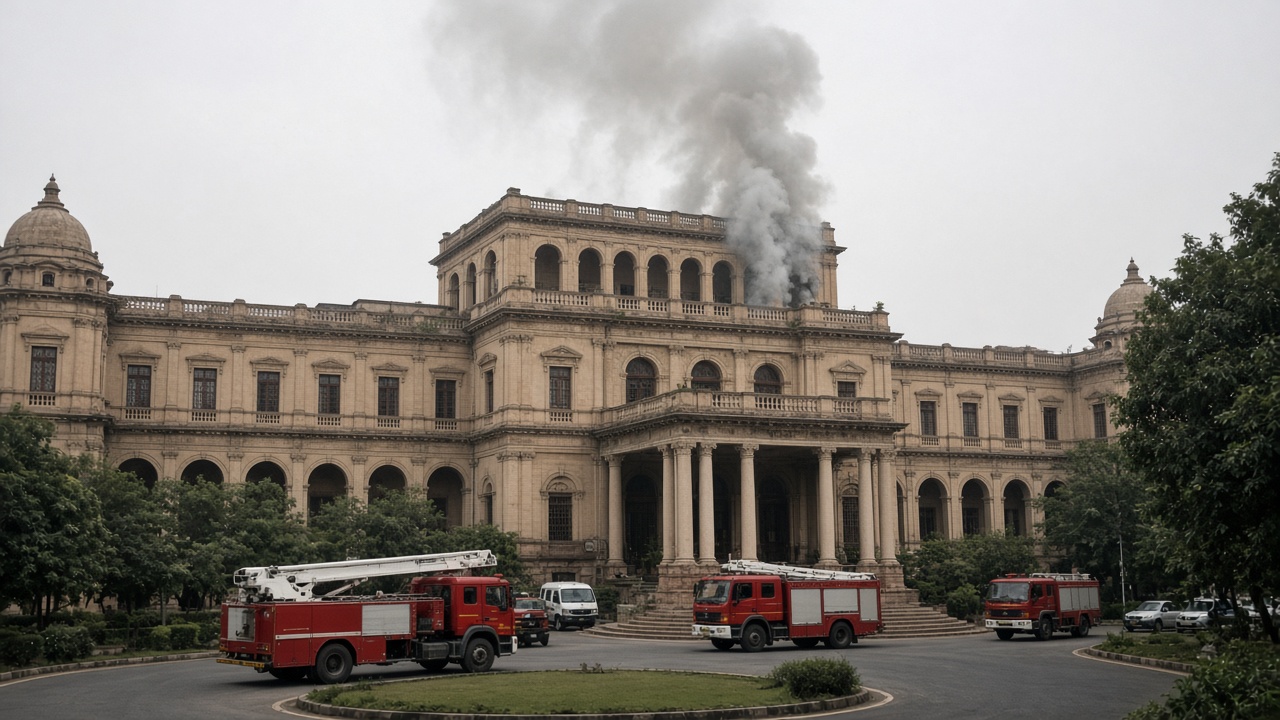
Thick grey smoke poured from the North Block of India’s central secretariat complex in New Delhi on Monday, drawing six fire tenders and a large police presence to Raisina Hill as staff and visitors were cleared from one of the country’s most sensitive government addresses.
A police officer told reporters that repair work was underway inside the building when the smoke was spotted, according to the Times of India’s live updates. Authorities had not linked the incident to any security threat by mid-afternoon, and officials said there were no reports of casualties, though the visual of smoke curling over sandstone colonnades instantly dominated television and social feeds.
A symbol of the Union government
The North Block sits beside Rashtrapati Bhavan on Raisina Hill and houses key ministries, including the home and finance portfolios in the traditional allocation of offices across the North and South Blocks. Any alarm there triggers protocol responses that ripple through Delhi’s security grid, because the complex is both a working headquarters and a monument from the British-era capital shift.
Monday’s response illustrated that reflex: fire crews positioned ladders and hoses along the façade while police cordoned approaches used daily by ministers, civil servants and visiting delegations. The Indian Express reported that teams were on site within minutes of the first calls, a reminder of how tightly choreographed emergency drills have become after earlier fires in government and heritage structures.
What officials said early on
Initial accounts pointed to maintenance or renovation activity rather than an unexplained electrical fault, though a full technical finding will depend on fire officers’ inspection. In past incidents across Delhi’s aging public estate, short circuits during retrofit work or air-conditioning upgrades have produced smoke without major structural damage.
Until a formal statement arrives from the Central Public Works Department or the home ministry, speculation will focus on whether the work involved cabling, archival storage or HVAC systems in upper floors that are rarely visible to the public. Opposition politicians were quick to demand transparency, arguing that citizens deserve a timeline if ministerial offices must shift temporarily.
Political week already heated
The smoke episode unfolded on a day when the Bharatiya Janata Party staged nationwide protests over Congress president Mallikarjun Kharge’s remarks about Prime Minister Narendra Modi’s late father, and as courts in Uttar Pradesh dismissed a years-old defamation case against opposition leader Rahul Gandhi. Those stories will compete for airtime, yet images from Raisina Hill carry a different weight because they touch the physical seat of executive power.
Andhra Pradesh and Odisha, meanwhile, were preparing for Cyclone Arnab’s expected approach later in the week—a reminder that Delhi’s drama does not pause disaster planning elsewhere. Still, for hours on Monday, capital coverage centered on whether the North Block fire was contained and whether any records or secure communications rooms were affected.
What happens next
Fire officials typically issue a cause determination after cooling and ventilation, and ministries may relocate meetings if odor or water damage lingers. Security agencies will also review access logs for contractors on site, standard practice whenever smoke appears in a classified-adjacent building even if no classified material is confirmed at risk.
For Delhi residents, the practical impact was localized traffic diversions around Rajpath and Vijay Chowk. For the Union government, the priority is to demonstrate that a visible plume over North Block was a containable maintenance emergency—not a broader failure of the capital’s estate management.