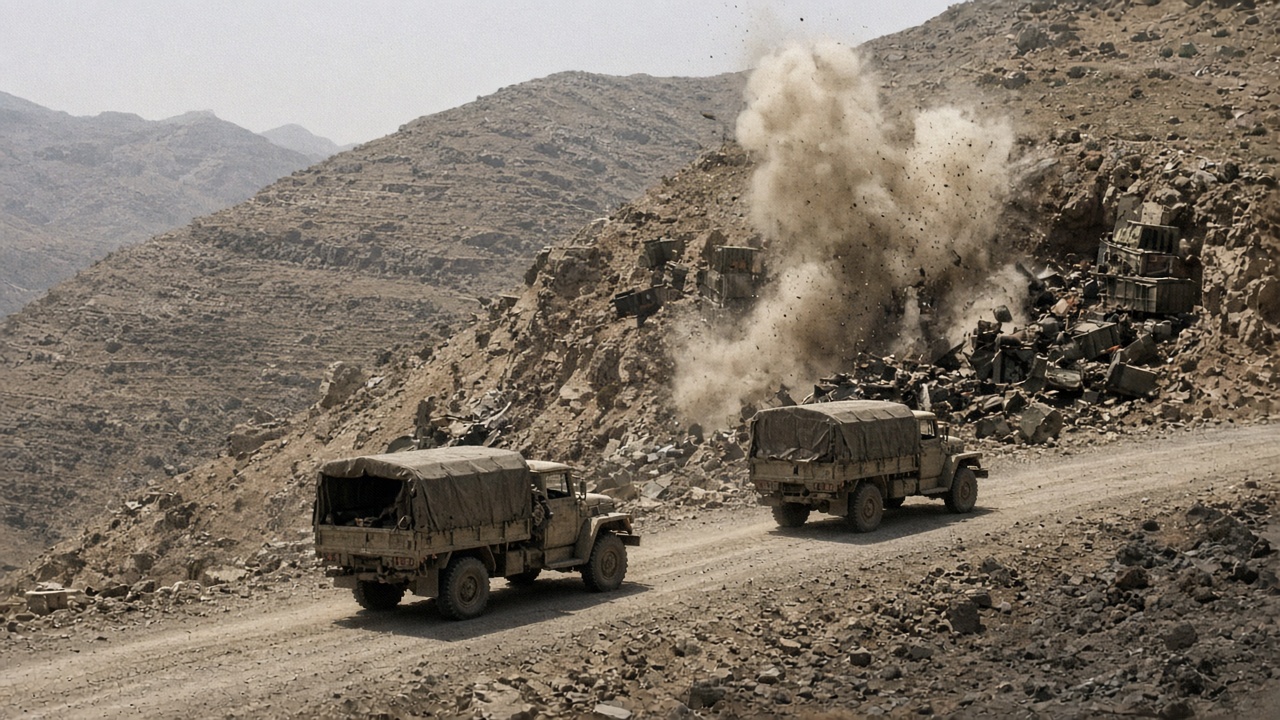
The Saudi-led military coalition fighting in Yemen said Monday that it had struck ballistic-missile infrastructure in areas held by the Iran-aligned Houthi movement, describing tunnels, launchers and underground storage destroyed in the latest round of a conflict that has again spilled into cross-border missile fire.
A coalition spokesperson said the operation targeted five tunnels used to store ballistic missiles, four ballistic-missile launchers and an additional missile-storage site in Houthi-controlled territory, according to reporting from the Associated Press. The statement did not give a precise location or a casualty count, and independent verification of battlefield damage in Yemen remains difficult.
Strikes land amid renewed Houthi salvos
The announcement came as the wider Middle East remained on edge over the Iran-Israel-United States confrontation and parallel security crises along the Arabian Peninsula. Houthi forces have repeatedly launched ballistic missiles and drones toward Saudi Arabia in recent weeks, including salvos that Riyadh said its air defenses intercepted near the capital and near civilian infrastructure.
Anadolu Agency and other regional outlets reported that the Houthis claimed operations against Saudi military sites and airports in the same period, part of a pattern the group has used to pressure the kingdom while fighting continues inside Yemen. Saudi Arabia leads a coalition that backs the internationally recognized Yemeni government based in Aden; the Houthis control much of the north, including the capital, Sanaa.
What the coalition says it hit
Coalition statements on Monday framed the strikes as defensive action against weapons that could threaten Saudi territory and shipping lanes. Tunnel complexes have long featured in Houthi military doctrine, allowing missiles and launch equipment to be concealed and moved with less exposure to aerial surveillance.
By listing tunnels and launchers separately, the coalition appeared to be signaling that it was going after both storage and firing capacity rather than a single isolated site. Western and Gulf officials have warned for years that missile technology transferred or adapted with Iranian support has extended the Houthis’ reach beyond Yemen’s borders.
Humanitarian and diplomatic backdrop
Yemen’s war has already created one of the world’s worst humanitarian emergencies, and any escalation that widens bombing or blockade risk draws immediate concern from aid agencies. The United Nations and mediators have struggled to convert short ceasefires into a durable political settlement, while front lines and economic collapse continue to shape daily life for millions of Yemenis.
Separately on Monday, high-level delegations from Saudi Arabia, Pakistan and Turkey were in Tehran for talks with Iranian authorities aimed at preventing a wider regional war after the U.S.-Israeli campaign against Iran, Iran’s foreign ministry said. Those diplomatic tracks run on a different calendar from the Yemen battlefield but share the same worry: that missile and drone exchanges could draw more outside powers into direct confrontation.
What happens next
Riyadh is likely to keep pairing publicized strikes on Houthi missile sites with air-defense claims when projectiles are launched toward the kingdom. The Houthis, for their part, have shown little inclination to halt long-range attacks while they remain locked in a grinding domestic war.
Shipping insurers, port operators and airlines will watch whether Houthi rhetoric translates into renewed threats against Red Sea transit, a lever the group has used before. For now, Monday’s coalition account points to another cycle of strike and counterstrike in Yemen itself, with the missile architecture in the crosshairs.