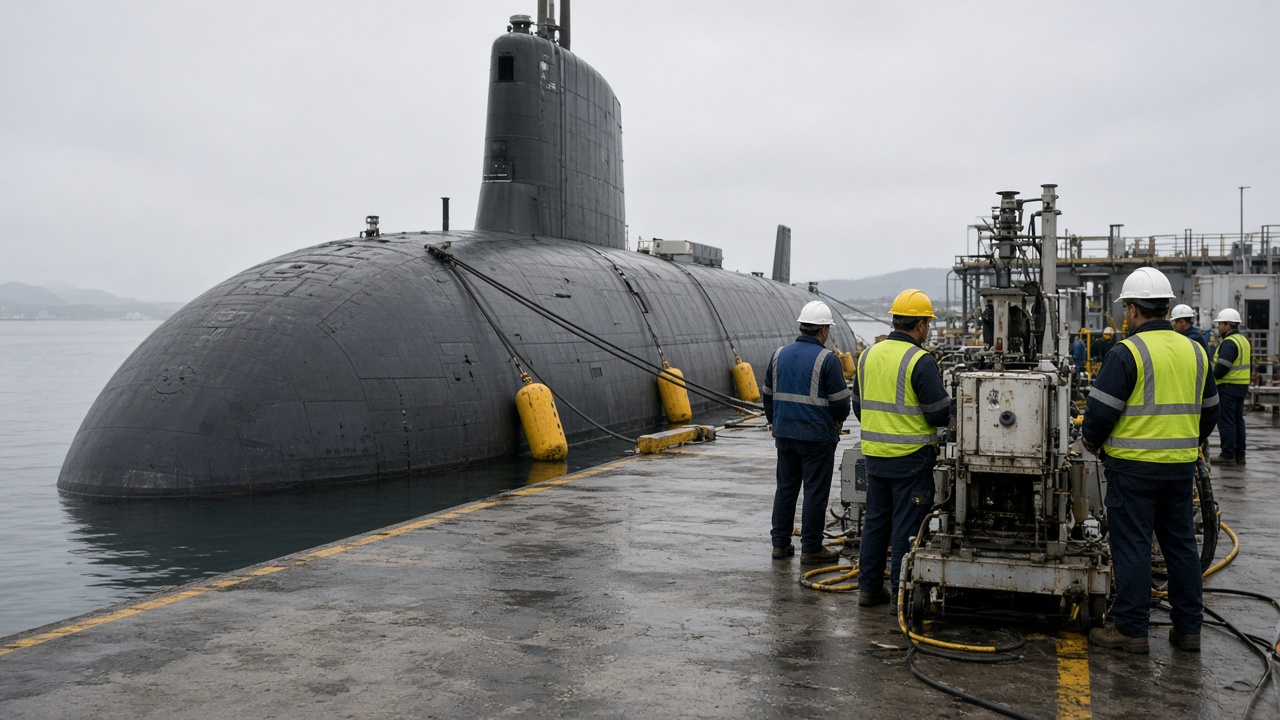
The United States Navy attack submarine USS Colorado arrived at HMAS Stirling in Western Australia on Tuesday to begin a scheduled maintenance period, one day after AUKUS defence ministers named it the first Virginia-class boat that will rotate through Submarine Rotational Force-West from late 2027.
Why this visit matters for Australia
For the first time at the Stirling base, more than 30 civilian technicians from Australian shipbuilder ASC will perform routine work on a U.S. nuclear-powered submarine alongside specialists from Pearl Harbor Naval Shipyard, according to the Australian Submarine Agency. Royal Navy personnel are also participating, turning the visit into a trilateral test of the workforce and pier infrastructure Canberra has spent billions upgrading under the AUKUS pillar-one pathway.
Deputy Prime Minister and Defence Minister Richard Marles, U.S. Secretary of War Pete Hegseth and UK Defence Secretary Wes Streeting said in a joint statement on Monday that Colorado (SSN-788) would anchor the rotational force projected to host up to four U.S. and one British fast-attack submarine at Stirling. The arrangement is intended to accelerate Australia’s ability to operate its own conventionally armed nuclear-powered submarines while expanding regional maintenance options for allies.
Work starting on the pier
Rear Adm. David Mann, who leads the agency’s Virginia Division, said Australian personnel will use locally built equipment—including a pure-water plant, high-pressure air compressor and dehumidifier validated during earlier visits—to sustain Colorado during the monthlong period. Upgrades to Diamantina Pier and a safety walkway around the sail are part of the exercise.
The U.S. Navy said Colorado is assigned to Submarine Squadron Three, the American unit re-established at Stirling in June. When the boat returns in 2027, officials expect it to help formally stand up Submarine Rotational Force-West, known as SRF-West, under the bilateral force posture agreements that govern allied presence in Australia.
Nuclear stewardship and regional politics
All three governments stressed that rotations will comply with non-proliferation obligations and Australia’s commitments under the South Pacific Nuclear Free Zone Treaty. Environmental groups in Western Australia have continued to challenge the transparency of nuclear safety reporting at Stirling, but the Albanese government argues that hosting allied submarines is central to deterrence in the Indo-Pacific.
Rear Adm. Chris Cavanaugh, commander of U.S. Pacific Fleet submarine forces, said Tuesday that AUKUS integration was proceeding “full steam ahead” despite political transitions in Washington and London. Colorado’s visit is the fourth submarine maintenance period in Western Australia since AUKUS was announced and the third nuclear-powered attack boat serviced on Australian soil in the past 12 months.
What comes after Colorado leaves
Defence officials in Canberra said follow-on visits will stress supply chains for spare parts and classified maintenance data sharing before Australia accepts its first sovereign boat in the 2030s. For now, the immediate task is proving that Australian workers can keep a front-line U.S. submarine operational without sending it back to Hawaii for every intermediate repair.
Colorado is expected to depart Stirling after the maintenance window closes in late November, returning to its Pacific patrol cycle until the 2027 rotational deployment that ministers flagged as a milestone for all three navies.