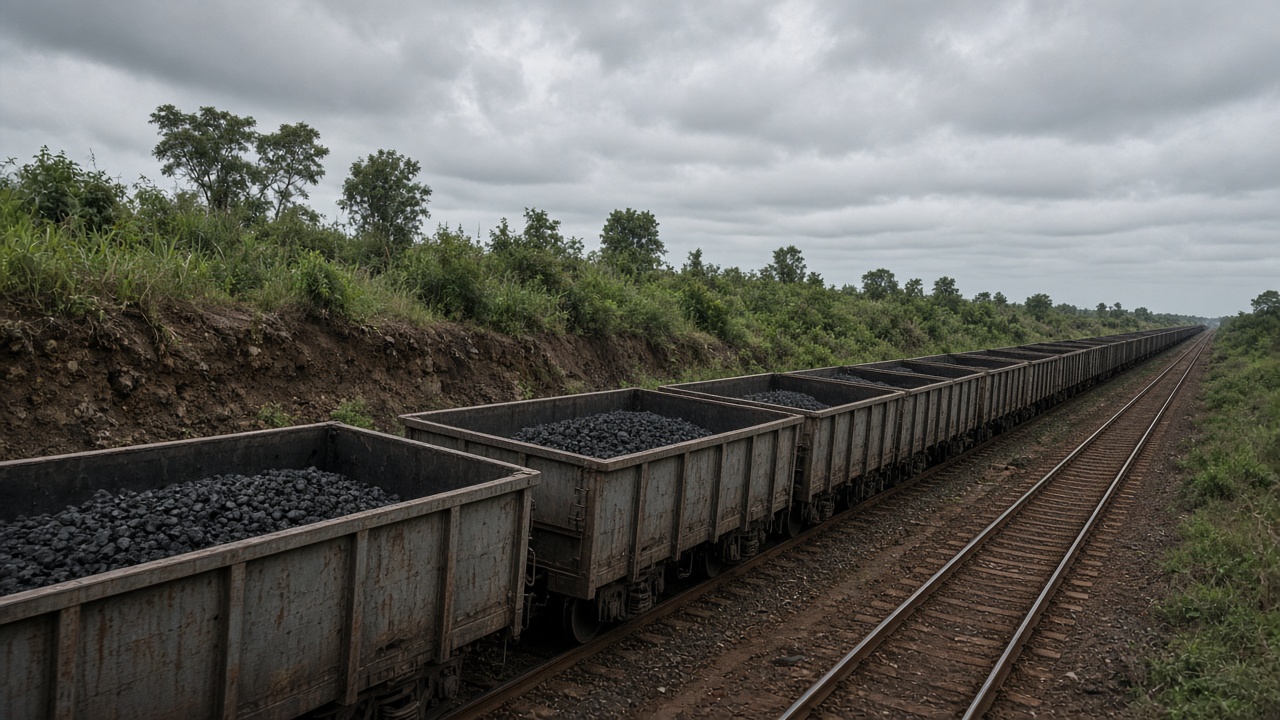
Coal India Ltd cut daily rake allocations to eastern power plants on Monday after flood repairs on the Dhanbad loop line left loaded wagons stranded for more than 72 hours, forcing two state gencos to burn through yard inventories faster than their fuel-supply agreements allow.
The Mahanadi Coalfields subsidiary told buyers in a Sunday night advisory that it would hold back 18 rakes a day until Indian Railways certifies the loop’s restored gradient, according to letters seen by InfoHandle. The line feeds washeries that supply blended fuel to NTPC’s Kahalgaon complex and several West Bengal state units.
Where the bottleneck sits
Railway engineers closed one chord of the loop after embankment slippage during last week’s cloudburst, routing traffic through a single-track detour with a 12-hour backlog. Coal India’s dispatch cell said loaded rakes were averaging 41 hours from pithead to power-plant siding, against the 36-hour norm written into most fuel-supply agreements.
Officials at Eastern Coalfields, which moves much of the volume through Dhanbad, said they redirected six rakes toward the Howrah-Dankuni corridor, but that path cannot absorb the full shortfall without delaying cement and steel consignments already booked for Kolkata ports.
Plant inventories under pressure
Jharkhand State Electricity Board officials told InfoHandle that two 500-megawatt units at Tenughat were operating with less than four days of coal cover on Sunday evening, below the seven-day comfort band regulators prefer before monsoon withdrawal ends. West Bengal Power Development Corp. said its Sagardighi plant accepted two emergency rakes by road from Raniganj, a costly workaround it has not used since 2022.
Central Electricity Authority dashboards showed eastern region coal stocks at 33 percent of normative levels on Friday, improving slightly from mid-October but still thin for plants that did not build inventory during the September price softening.
Coal India’s response
Coal India’s chairman told analysts on a Friday earnings call that the company would “prioritize power over non-regulated sector” if rail congestion persisted, echoing ministry guidance issued after the 2024 heatwave crunch. Monday’s rake cuts formalize that stance for eastern subsidiaries without yet declaring force majeure on commercial contracts with aluminum smelters.
Traders on the e-auction platform said spot premiums for 4,200-kilocalorie coal widened by Rs 180 per tonne in morning trade, a modest move that suggests buyers expect the rail repair to finish within a fortnight rather than drag into November.
Railway repair timeline
Indian Railways’ engineering wing posted a bulletin estimating permanent ballast work would finish by November 3 if weather holds. Until then, dispatchers are running pilot locomotives at restricted speed across the patched section, limiting train length to 58 wagons instead of the usual 84.
Coal ministry officials said they would not intervene on price caps while the disruption remains localized. Independent power producers with coastal linkage contracts are largely insulated, but inland merchant plants buying on e-auction remain exposed to both freight surcharges and higher spot coal.
What buyers watch next
Discoms in Bihar and Odisha said they had not yet curtailed agricultural feeders but would review daytime industrial schedules if rakes do not normalize by the weekend. Coal India promised a revised allotment table by Wednesday once Railways signs the loop certificate.
For investors, the episode is a reminder that Coal India’s volume guidance still hinges on monsoon-damaged track as much as on pithead output. Until the Dhanbad loop reopens at full capacity, eastern generators are living off stockpiles—and counting hours, not days, of fuel left in the yard.