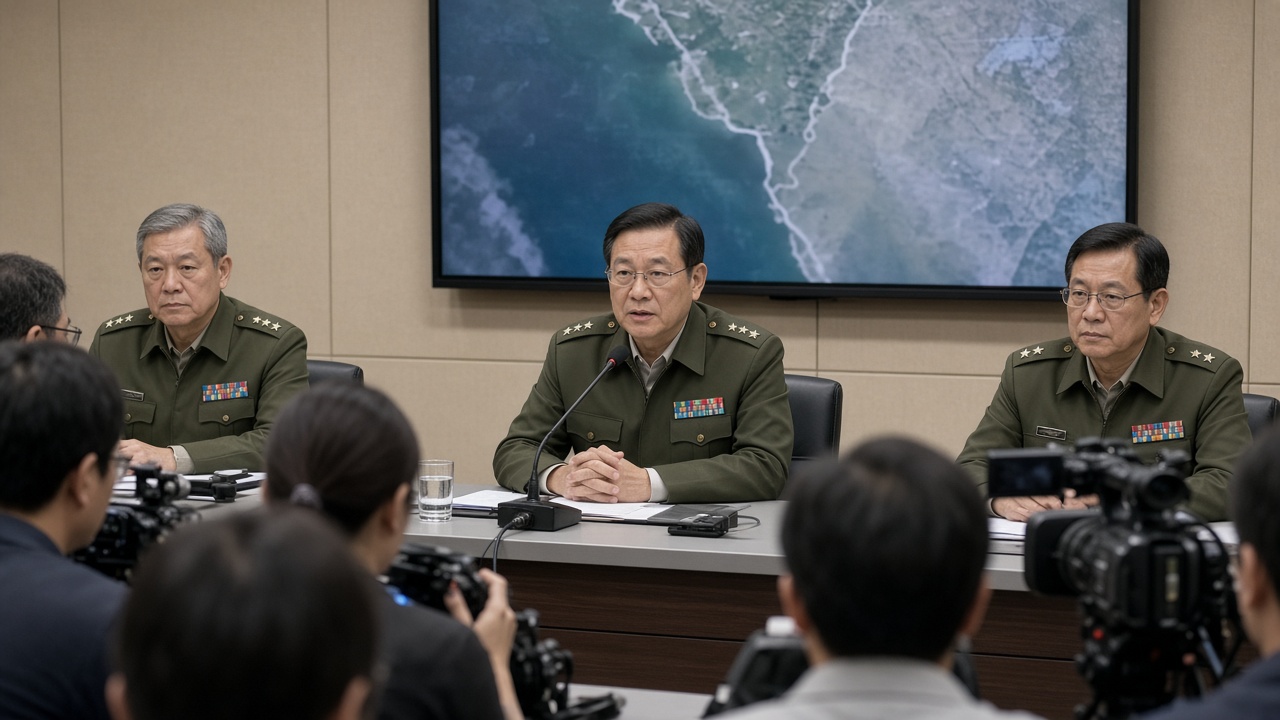
Taiwan’s defence leadership pledged to keep forces dispersed and alert after Beijing released high-resolution satellite photographs of the island’s military facilities and civilian landmarks, part of a state-media campaign tied to the Jilin-1 commercial imaging constellation. Defence Minister Wellington Koo told reporters Tuesday that Taipei treats the releases as intelligence pressure and will apply concealment and mobility measures to protect operational security.
What Beijing published
Chinese outlets circulated detailed overhead views of locations including harbours, airfields and well-known urban sites, according to regional security reporting. The South China Morning Post noted that Jilin-1 footage has figured prominently in Beijing’s messaging for a second consecutive year, raising concern in Taipei about how quickly commercial-grade sensors can be paired with propaganda narratives during periods of elevated cross-strait tension.
Taiwan’s Ministry of National Defence separately reported routine grey-zone activity in the 24 hours through Tuesday morning, including eight Chinese naval vessels, four official ships and three aircraft operating near northern and southwestern approaches. The ministry said it deployed aircraft, ships and coastal missile units to monitor the movements, a pattern Taipei has tracked with increasing frequency since 2020.
Taipei’s response
Koo said the ministry “will not lower its vigilance at any time regarding all such satellite imagery and related intelligence collection directed at Taiwan,” and that early-warning procedures would include dispersal of assets where appropriate. He did not disclose specific units affected, but stressed that commanders are expected to assume overhead collection is ongoing even when public releases are timed for media impact.
Legislators from both governing and opposition camps asked whether Taiwan’s own satellite and counter-surveillance programs are keeping pace. Officials pointed to ongoing investments in space and electronic warfare but declined to detail capabilities, citing classification rules.
Why the timing matters
The imagery drop coincides with campaigning for November’s local elections and with steady PLA activity around the median line. Analysts in Taipei said Beijing may be signaling reconnaissance depth to domestic audiences while probing how Taiwan communicates readiness to partners.
For Washington and Tokyo, the episode is another reminder that peacetime competition includes open-source optics as well as ship counts. Taiwan’s immediate task is to show that published photos do not equate to uncontested access—without escalating rhetoric that could feed a crisis cycle both sides say they want to avoid.
Commercial satellites in a military narrative
Jilin-1 is operated by a Changchun-based commercial venture that markets rapid-revisit imaging to governments and businesses. Security researchers say the constellation’s public releases rarely include the sharpest products held for paying clients, which means state media may be showcasing a subset of what Chinese analysts can already access through classified channels.
Taiwan’s National Security Council told legislators that tritium-related discharges from Japan’s Fukushima plant remain within modeled bounds for local waters, a separate Tuesday briefing that underscored how multiple environmental and security threads now compete for public attention during the election season. Defence officials declined to link the Fukushima statement to the satellite releases, but acknowledged that crisis communications teams are juggling several monitors at once.