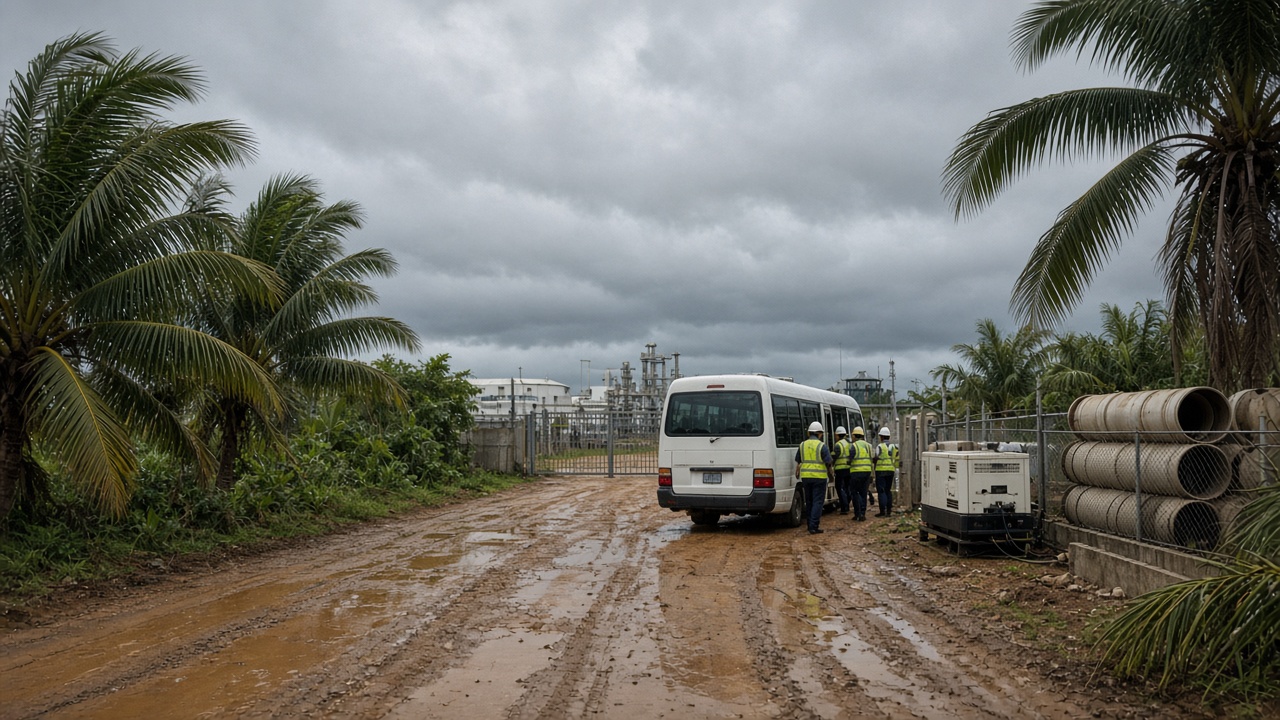
Posco International told employees Monday it had paused scheduled crew rotations to its Mozambique liquefied natural gas operations after national forecasters placed the Maputo corridor under a cyclone watch, leaving roughly 120 Korean expatriates and local contractors on extended site tours rather than risk helicopter transfers in deteriorating weather.
What the company changed on the ground
The trading and energy arm of Posco Holdings operates logistics and equity stakes tied to offshore blocks in Area 1 of the Rovuma Basin. A company bulletin seen by InfoHandle Network said charter flights from Maputo to the Afungi peninsula would not run until aviation authorities lift the watch, which Mozambique's National Institute of Meteorology extended through late Wednesday.
Site managers activated a shelter-in-place protocol for nonessential travel along the dirt access spine, according to two contractors briefed on the memo. Fuel for backup generators was topped off, and refrigerated modules that store spare turbine parts were double-checked after overnight gusts topped 70 kilometers per hour near Pemba.
Production and shipping exposure
Posco International does not operate the liquefaction trains owned by TotalEnergies-led Mozambique LNG, but it holds marketing rights on a slice of output and coordinates Korean procurement for long-lead items. Analysts at Korea Investment and Securities said a week-long rotation freeze would not by itself cut cargo nominations, though delayed maintenance teams could push back a minor valve retrofit scheduled for November.
Freight forwarders in Busan said one October slot for condensate loading was already shifted to a floating storage unit to avoid stacking vessels inside the cyclone cone. Korea Gas Corporation, a downstream buyer, told reporters it has 18 days of cover at Pyeongtaek and Incheon terminals and is not requesting emergency spot cargoes.
Seoul headquarters response
At the Posco International tower in Gangnam, investor relations staff opened a hotline for minority shareholders asking whether force majeure clauses might apply to third-quarter volume guidance. The company reiterated that it is monitoring jointly with partners and will file a Korea Exchange disclosure if material output is affected for more than ten consecutive days.
The Federation of Korean Industries, which has pressed the government to release draft customs texts tied to trade agreements, separately noted that energy affiliates are carrying higher insurance premiums on African logistics this year after two cyclone seasons disrupted east-coast ports.
What happens next
Meteorologists expect the system to track south of Beira, but INAM warned of secondary flooding along EN1. Posco International said it would resume rotations in phases, starting with medevac-capable helicopters, and publish an updated staff count once the watch downgrades to a yellow advisory.
Insurance and contractor networks
Marine underwriters in London and Seoul re-rated east African energy voyages after Cyclone Chido damage in 2024, and brokers said Posco International's policy now carries a seven-day weather delay clause that caps charter hire rebates. Korean construction partners Hanwha Ocean Engineering and Hyundai Engineering and Construction maintain fabrication yards in Maputo; both said welders scheduled for November redeployment will remain in Korea until flights reopen.
Union officials representing Korean expatriates asked the Ministry of Foreign Affairs to keep consular staff on standby in Maputo, citing spotty mobile networks when towers lose diesel backups. The ministry posted a travel alert urging nonessential trips to Cabo Delgado province to be postponed, though it stopped short of ordering evacuations.
Historical context for investors
Mozambique LNG exports resumed only gradually after insurgent attacks near Afungi in 2021, and Korean investors have treated the asset as a long-cycle bet tied to Asian spot prices. Posco International shares closed up 0.6 percent in Seoul, outperforming the broader materials index as traders treated the rotation pause as a logistics hiccup rather than a production halt.
Energy analysts at Daishin Securities noted that Korean utilities still pay a premium for Atlantic cargoes when Asian LNG hubs tighten, so even brief shipping delays can ripple into winter tariff hearings. They advised watching Japan Korea Marker spreads rather than headline cyclone tracks when sizing positions in Posco affiliates.