
Ishfaq Ahmad Tramboo was 65 when the Regional Transport Office in Kashmir told him he would have to pay road tax of roughly nine percent on his car before it could take a Jammu and Kashmir registration mark. The demand, reported at about four lakh rupees, sat on top of a vehicle he had already bought and registered in Haryana in 2023. He went to the Jammu and Kashmir High Court. On 9 August 2024 the court pared back the charge, but the fight is a useful entry point into a line item that surprises almost every first-time buyer: a single motor-vehicle tax payment that can rival a year of insurance, collected the day the registration certificate is issued.
The second invoice
Tramboo's case is extreme, yet the underlying paperwork is familiar. Walk out of a dealership and the price sheet splits into ex-showroom cost, goods and services tax, registration fees, and then a state levy often labelled motor vehicle tax or lifetime tax. That last figure is not a processing fee for the union government's registration rules. It is a state tax on using the vehicle on public roads, calculated from the invoice price and due before the registering authority hands over the certificate.
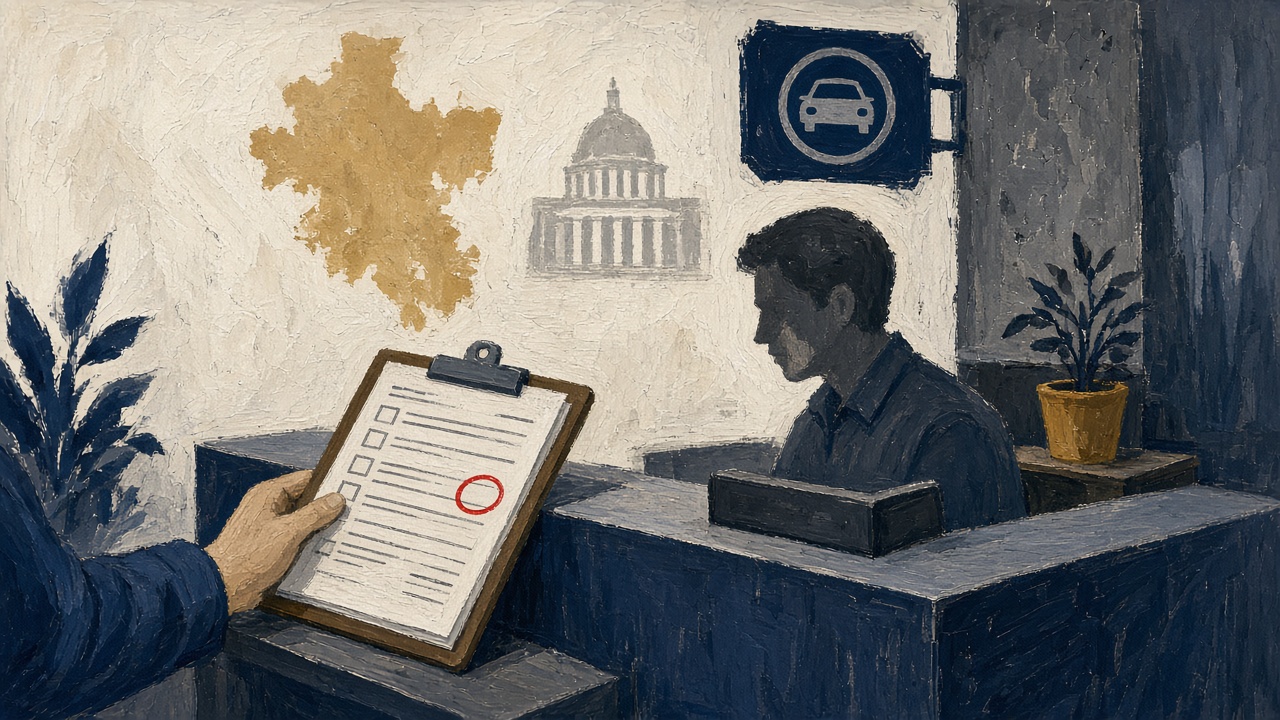
News coverage of Tramboo's win focused on the Kashmir RTO's nine-percent demand, but the numbers on any showroom quote obey the same state schedules. The vehicle's age, fuel, and ex-showroom price pick a row in an act most owners never open.
Buyers who expect something like an annual property tax bill are looking at the wrong clock. For most private cars in most states, the tax is collected once, upfront, for a period tied to how long the first registration certificate is meant to last. Miss that distinction and the showroom quote feels like a bait-and-switch even when every number is legal.
Not the registration fee
The Motor Vehicles Act makes the separation explicit. No one may drive a vehicle in a public place unless it is registered under Chapter IV and carries a valid certificate. That chapter is union law: forms, fees, registration marks, and the certificate itself. Motor vehicle tax sits in a different stack of statutes, one per state, with titles such as the Maharashtra Motor Vehicles Tax Act or the Karnataka Motor Vehicles Taxation Act.

The Ministry of Road Transport and Highways reminds owners that taxes on motor vehicles are a state subject. The central Motor Vehicles Act and Central Motor Vehicles Rules do not set the rate or the refund rules. When you pay at registration, you are settling a state demand that the registering authority checks before issuing a no-objection certificate for an interstate move, not paying Delhi for the plastic card alone.
Fifteen years, one payment
The length of the first certificate is what converts an annual-sounding tax into a lump sum. Section 41 of the Motor Vehicles Act, as amended in 2019 and brought into force from 1 September 2019, provides that a registration certificate is valid for fifteen years from the date of issue, then renewable. Parivahan, the government's transport portal, spells out the mirror image on tax: for non-transport vehicles, motor vehicle tax is taken as a one-time lifetime payment covering fifteen years, with tax payable again at renewal for a five-year stretch.
States have aligned their statutes with that horizon. The ministry's own interstate guidance tells owners that, for non-transport vehicles, one-time tax for fifteen years is the norm at first registration, with a shorter renewal period afterward. Maharashtra levies a one-time tax for the lifetime of a motor car used in the state. The rate is a percentage of the cost of the vehicle read off the purchase invoice, with slabs that rise with price and fuel type. Take a petrol car whose invoice sits in the middle band above ten lakh rupees but not above twenty lakh rupees. The Third Schedule charges twelve percent of the cost at registration. On a twelve-lakh-rupee car that is one lakh forty-four thousand rupees, due in one tranche.
Spread that payment across the fifteen-year certificate period and it averages nine thousand six hundred rupees a year, a useful mental comparison even though the treasury collects it on day one. The same invoice price in Karnataka lands in a higher lifetime slab: seventeen percent in the ten-to-twenty-lakh band, or two lakh four thousand rupees upfront. Geography therefore moves the registration-day shock by sixty thousand rupees on an identical sticker price.
How the percentage is chosen
Maharashtra publishes the arithmetic in the Third Schedule to its tax act. Petrol private cars pay eleven percent up to ten lakh rupees, twelve percent in the next ten-lakh band, and thirteen percent above twenty lakh rupees. Diesel cars pay two points more in each band. If the buyer cannot produce the purchase invoice, the law directs the authority to use the present cost of the closest comparable model from the same manufacturer, closing a loophole that might otherwise shrink the tax base.
The state did not always bill this way. Cars registered after the commencement of the Bombay Motor Vehicles Tax (Amendment) Act of 1998 moved onto these one-time ad valorem schedules. A 2012 Press Information Bureau note on motor vehicle tax across India observed wide variation among states but said most now follow lifetime tax based on a percentage of value or sale price. Progressivity shows up inside a state: richer cars hit higher percentages, and some states add a road safety cess of up to ten percent on top of the base tax in Maharashtra.
The chart matters when the car is not new to India but new to the state. If a vehicle already registered elsewhere is reassigned a Maharashtra mark, Part II of the Third Schedule charges a share of the new-car rate based on age since first registration. A car between one and two years old still pays ninety-seven point two percent of the full lifetime tax. Even at twelve to thirteen years the share is fifty-five point four percent. The curve falls slowly, which is why interstate transfers feel like buying the road twice.
When the car crosses a border
Central law sets the trigger. When a vehicle registered in one state has been kept in another state for more than twelve months, the owner must apply for a new registration mark in the state where the vehicle now sits. The application rides with a no-objection certificate from the original registering authority, and the law requires that authority to verify that road tax due on the vehicle has been paid before it clears the NOC.
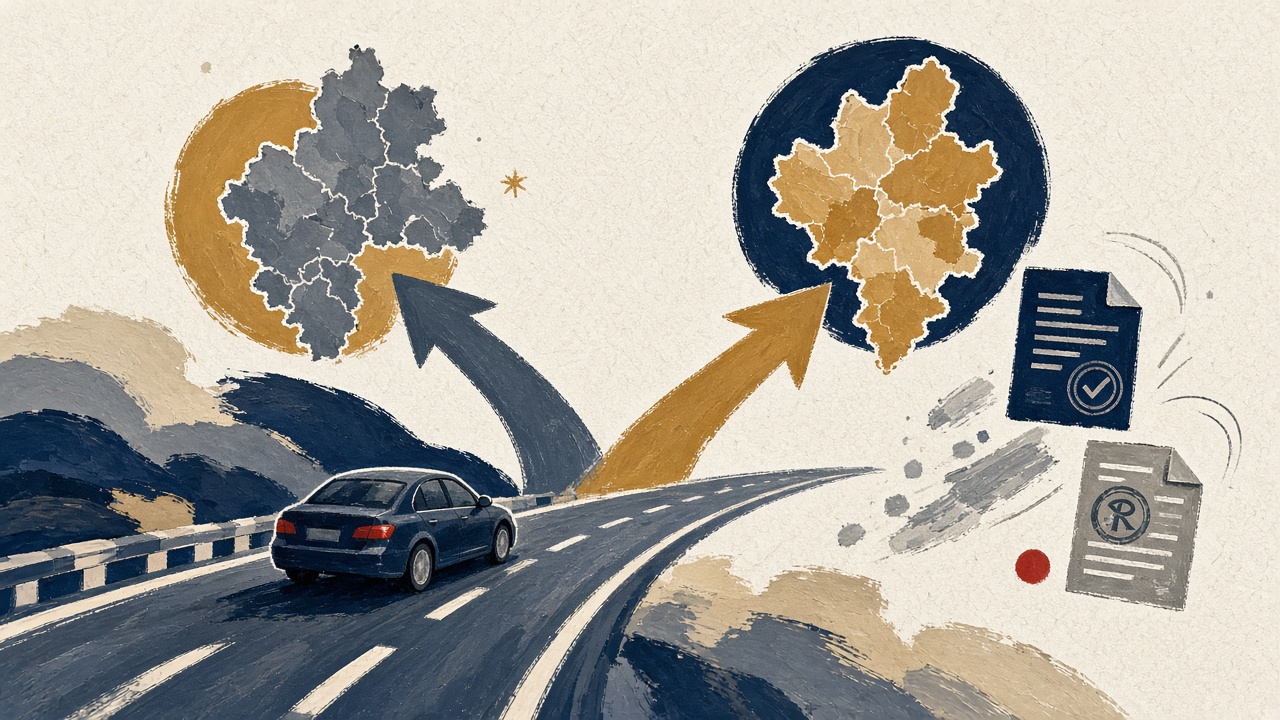
The ministry's interstate transfer FAQ describes what happens next in plain language. Most states collected one-time tax for fifteen years at first registration. After a move, the new state demands prorata tax for the remainder of that one-time period, while the old state should refund the unused share. In practice the refund leg lags. The ministry listed an Advisory on Refund of Road Tax dated 19 January 2024 among its circulars, responding to owners who paid twice because refunds stalled.
the Motor Vehicles Act, 1988 nowhere provides for re-registration of a vehicle and payment of fee upon such re-registration.
Justice Javed Iqbal Wani's order in Tramboo's petition turned on that line. Registration marks can change when a vehicle settles in a new state, but the court distinguished union registration charges from state token taxes assessed on value. The relief was case-specific, yet it highlights the tension: a certificate valid across India, tax ledgers that remain stubbornly local, and buyers caught between proration tables on the way in and slow refunds on the way out.
What fifteen years buys
Defenders of lifetime tax argue administration and compliance. Collecting once at registration ties payment to a moment when the vehicle cannot legally be driven without clearing the ledger, and a 2012 government release noted that states have converged on percentage-of-cost lifetime schedules even as bases differ. The same release warned that structures still vary widely among states, which is why comparing on-road prices between Delhi, Mumbai, and Bengaluru requires looking past identical ex-showroom stickers. Fairness cuts the other way when refunds slip and a mover pays nearly the full slab again while the first state sits on eleven years of prepaid road use.
When the first fifteen-year certificate expires, the cycle shortens. Parivahan notes that tax at renewal is commonly taken for five years at a time, still ahead of use rather than month by month. The Press Information Bureau's 2019 release on registration validity quoted the amended Section 41 language tying certificate life to fifteen years, the statutory hook states copied when they wrote lifetime tax into their schedules.
None of this appears on the windshield sticker. Dealers quote an on-road price, the RTO portal lists separate heads, and only at payment does the lifetime levy read as a single rupee total. That is the design: one clearance event at the start of a fifteen-year registration arc, with state legislatures free to set the percentage so long as they respect the federal registration framework. Karnataka's 2024 assembly bill revision pushed lifetime percentages higher in several car bands than Maharashtra's Third Schedule, which is why the same twelve-lakh petrol car can carry a two-lakh-four-thousand-rupee tax in Bengaluru and a one-lakh-forty-four-thousand-rupee tax in Mumbai.
Until the certificate ages out, the registration receipt you sign at the dealer is also a fifteen-year road lease paid in full. The calendar on the certificate and the numbers on the tax challan are the same document in different inks.
On an RTO counter somewhere, that pairing is still paper: a registration certificate whose validity runs fifteen years, stapled to a payment receipt for road tax whose amount was fixed the day the car first entered the state's rolls. Tramboo's dispute began with that stack. Most buyers simply pay and drive away, without realising the lump sum was never an extra registration fee, but the road charge for the whole first act of the car's life.