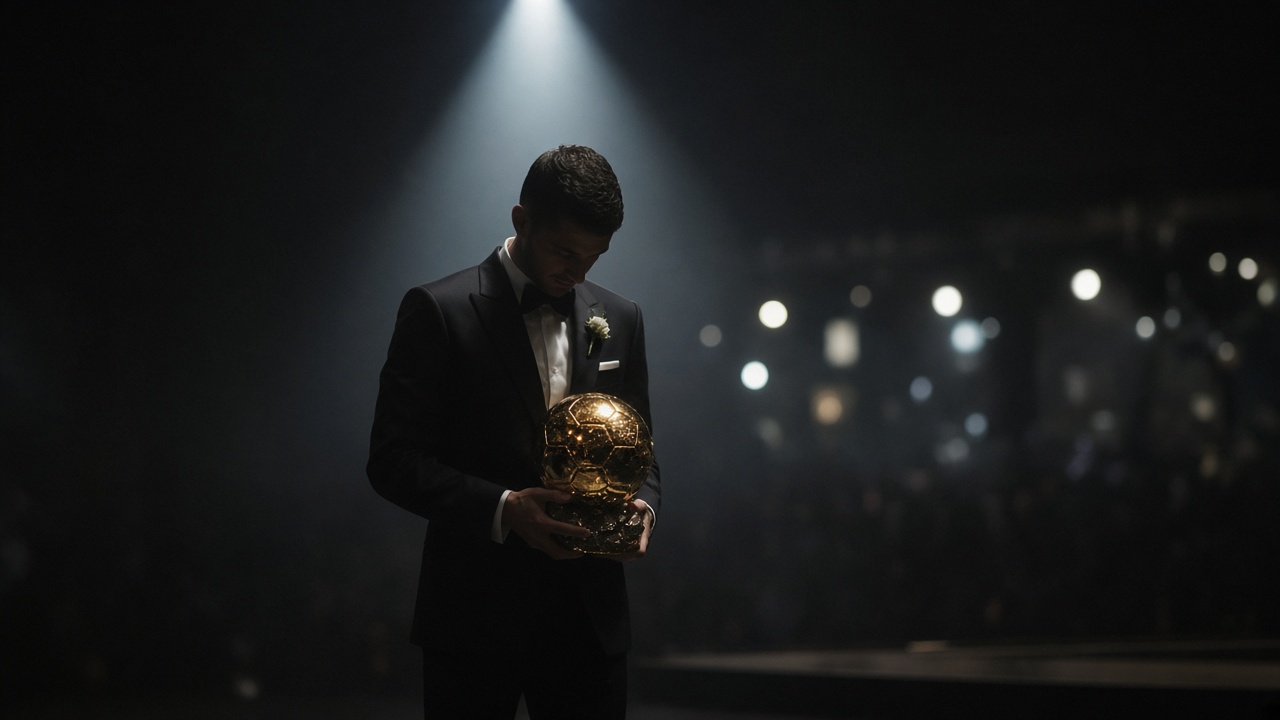
Harry Kane was named men’s Ballon d’Or winner at the London Palladium on Monday, ending a 25-year wait for an English recipient since Michael Owen lifted the trophy in 2001 and giving the award a home-city storyline on its 70th anniversary.
Kane, 33, also collected the men’s Striker of the Year prize on the same stage. Alexia Putellas won the women’s Ballon d’Or for a third time, while Barcelona’s Vicky López and Spain’s Lamine Yamal took the young-player awards in their respective categories.
The numbers behind the vote
France Football’s jurors rewarded a season defined by volume and efficiency. Kane scored 61 goals in 51 club matches for Bayern Munich—the most any Bayern player has managed in a single campaign—and added 12 more for England, taking his overall tally to 73 goals and eight assists in 65 appearances across club and country.
Real Madrid forward Kylian Mbappé finished second in the main ranking, with Barcelona and Spain winger Lamine Yamal third. The podium underlined how European club football’s scoring load is still concentrated in a handful of superclubs, but Kane’s international profile and penalty-box reliability tipped a tight race.
A London night with English echoes
Organizers staged the ceremony in London for the first time, citing Stanley Matthews’s inaugural win in 1956. Thierry Henry and Kate Scott hosted; inside the auditorium, chants of “Harry! Harry! Harry!” greeted the announcement according to broadcast coverage.
Kane becomes only the fifth Englishman to win outright, joining Matthews, Bobby Charlton and Kevin Keegan, who took the prize twice. Denis Law (Scotland, 1964) and George Best (Northern Ireland, 1968) are the other British winners. Wembley’s arch was lit gold on Monday evening to mark the result.
What it means for Kane and England
The award arrives with Kane deep into his Bayern chapter and still central to England’s attack ahead of major tournaments. Individual honors rarely shift transfer policy, but they cement legacy pricing: sponsors, broadcasters and national-team marketers can now point to a formal consensus that he was the planet’s best outfield performer over the reviewed window.
For English football more broadly, the win breaks a psychological drought. Owen’s triumph came in an era of galácticos; Kane’s came after a generation of near-misses for strikers who carried Premier League teams deep into Europe without collecting France Football’s top prize. Whether it signals a lasting English renaissance or a single-player peak will depend on what happens next on the pitch—but on Monday night, the trophy case finally had a new English name.