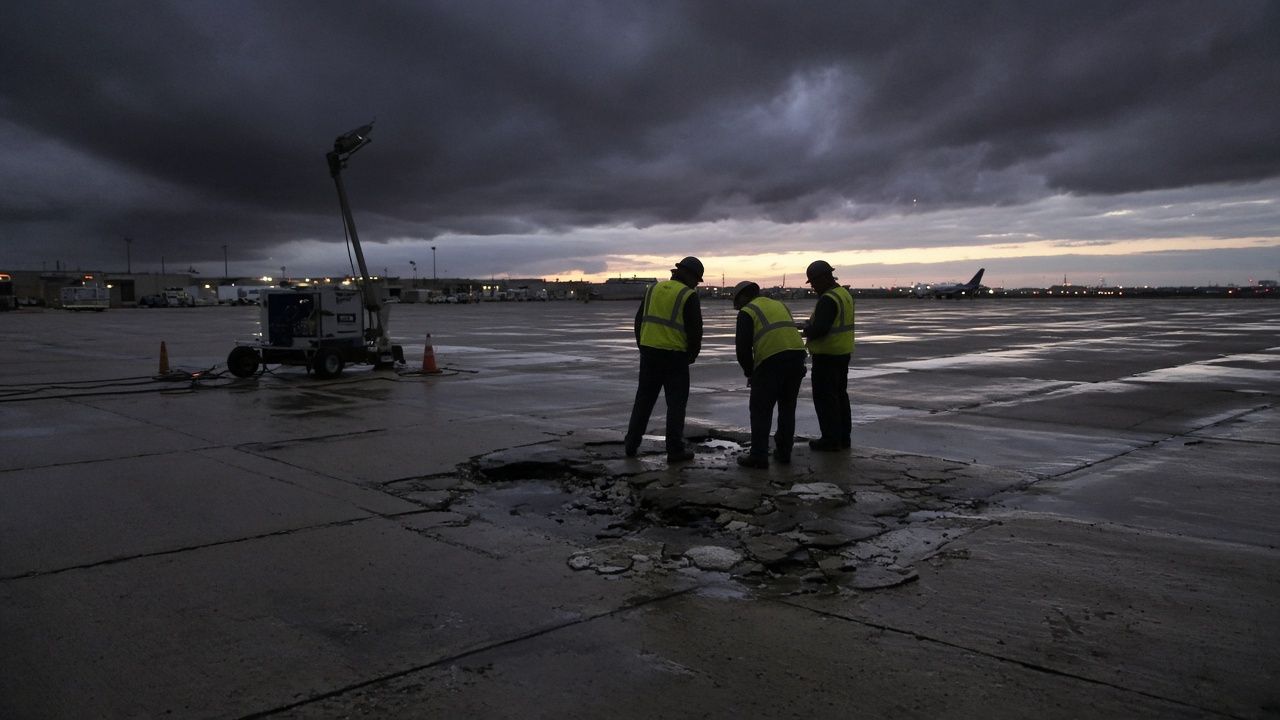
A lightning strike punched holes through the western runway at Brisbane Airport on Tuesday afternoon, forcing an emergency closure of more than eight hours while engineers patched the damaged bitumen. Airport footage showed the bolt hitting the surface about 3:11 p.m., scattering fist-sized craters along a section of pavement as severe storms rolled across south-east Queensland.
Brisbane Airport spokesperson Peter Doherty told InDaily that no flights were cancelled despite delays, because traffic shifted to the eastern runway for the repair window. Crews reopened the western strip at 11:52 p.m. after what the airport described as significant engineering work. Operations were back to normal by Wednesday, but the strike highlighted how exposed Queensland’s busiest aviation hub remains during a week of giant hail, flash flooding, and fire-ant washouts.
Storms that preceded the runway hit
The Bureau of Meteorology and private forecaster Higgins Storm Chasing had warned of destructive winds, hail up to seven centimetres, and flash flooding from lunchtime Tuesday. Observations later confirmed hail of that size at Yamanto, Flinders View, Ripley, and Mudgeeraba on the Gold Coast hinterland. Higgins told its social media followers the setup carried a low tornado risk and winds above 125 km/h.
Those same cells flooded creeks across the south-east, prompting wildlife rescuers to plead for donations after kangaroos, possums, and birds were stranded or injured. Wildlife Rescue Queensland said volunteers were inundated with call-outs as animals fled rising water into roads and suburban yards. The bureau said conditions should ease toward more typical spring afternoon showers later in the week, but catchments remain sodden after repeated severe days.
Aviation and passenger impact
Airlines did not publish aggregate delay figures, yet Doherty’s account indicates the airport maintained a single-runway flow rather than cancelling rotations. That choice kept passengers moving but added congestion to approaches and taxi times on the eastern strip. Engineers will now inspect whether underlying layers were stressed beyond the visible potholes, a standard step after direct lightning strikes on paved surfaces.
The incident sits alongside broader storm damage across Queensland, including major flooding that has killed at least one person in recent days and triggered emergency warnings along multiple rivers. For Brisbane Airport, the immediate risk is reputational as well as structural: travellers already nervous about summer storm seasons will watch how quickly surface repairs hold under continued heat and humidity.
What regulators and insurers will review
Civil Aviation Safety Authority rules require airports to certify runways as safe before reopening, a process the airport said it completed before the 11:52 p.m. all-clear. Insurers and airlines may seek detailed metallurgical and pavement scans even if flights resumed, because lightning can weaken reinforcement not visible in social media clips.
Queensland’s storm season still has months to run, and climate scientists have noted longer warm-season humidity spikes that fuel supercells near the coast. Airport operators across the state may revisit lightning protection and rapid repair contracts if Tuesday’s closure becomes a template for future strikes.