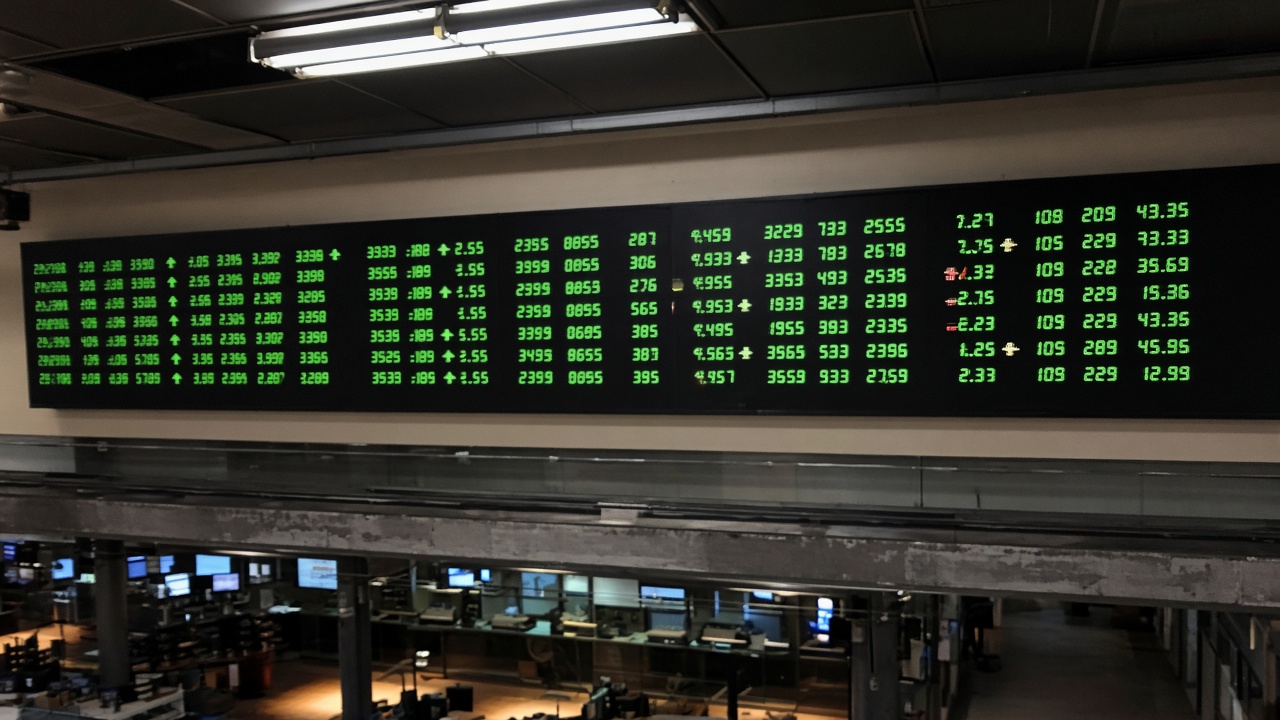
The S&P 500 closed at 7,719.65 on Wednesday, up 42.88 points or 0.56%, as semiconductor stocks carried the session while investors waited for after-hours quarterly reports from Microsoft and Alphabet and a Federal Reserve rate decision on the calendar.
Index cross-currents
Market summaries for the session showed the Dow Jones Industrial Average up just 18.40 points to 52,379.98, a 0.04% move that underscored how narrow leadership ran. The Nasdaq Composite gained 299.79 points, or 1.15%, to 26,469.17, while the Russell 2000 rose 1.08% to 2,816.57.
Cross-asset reads included a 10-year Treasury yield at 4.9930%, gold near $4,069.70, and crude oil down about 1.8% toward $99.90—macro inputs the Fed will weigh alongside labor and inflation data already on the desk.
Memory chips set the tone
Reuters reported that Nasdaq futures firmed before the open after SK hynix posted a more than sevenfold jump in quarterly profit, lifting U.S.-listed SK hynix shares about 7.8% in early trading. Micron Technology rose roughly 4% in premarket action on the read-through for DRAM pricing. Western Digital and Sandisk also traded higher, while Seagate slipped after its own quarterly print.
Nvidia, Advanced Micro Devices, and Marvell Technology posted modest premarket gains as the broader semiconductor complex followed Seoul’s memory rally. The sector’s sensitivity to AI infrastructure demand remains the swing factor: strong memory pricing helps suppliers even when hyperscaler capex plans face scrutiny.
What the cloud reports must answer
Microsoft and Alphabet were scheduled to report after the closing bell, with consensus estimates in public data aggregators pointing to revenue near $90.6 billion and $128 billion respectively. Investors focused less on whether cloud units beat by a penny and more on capital expenditure guidance—whether AI data center spending continues to accelerate and whether management ties that spending to monetization timelines.
Amazon.com and Intel are on deck later in the week, extending a stretch that often sets the tone for year-end positioning. Any sign that AI-related depreciation is outrunning revenue growth would hit the same megacap names that lifted indexes through much of 2026.
Retail and macro holders
Index-level moves matter for anyone holding S&P 500 mutual funds or target-date retirement accounts, not just active traders. A 0.56% daily gain does not change long-term allocation math, but consecutive sessions of chip-led rallies can tilt sector weights inside passive funds toward technology without a conscious investor choice.
Fixed-income holders watched the 10-year yield creep toward 5% again; equity strength paired with higher yields can compress price-to-earnings multiples for rate-sensitive sectors such as utilities and real estate investment trusts even when the headline index prints green.
What would break the narrative
Disappointing cloud guidance after the bell, a hawkish Fed surprise, or a reversal in memory pricing would quickly unwind Wednesday’s chip trade. Until those inputs land, the tape showed risk-on behavior inside technology and caution everywhere else—a split Nina Okonkwo’s desk will re-score once Thursday’s futures open.