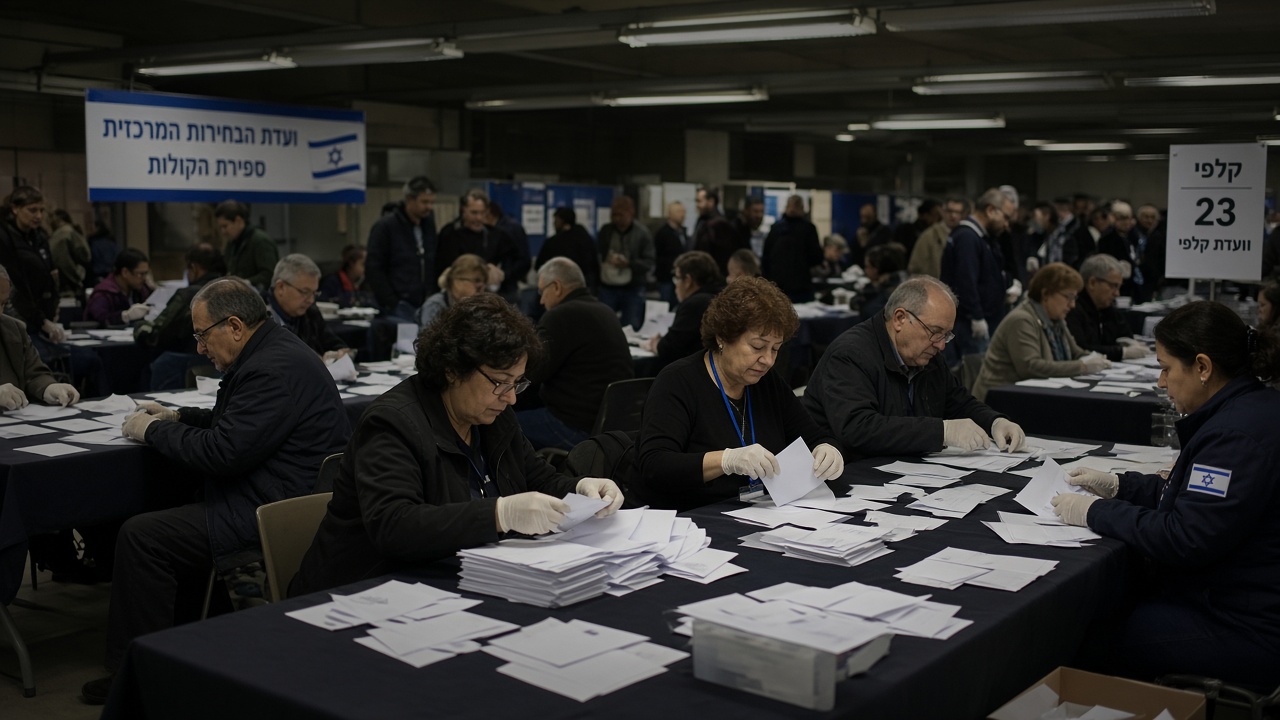
More than three-quarters of Israel’s regular ballot boxes had been counted by late Wednesday morning local time, and neither Prime Minister Benjamin Netanyahu’s right-wing bloc nor the opposition camp led by former army chief Gadi Eisenkot was anywhere near the 61 seats required for a Knesset majority, according to partial results published by the Central Elections Committee and tracked by Israeli broadcasters.
With 76.8 percent of boxes processed shortly before 11 a.m., the committee’s running totals gave Netanyahu’s bloc 54 seats and Eisenkot’s bloc 47, while the two Arab-led lists — the Joint List and Ra’am — had risen to a combined 19 seats, the Times of Israel reported from the live tally. Likud remained the largest single party in the projections, but the arithmetic still left both Jewish-led camps short of a workable majority without painful trade-offs.
Why the count keeps shifting
Israel’s election night is rarely settled in a single headline. Early batches of counted votes historically over-represent stronghold areas, which is why analysts warned throughout the morning that Netanyahu’s narrow lead could shrink as ballots from more mixed cities entered the totals. Turnout on Tuesday hit 77.7 percent when polls closed — the highest at that hour since 1999, the elections committee said — which increases the volume of late-arriving paperwork but does not by itself tell observers who will ultimately form a government.
Complicating the picture further are hundreds of thousands of double-envelope votes, including ballots cast by soldiers, that are not fully processed until Thursday. BBC reporting from Jerusalem noted that these absentee bundles can represent roughly a tenth of all votes, enough to move seat projections by several mandates in a system where parties routinely hover near the 3.25 percent threshold.
Arab parties as potential kingmakers
The surge for Arab-led factions is the clearest structural change in Wednesday’s partial math. BBC correspondent Yolande Knell wrote that the lists could hold the balance of power even though most Jewish opposition leaders, including Eisenkot, campaigned on ruling out a coalition that depends on them. Democrats leader Yair Golan, whose party sits in Eisenkot’s “change” bloc, had been the notable exception before the vote, saying he would work with the Joint List and Ra’am; other bloc leaders cited disagreements over national security and values.
Netanyahu, speaking to Likud supporters after the first exit polls, said he would wait for “real results” and pledged to build a “strong, right-wing” government. Eisenkot told his own rally that voters had sent a message against prolonging Netanyahu’s tenure, even as his path to 61 seats without Arab partners looked blocked by the midday counts.
What happens next
President Isaac Herzog will eventually ask whichever leader he judges can assemble 61 signatures to try to form a cabinet, but that phase may be weeks away. Coalition talks in 2022 and 2021 dragged on through repeated deadlines, and this election follows the first national vote since the October 2023 Hamas attack and the subsequent Gaza war — issues that dominated campaigning but did not produce a clear victor in the first tranche of official numbers.
Until the soldier ballots and remaining urban precincts are in, parties will spin partial data while avoiding firm commitments. For now, the operative fact is simpler: more than half — and then three-quarters — of the ordinary vote has been counted, and Israel still has no majority bloc.