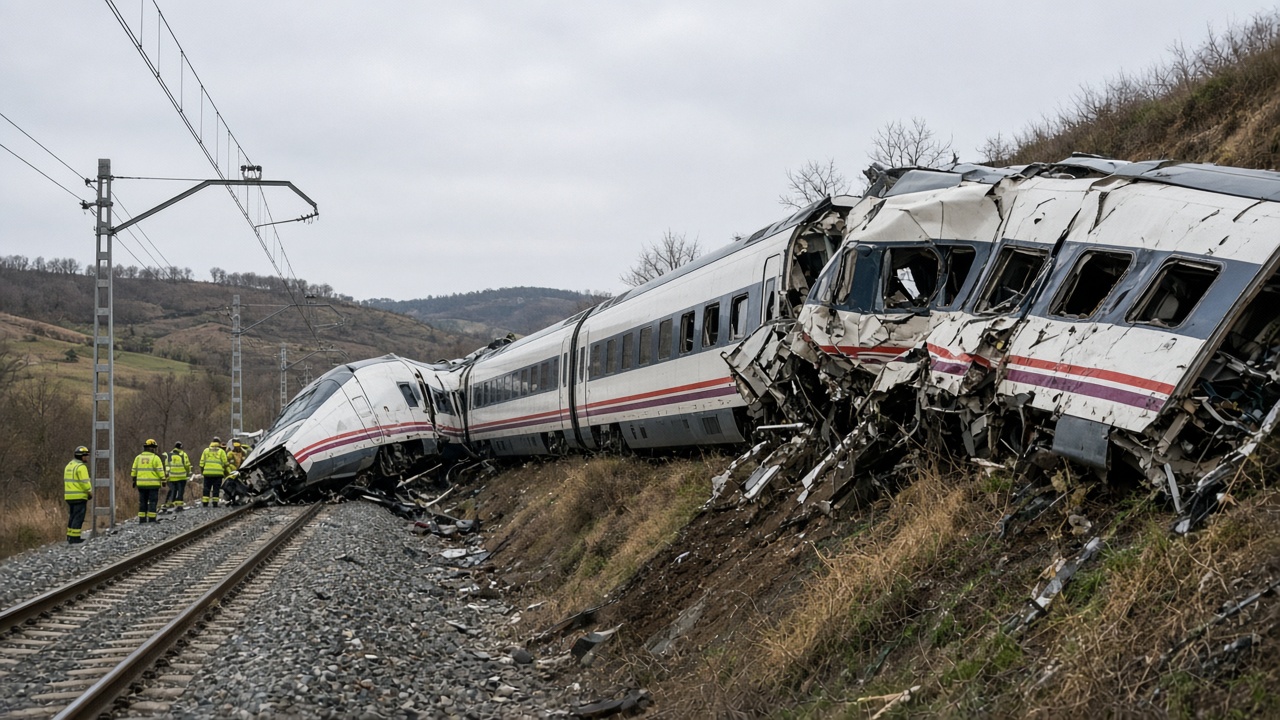
Fresh audio from Spain’s rail control centre has sharpened the central question in the Urda disaster: why a state-run Renfe high-speed train was moving at full line speed when it slammed into a stopped Iryo train on Wednesday, killing at least 69 people on the Madrid–Seville corridor.
Recordings published by Spanish outlets capture an Adif operator at Atocha instructing the Renfe driver at 8:36 a.m. to disconnect and reconnect the LZB automatic safety link and then continue under manual block rules “at normal speed with normal operation.” The driver asks, “At normal speed?” The controller answers, “Yes.” Twelve minutes later the Renfe train struck the rear of the Iryo service near Urda, Toledo province.
What the tapes add to Puente’s account
Transport Minister Óscar Puente had already called the restart decision “inexplicable,” blaming a computer failure around 8:30 that halted six trains before human controllers took over. The new exchanges show the Iryo crew reporting at 8:48 that they could not restart their safety system and remained stopped at the Urda entry signal—information the control room had received before the rear-end impact at 8:53.
Under Spain’s fallback regime, drivers are expected to proceed at no more than 40 km/h when automatic signalling fails, using line-of-sight limits on a track engineered for roughly 200 km/h. Puente told reporters the Renfe train should not have been released without speed restrictions while another train was ahead on the same path.
Scale of the wreck and political fallout
More than 540 passengers were aboard the two trains, authorities said. Castilla-La Mancha officials put the Iryo load at 146 passengers plus an infant and the Renfe train at 397. Emergency services treated more than 100 injured; hospitals across the region cancelled elective surgery as blood banks appealed for donations. Prime Minister Pedro Sánchez declared three days of national mourning and promised a full inquiry into any negligence or security-system failure.
The crash is the second fatal high-speed collision on the same corridor in nine months, after a January derailment that killed 46. Opposition leader Alberto Núñez Feijóo said Spain “has the right to know what is going on with its infrastructure,” while most parties paused campaigning ahead of 29 November elections. Investigators from Spain’s Civil Guard are collecting DNA from families reporting missing travelers, including business leaders who were aboard.
What investigators will reconstruct next
Adif, which operates the infrastructure, and Renfe have opened parallel reviews alongside a judicial probe. Engineers will trace the initial LZB outage, the sequence of manual authorisations, and whether controllers maintained contact with both crews once the Iryo train reported it could not move. European Commission officials said the bloc stood ready to assist if Madrid requested technical support.
For now the Madrid–Seville high-speed link remains partially suspended, with buses replacing some segments. Puente’s ministry has not identified individual controllers, but the audio leaves little doubt that human decisions—not merely equipment failure—are at the heart of the deadliest Spanish rail accident since 2013.