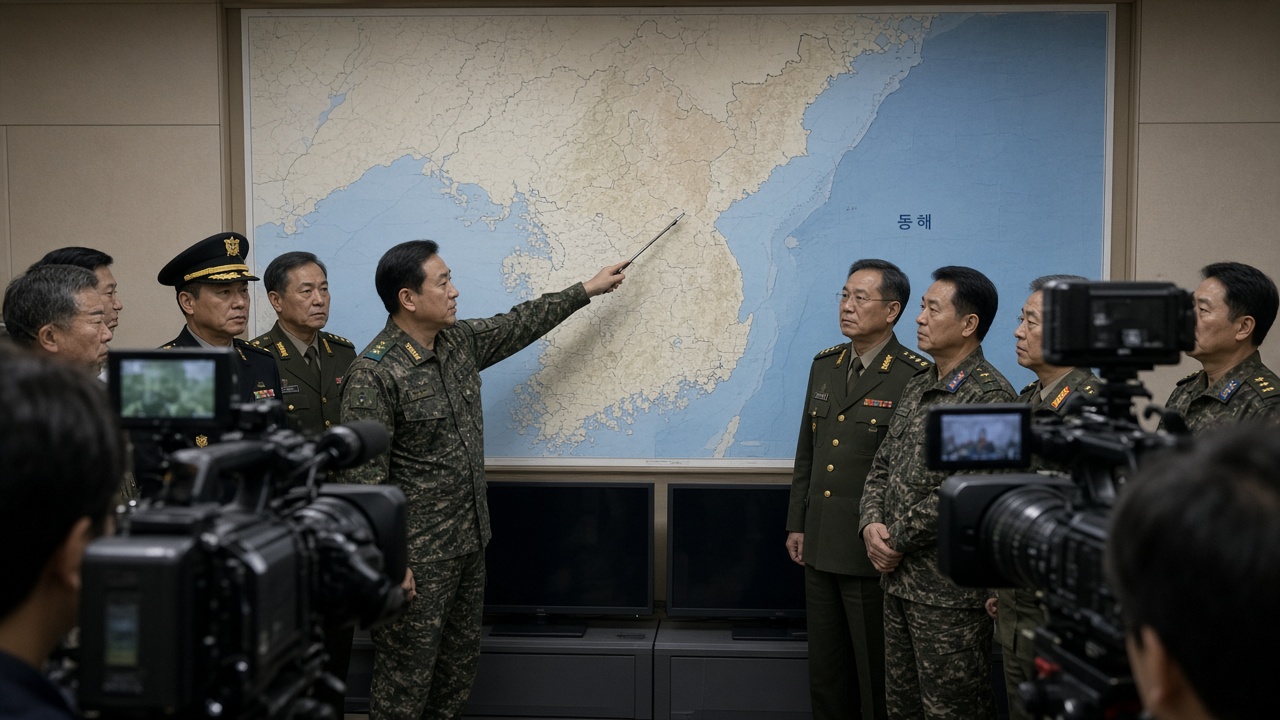
North Korea fired roughly a dozen short-range ballistic missiles toward the East Sea on Thursday, South Korea’s Joint Chiefs of Staff said, launching the salvo from the Wonsan area on the country’s east coast at about 12:30 p.m. The projectiles flew about 250 kilometers before splashing down, according to Seoul’s initial tracking, and officials said they were still analyzing whether the drill involved mixed weapons such as cruise missiles or heavy rocket artillery.
What Seoul and Tokyo reported
The Joint Chiefs said the military had stepped up surveillance and was sharing information with U.S. and Japanese counterparts in case Pyongyang follows with additional launches. Japan’s Defense Ministry told reporters it detected an object that could be a ballistic missile and that it appeared to fall outside Japan’s exclusive economic zone; the coast guard issued a similar alert to shipping.
A South Korean military official told Yonhap News Agency that analysts were examining whether the North used its KN-25 600-millimeter multiple rocket system, which Pyongyang has said can carry tactical nuclear warheads. Seoul has not publicly confirmed that assessment, and the launch profile could still reflect a mixed salvo designed to complicate tracking rather than a single system test.
Border tension behind the launch
The barrage landed less than two weeks after North Korea’s last ballistic test on October 12 and roughly a week after South Korea proposed military talks to resolve disputes over the Military Demarcation Line. Tensions spiked after a September 21 land-mine blast wounded three South Korean soldiers; Pyongyang denies planting the device and has accused Seoul of fabricating the incident while threatening to deploy new weapons and resume cross-border propaganda broadcasts.
Earlier this week, South Korean media photographed a North Korean self-propelled howitzer positioned far enough south along the western front to be visible from the South’s side of the border. A Joint Chiefs official said Thursday that the piece appeared to be legacy hardware staged for show rather than a newly fielded system, but the imagery still fed anxiety in a period when both armies are fortifying fences and minefields.
Political response in Seoul
South Korea’s presidential office convened an emergency meeting of national security officials after the launches and urged Pyongyang to halt provocations that violate United Nations Security Council resolutions. The statement did not announce new unilateral sanctions, but it stressed that Seoul and Washington would maintain a combined defense posture capable of “overwhelming” response if the North escalates further.
Leader Kim Jong Un’s surprise visit to China over the weekend had raised speculation that Beijing might press for restraint. Thursday’s launches suggest Pyongyang still uses missile drills to apply pressure while it rejects Seoul’s dialogue offer, leaving the peninsula in a cycle of proposals, threats, and weapons tests.
What to watch
Allied militaries will watch whether the North returns to loudspeaker broadcasts or live-fire exercises near the maritime boundary, either of which could trigger a sharper South Korean response. Additional missile launches in the coming days would signal that Pyongyang intends to keep pressure high through the winter training season rather than pivot to the talks Seoul proposed on border demarcation.