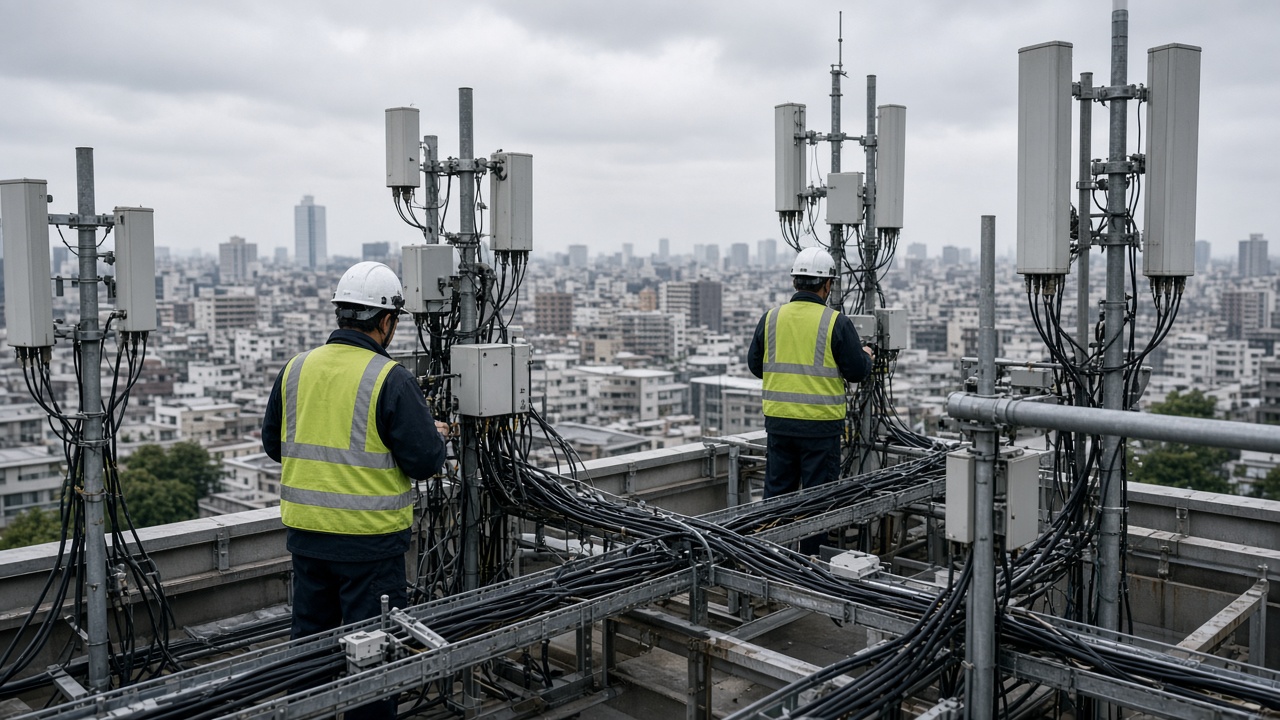
Rakuten Mobile Inc. and NEC Corp. began an open RAN field trial in the Kansai region this week, connecting NEC-supplied core and orchestration software to radio units from an external vendor on live sites around Osaka and Kobe, a step both companies cast as proof that Japan’s fourth carrier can expand beyond its original single-supplier radio stack without pausing subscriber growth.
What the trial connects
The pilot follows O-RAN split architecture: distributed units on rooftops talk to centralized units linked into Rakuten’s packet core, with NEC providing network management and security policies tuned for Japan’s lawful intercept rules. Engineers said initial sites reuse existing fiber backhaul and power feeds to avoid permitting delays, limiting the first phase to a few dozen cells worth of coverage in suburban corridors where congestion spikes during commuter hours.
Rakuten Mobile has marketed a fully virtualized core since launch; adding NEC as an integration partner addresses enterprise and municipal accounts that asked for a domestic systems integrator on call. NEC’s role is software and lifecycle support, not a rebranding of Rakuten’s consumer plans.
Field teams run drive tests along the Hanshin corridor to compare throughput against adjacent legacy cells; results feed a shared dashboard both vendors can view during the trial quarter.
Why Kansai and why now
Kansai density tests handover behavior between open RAN cells and legacy Rakuten radios still on some mountain edges. Regulators have pressed all carriers to close coverage gaps along expressways; Rakuten’s national share targets depend on proving multi-vendor operations before bulk radio purchases for 2027 budgets.
NTT Docomo, KDDI and SoftBank pursue their own open RAN labs, but Rakuten’s business model assumes cheaper radios from competition among hardware makers. A successful Kansai run would give procurement teams more room in price talks with existing suppliers, executives said in a joint briefing slide deck that avoided naming the third-party radio vendor.
Subscribers on legacy SIM plans see no tariff change during the trial; marketing teams were told not to advertise open RAN sites until drive-test KPIs beat control cells for seven consecutive days.
Risks subscribers might notice
Early-phase trials can trigger brief resets during software upgrades; Rakuten promised customer communications only if maintenance windows overlap peak evening data use. Metrics watched internally include call drop rates, uplink latency on video calls and power draw on new radios during Osaka heat waves.
Security reviewers asked whether open RAN interfaces widen the attack surface; NEC said penetration tests on the orchestration layer finished without critical findings before the trial went live.
If integration slips, Rakuten could delay open RAN expansion and buy more units from incumbents, raising capex per subscriber—a sensitive topic after years of losses on network build-out. NEC gains services revenue if the stack scales, but faces competition from other integrators pitching similar O-RAN bundles to regional carriers overseas.
Ministry of Internal Affairs and Communications spectrum dashboards list Rakuten’s population coverage percentage separately from the three incumbents; any trial downtime must be logged so quarterly coverage filings stay accurate.
Enterprise customers in Osaka’s bay-area warehouses asked whether open RAN handsets behave differently on voice-over-new-radio calls; Rakuten’s enterprise desk said it will publish a FAQ after the trial’s first sixty days.
Radio vendors outside Japan watch the trial because Rakuten’s public cloud-native story is a reference case for greenfield carriers in Southeast Asia weighing NEC-style integrators.
Power utilities in Kansai asked for advance notice before rooftop lift work; NEC schedulers share crane windows through a prefectural infrastructure mailing list used for typhoon repairs.
For Kansai users, the trial is mostly invisible until coverage maps fill in; the strategic bet is that open interfaces let Rakuten Mobile add capacity like a cloud operator adds servers—if NEC and the unnamed radio partner keep the Kansai cells stable through winter typhoon season.