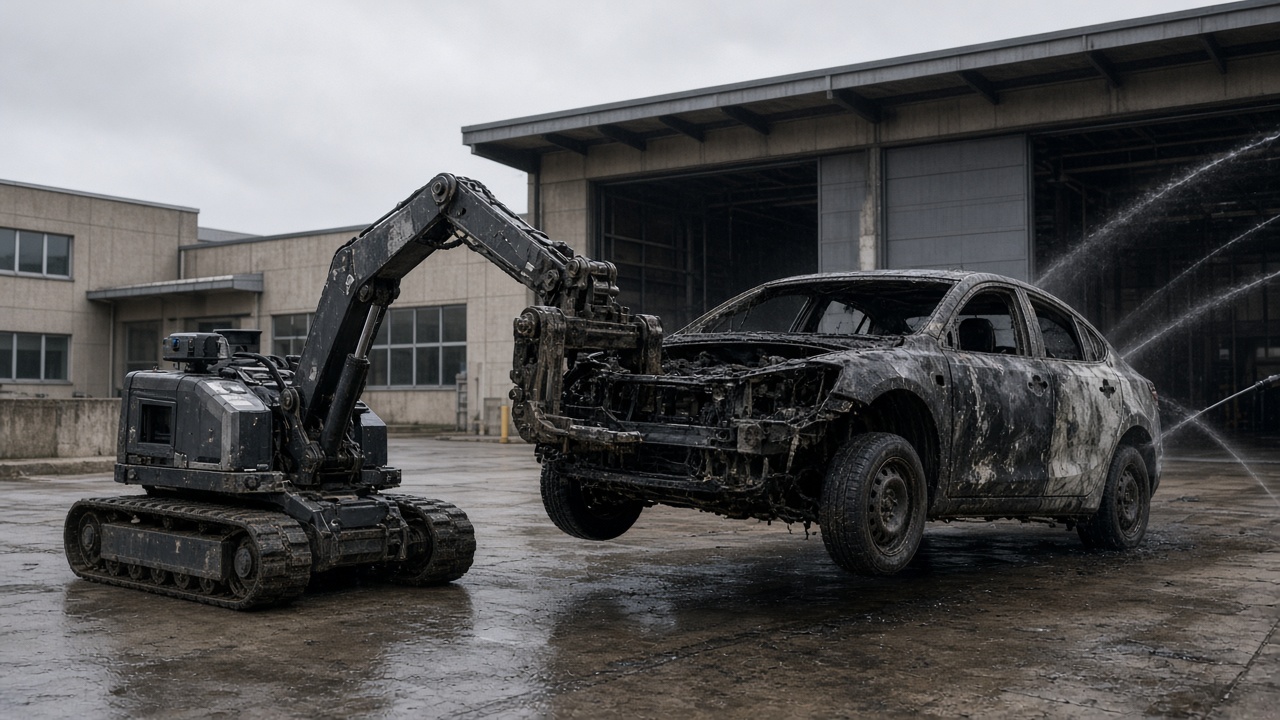
Second Minister for Home Affairs Sim Ann launched the Singapore Civil Defence Force’s Vehicle Extrication Robot on Wednesday at the Singapore-International Disaster and Emergency Management Expo, telling officers that more than 60 percent of new car registrations in the first half of 2026 were electric vehicles and that lithium-ion packs can reignite long after the visible fire is gone.
The tracked robot, known as the VXR, is built to lift a car by its front wheels and drag it up to 300 metres away while an integrated water-mist system shields the machine from radiant heat. SCDF said the goal is to move a thermally unstable battery out of an enclosed carpark or tight lane so crews can cool it in the open without standing beside a pack that may still be in thermal runaway.
Why relocation matters
Thermal runaway happens when heat inside a cell feeds on itself faster than it can dissipate. Because EV modules are densely packed, failure in one cell can spread through the pack even after firefighters have knocked down flames. SCDF’s factsheet noted that affected vehicles may need to be shifted quickly to a safer holding area before specialists drill into the battery casing or apply targeted cooling.
Sim said the force has been running burn tests and updating operational procedures as EV adoption climbs. She added that Singapore also intends to deepen disaster-cooperation ties with Japan through a new memorandum of cooperation signed on the expo sidelines, though the VXR trials are the immediate operational change residents may notice.
Punggol first, Kallang next
Operational trials begin at Punggol Fire Station from October 2026, with Kallang Fire Station scheduled to follow in April 2027. SCDF demonstrated a scenario in which firefighters extinguish a blaze, deploy the VXR to tow the car to open ground, then bring unmanned firefighting machines to continue cooling.
The robot is car-sized, runs on tracks, and is operated remotely so responders can stay outside the high-risk radius. For motorists, the policy signal is straightforward: as EVs become the default new car, emergency agencies are investing in equipment that assumes a fire is not finished when the smoke clears.
Regulatory follow-through
Sim linked the hardware rollout to ongoing work on fire safety regulations for EV parking and charging in buildings. She did not announce new mandatory rules on Wednesday, but framed the VXR as part of a broader package of research, equipment and standards meant to keep pace with registration trends.
Industry groups at SIDEX asked about training timelines; SCDF said trial outcomes at Punggol and Kallang will inform how widely the VXR is deployed beyond those stations. For now, the launch marks a visible step from laboratory burn tests to street-level trials in a town where EV share already crossed the majority of new registrations.
Drivers who charge at home or in basements should expect continued public messaging on what to do after an incident—move people away, call 995, and let SCDF decide whether relocation equipment is needed once the initial fire is controlled.
Expo context
SIDEX ran alongside regional disaster-management forums at Singapore Expo, giving foreign delegations a look at how a city-state scales unmanned tools as EV density rises. Sim’s speech tied the VXR to wider ASEAN cooperation on urban fires, even though trials themselves are domestic.
Property managers asked whether basement lots need new clearance widths for tracked robots; SCDF said station trials will produce engineering notes for Town Councils after Punggol data is collected.
Insurance underwriters at the expo said premiums for EV-heavy carparks may eventually reference whether relocation kits are on contract, though no insurer announced rule changes on Wednesday.
LTA data showing EVs crossing sixty percent of new registrations means fire stations in new towns may need wider appliance bays; SCDF engineers said Punggol trials include measuring turning circles for the VXR alongside regular pumper trucks.