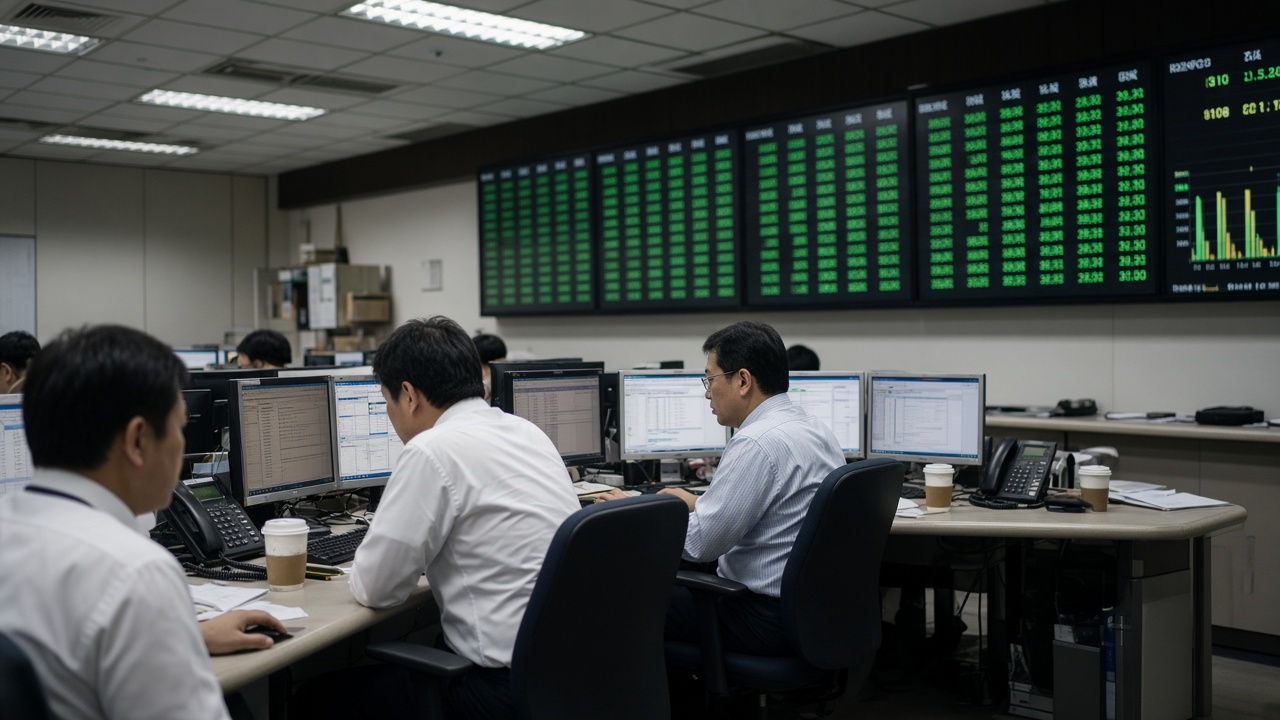
Taiwan’s benchmark TAIEX surged 939.35 points, or 2.04 percent, to close at 47,035.58 on Oct. 28 after U.S. technology shares rallied and local investors bought chip-heavyweights into a year-end window that desk strategists call the traditional “accounting season.” The session high touched 47,060.46, reclaiming the 60-day moving average near 46,398 points, yet cash turnover slipped to NT$722.14 billion—well below the NT$1.03 trillion recorded the prior session—signaling that many funds waited for hyperscaler earnings before adding risk.
Leadership inside the index
TSMC rose 1.04 percent to NT$2,425, contributing roughly 200 index points, while MediaTek jumped 6.94 percent to NT$4,235 and memory suppliers Nanya Technology and Winbond gained 8.16 percent and 5.52 percent respectively. The electronics sub-index added 2.48 percent even as financials slipped 0.56 percent, a split that reflects investor preference for AI-linked hardware over domestic lenders facing property-loan stress. Forty-nine listed shares traded above NT$1,000, a concentration desk analysts say magnifies index moves when a handful of bellwethers tick higher.
Foreign and local flows
Taiwan Stock Exchange data showed foreign institutional investors net bought NT$15.92 billion on the main board, a reversal from recent sell streaks that had weighed on sentiment after typhoon-related closures and quarterly rebalancing. Proprietary desks and trust funds also participated, according to block-trade chatter, while retail participation looked thinner given the volume drop. Dealers linked the Philadelphia Semiconductor Index’s 3.6 percent overnight gain—and enthusiasm around a high-profile U.S. AI safety company’s IPO filing—to the opening bid, even though local traders noted the filing itself does not guarantee near-term orders for Taiwan foundries.
Volume tells a second story
Concord Securities analyst Kerry Huang told clients the rally cleared technical resistance but shrinking turnover implies skeptics stayed sidelined. Several managers said they want proof from U.S. cloud giants that AI capital spending translates to revenue before expanding Taiwan positions again. The OTC index still outperformed, rising 4.06 percent, hinting that mid-cap AI component names drew aggressive buying even as bank stocks lagged.
Sector snapshots
Printed circuit board maker Gold Circuit Electronics hit the daily limit up at NT$1,185, while Delta Electronics and Hon Hai Precision also advanced, tying the session to power and assembly names that feed server racks. Financial holding companies presented a mixed picture: Cathay Financial Holding rose 1.32 percent, but Fubon and E.SUN Financial lagged, reflecting credit concerns unrelated to the tech surge. Insurance names tracked the broader financial weakness as long-end yields moved only modestly.
Technical levels traders cite
Chart desks highlight 47,000 as a psychological handle and the reclaimed moving average as support if U.S. futures soften. Resistance clusters near October highs around 49,800 from early-month trading, a zone sellers may test if turnover returns. Options market makers reported higher call open interest at 47,500 strikes expiring in November, consistent with a cautiously bullish positioning rather than heavy margin financing.
What the open needs
Oct. 29 brings a heavy Taiwan investor-relations calendar, with Delta Electronics, Realtek, AU Optronics and others hosting briefings that could either confirm the rally’s fundamentals or expose stretched valuations. Macro desks also watch U.S. mega-cap earnings and oil moves after recent volatility. For now, the Oct. 28 print gives Taiwan a stronger headline number with a footnote: the market went up on fewer NT dollars changing hands, leaving the next session to prove whether confidence matched the point gain.
Derivatives and hedging
Taiwan futures open interest rose modestly on Oct. 28 as macro funds delta-hedged call positions tied to November expiries. Life insurers continued to trim equity exposure into the rally, brokers said, preferring to wait for dividend guidance from financial holding companies reporting next month. Retail margin financing ticked up but remained below September peaks, suggesting household exposure is not yet chasing the 47,000 handle aggressively.
FX linkage
The New Taiwan dollar traded steady against the U.S. dollar during the session, preventing an FX translation boost that sometimes flatters TAIEX when the local currency weakens. Exporters with dollar revenue therefore saw index gains reflect pure stock moves rather than currency effects—a nuance offshore funds track when comparing Taiwan with Korea and Japan benchmarks that day.