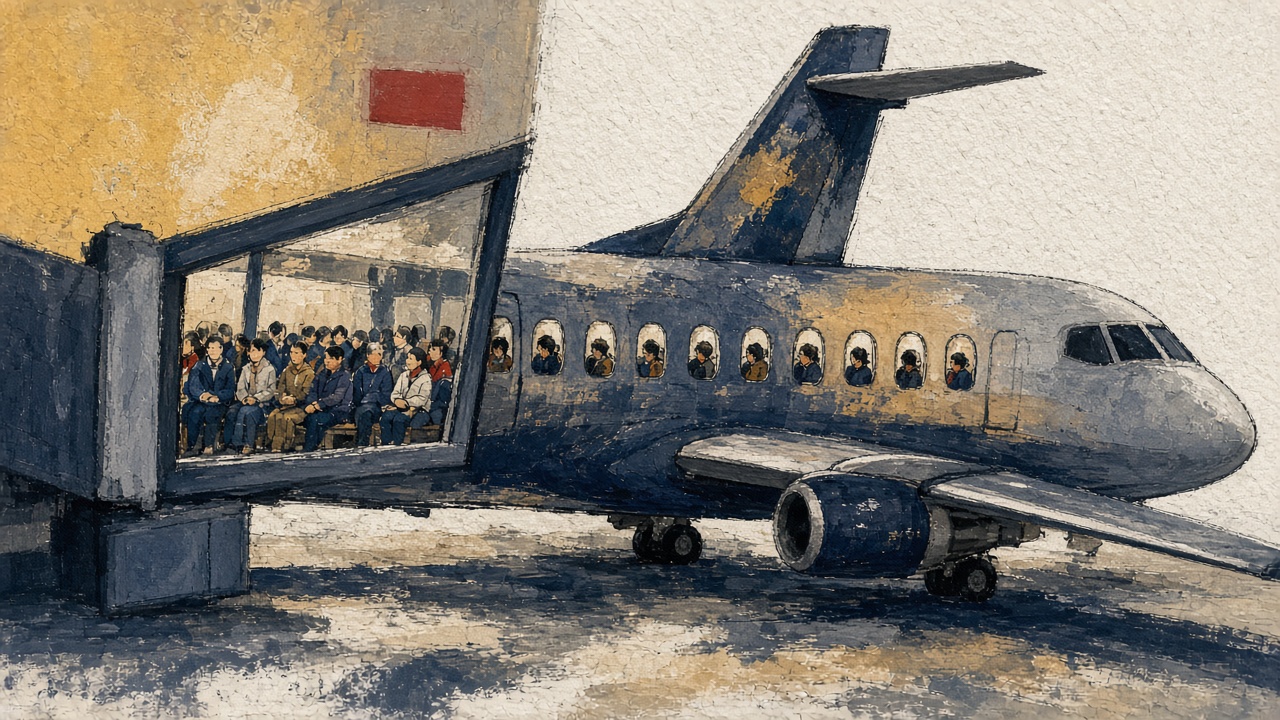
On April 9, 2017, United Express Flight 3411 was supposed to leave Chicago O'Hare for Louisville with every seat full. Four Republic Airways crew members needed to reach Kentucky for a next-day assignment. When the gate agent could not buy enough volunteers, the airline called aviation security to remove a seated passenger who refused to give up his place. Video of the encounter circled the globe. United's first public explanation used a word travelers now recognize: the flight was overbooked.
Two days later, United's chief executive, Oscar Munoz, apologized in a public statement. The airline later clarified that the jet was not oversold in the usual sense, every ticketed passenger had a seat, but four employees still had to fly as must-ride crew. The distinction mattered to lawyers, not to anyone watching a paid passenger dragged off a regional jet. The question the episode raised never went away: why does U.S. aviation still tolerate selling more seats than the cabin holds?
The seat that would not empty
Flight 3411 was a routine hop on an Embraer regional jet, the kind that connects hubs to smaller cities hundreds of times a day. United's initial statement said the Chicago–Louisville flight was overbooked and that one customer refused to leave voluntarily after the carrier sought volunteers. Reuters later reported United's revised account: the aircraft was sold out, not oversold in the accounting sense, yet four crew still had to board.
That nuance will return. For now, treat Flight 3411 as the stress test: every seat taken, yet the airline still needed to move people off the plane. The Department of Transportation's oversales statistics count passengers who hold confirmed reservations and are denied boarding because a flight is oversold, not passengers stranded by cancellations or long delays. Flight 3411 became the moral hazard poster, but the underlying practice is older, legal, and spreadsheet-driven.
What overselling is, and is not
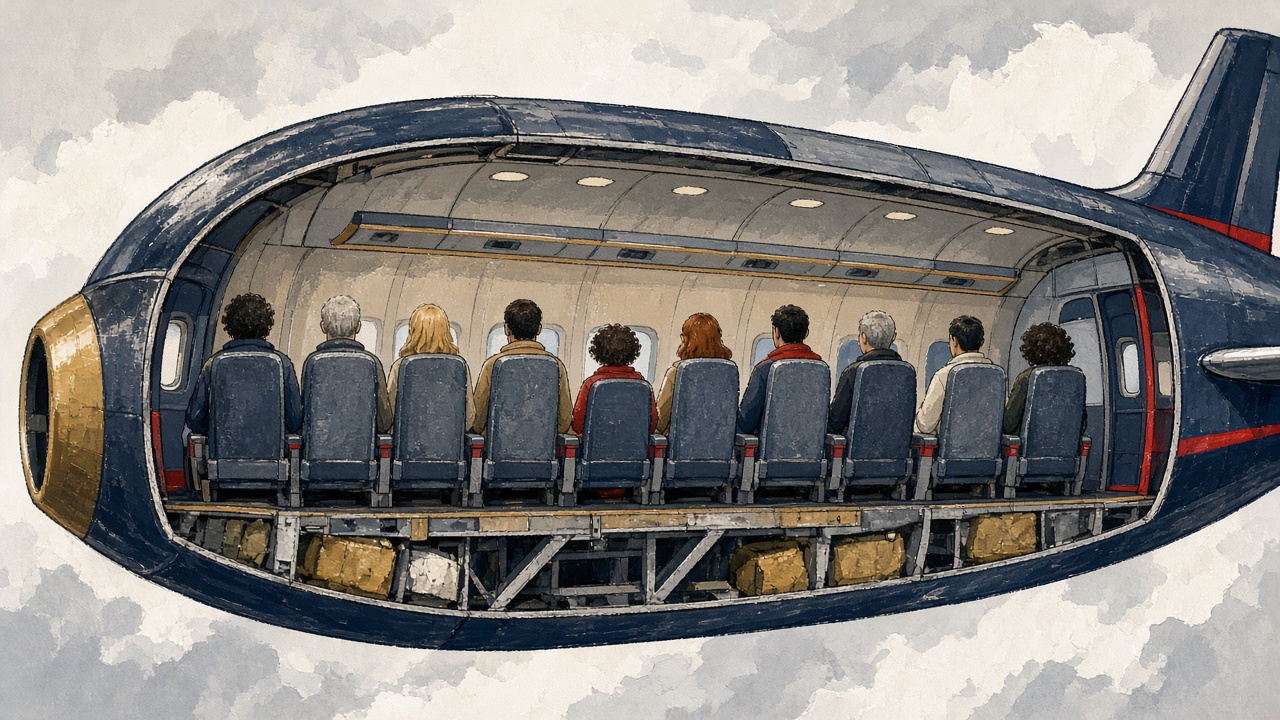
Overselling is not double booking in the hotel sense. Airlines issue confirmed reservations, then forecast how many ticket holders will miss the flight. Business travelers miss connections; leisure travelers change plans; no-shows happen. An empty seat at pushback generates no fare revenue but still burns fuel and crew time. Carriers therefore sell a calculated number of extra seats on flights where history says no-shows will exceed walk-ups.
If everyone with a ticket shows up, the flight is oversold in the operational sense even when the reservation system looked healthy hours earlier. That is why the gate agent's volunteer speech is the true last line of defense: it converts a revenue-management bet into a negotiated trade before boarding priorities kick in.
Federal rules do not cap how many tickets may be sold. They cap what happens if too many people show up. Since 1982, 14 CFR Part 250 has governed "oversales" for scheduled flights on aircraft with at least 30 passenger seats in interstate transportation and on international segments that start in the United States. The rule requires carriers to solicit volunteers before denying boarding to anyone involuntarily, publish boarding-priority criteria, and pay cash compensation if involuntary denial cannot be avoided.
Each quarter, carriers report denied-boarding counts to the Bureau of Transportation Statistics. Those tables separate passengers who voluntarily gave up a seat for compensation from those bumped involuntarily. The figures include only travelers whose oversold flight departed without them; they exclude people affected by cancellations or diversions. That reporting requirement is why analysts can rank airlines by bumping rate every three months.
The federal price list
Part 250 turns bumping into a menu of liabilities. Before any involuntary denial, gate agents must ask for volunteers and disclose whether a passenger is in danger of forced removal and what compensation the carrier must pay if that happens. Boarding priority rules may consider check-in time, whether a seat assignment exists, fare paid, and frequent-flyer status, factors the regulation lists as examples, not limits.
Carriers must publish those priority rules in plain language and apply them without undue or unreasonable preference, as the regulation requires. In practice, the last passengers to check in, often basic-economy travelers without seat assignments, face the highest involuntary risk when a flight is still oversold at the gate.
If volunteers are insufficient, compensation depends on how late alternate transportation arrives. For domestic flights, no payment is required when the substitute flight reaches the passenger's first stopover or final destination within one hour of the original plan. If the alternate lands more than one hour but less than two hours late, the carrier owes at least 200 percent of the one-way fare to that destination or first stopover, or $1,075, whichever is lower. If the delay exceeds two hours, the minimum rises to 400 percent of the fare or $2,150, whichever is lower.
The caps adjust with inflation on a two-year cycle tied to the Consumer Price Index. Nothing stops an airline from offering more than the statutory minimum after a public relations crisis, but the federal floor defines the worst-case cash cost of mis-forecasting show-up rates. On a $400 one-way ticket, 400 percent equals $1,600, still below the cap.
That price list is why overselling survives. Empty seats are worth zero dollars. Extra sold seats are worth expected fare minus expected payout to volunteers or, in rare cases, involuntary compensation. When the Department of Transportation publishes quarterly bumping rates near zero point several per 10,000 passengers, the industry is saying its models plus volunteer auctions usually clear the cabin without hitting the expensive tier.
How often anyone actually gets bumped
Involuntary bumping is rare and has become rarer. Reporting marketing carriers posted a bumping rate of 0.62 per 10,000 passengers in 2016, the highest annual figure cited when 2017 set a new low. The rate dipped to 0.14 per 10,000 in 2018, rebounded to 0.32 in 2022 as travel recovered, then eased to 0.28 per 10,000 in 2024, roughly a 55 percent decline from that 2016 peak.
The drop is not evenly distributed. In the third quarter of 2024, Delta Air Lines' marketing network recorded zero involuntary denied boardings on 48,143,997 enplanements in the period, while Frontier Airlines reported 1,781 involuntary cases on 8,621,022 enplanements, a rate of 2.07 per 10,000, the highest among major marketing carriers that quarter. American's network rate was 0.72 per 10,000 in the same window. Same rulebook, different forecasts and volunteer budgets.
Most oversold flights never reach the involuntary list. Industry-wide in that quarter, carriers reported 82,746 voluntary denied boardings against 6,578 involuntary ones, about twelve volunteers for every forced removal. The gate auction works often enough that the public rate looks tiny even while extra tickets keep selling.
After the video went viral
Flight 3411 landed in the middle of a year when bumping rates were already falling. The Department of Transportation reported a 2017 rate of 0.34 per 10,000 passengers, down from 0.62 in 2016. The scandal accelerated airline competition for volunteers and reputational risk management, not a statutory ban.
First-quarter 2017 data illustrate how routine involuntary denials were before the video: Southwest alone reported 2,537 involuntary denied boardings on 35,246,083 boardings in that quarter, far above today's industry-wide rate, though still a tiny fraction of total passengers.
No one should ever be mistreated this way.
Two weeks later, Southwest Airlines told Reuters it would stop booking flights over capacity during the sales process. Gary Kelly, Southwest's chief executive, said the carrier would cease overbooking "very shortly," and a spokesman added: "Soon, we will no longer book a flight over capacity as part of the selling process." Reuters noted Southwest had logged the highest forced bumping rate among large carriers in 2016 Transportation Department data, 9.9 involuntary removals per 100,000 passengers, while still drawing fewer consumer complaints than rivals.
Southwest's pledge did not end involuntary denials. Operational needs, crew repositioning, unaccompanied minors, recovering from broken aircraft, can still leave more bodies at the gate than seats. The counterargument that airlines should simply stop overselling therefore collides with both economics and crew logistics. Even carriers that exit sales-side overbooking can appear in the involuntary columns when the day of operation goes wrong.
Why the practice survives
Congress and the Department of Transportation have repeatedly tightened passenger protections, raising compensation caps, requiring proactive payout offers, indexing limits to inflation, without prohibiting oversales themselves. Part 250's policy statement still instructs carriers to keep involuntary denials to the "smallest practicable number" on an oversold flight, not to zero tickets sold beyond seat count.
Later revisions raised the percentage-based payouts and tied the dollar caps to inflation reviews every two years, producing the $1,075 and $2,150 figures now in the rule. Consumer advocates argued the amounts were still too low to deter abuse; airlines countered that higher caps would raise fares for everyone. The compromise left overselling legal while making the maximum cost of an involuntary mistake predictable enough to model.
That compromise treats no-shows as predictable revenue leakage and bumping as a priced externality. Quarterly scoreboards keep the externality visible: when Frontier's rate spikes above 2 per 10,000, investors and regulators know which forecast failed. When Delta posts zero involuntary cases for a quarter, it signals either conservative selling or aggressive volunteer spending, both compatible with the same law.
Historians of airline regulation often start in November 1982, when the Department of Transportation published Part 250 in the Federal Register. Before that codification, denied boarding was mostly a contract-of-carriage fight. The modern version nationalized the compensation schedule and, crucially, required public reporting so bumping rates could be compared across carriers rather than buried in tariff footnotes.
Return to Flight 3411. The flight was a reminder that the price list exists because dragging passengers off planes is unacceptable, not because overselling vanished. United's Munoz later told interviewers that the removed doctor "can't be" at fault: "He was a paying passenger sitting on our seat in our aircraft." The line reads like a belated recognition that revenue management collided with human dignity.
Today's typical traveler still boards flights where the manifest can exceed seat count, still hears the volunteer plea over the PA, and still faces boarding priority rules written into carrier contracts. Involuntary bumping rates near 0.28 per 10,000 passengers in 2024 mean almost nobody will be the unlucky integer. The practice persists because federal law priced the downside, published the score, and left the upside, every no-show dollar, on the airline's ledger.
When the cabin door closes on Flight 3411's successors, the empty seat the airline feared is still worth nothing. The seat someone refuses to surrender remains the one the rulebook was written to price.