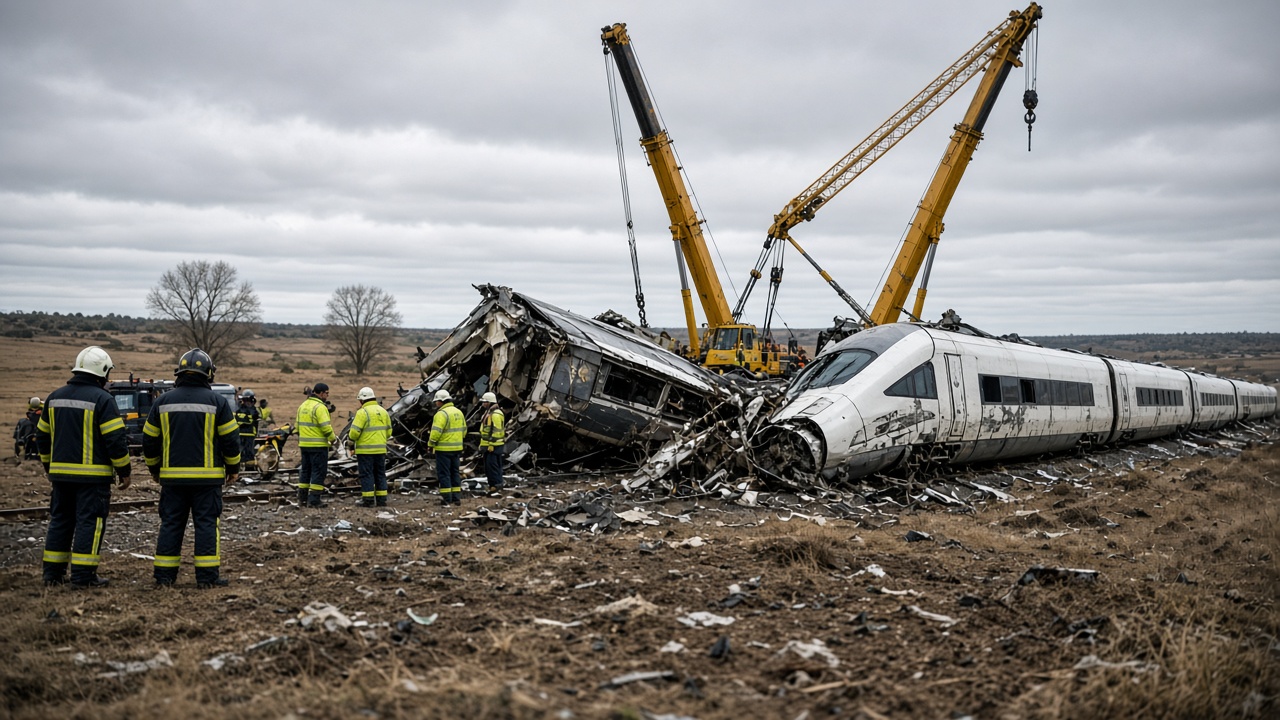
Spain began three days of national mourning on Friday after authorities confirmed that 69 people were killed in the high-speed train collision near Urda, in Toledo province, making it one of Europe’s deadliest rail disasters in more than a decade and the country’s second major crash on the Madrid–Seville corridor this year.
Prime Minister Pedro Sánchez travelled to the site as emergency crews continued to search the mangled Renfe and Iryo carriages with sniffer dogs and thermal drones. Dozens of passengers remain hospitalised, and regional officials said the toll rose by one overnight as investigators combed through debris on a line that carries holiday and business traffic between the capital and Andalusia.
Mourning and political timing
Government buildings lowered flags, and a minute of silence was observed at stations and in Parliament on Thursday. Seville residents held five minutes of silence at Santa Justa station on Friday morning, Reuters and ABC reported, as Spain absorbed a catastrophe that unfolded just weeks before a general election scheduled for 29 November.
Sánchez pledged that investigators would establish a full account of the crash. Transport Minister Óscar Puente has described an “error” and “inexplicable circumstances” after an automatic LZB safety system failed along a 63-kilometre stretch south of Toledo, halting six trains shortly after 8:30 a.m. on Wednesday.
What controllers knew
According to Puente and rail investigators, an Iryo express was stopped at a red signal near Urda when a Renfe AVE train travelling from Madrid to Seville struck it from behind at about 8:53 a.m. The Iryo train had 147 passengers aboard; the Renfe service carried 379 passengers and seven crew members across eight coaches.
Spanish media published audio excerpts in which a controller at Adif’s Madrid–Atocha control centre authorised the Renfe train to resume “normal running” even though the Iryo train remained stationary on the same track roughly 25 kilometres ahead. The independent accident authority AITAT said on Thursday that all hypotheses remained open and that it had not yet interviewed drivers or dispatchers.
Union leaders pushed back against pinning blame solely on a single controller. They argue that staffing pressure and heavier workloads at Adif’s control centres have made it harder to manage simultaneous failures across Spain’s expanding high-speed network, which operators once marketed as among the safest in the world.
Investigations ahead
AITAT classified the crash as a “grave” incident and said the Renfe train was travelling at an estimated 160 to 200 kilometres per hour at impact, pending data from onboard recorders. Guardia Civil investigators are examining whether criminal charges could follow once technical and human factors are separated.
Renfe and Iryo have suspended services on affected sections while engineers inspect signalling equipment linked to the LZB malfunction. Puente said the computer fault that triggered the initial halt is itself a central line of inquiry, not only the dispatch order that followed.
For passengers, the mourning period is a reminder that Wednesday’s crash was not a single mis-click but a chain of technology failure, human decision and enormous kinetic energy on a line Spain depends on every day.