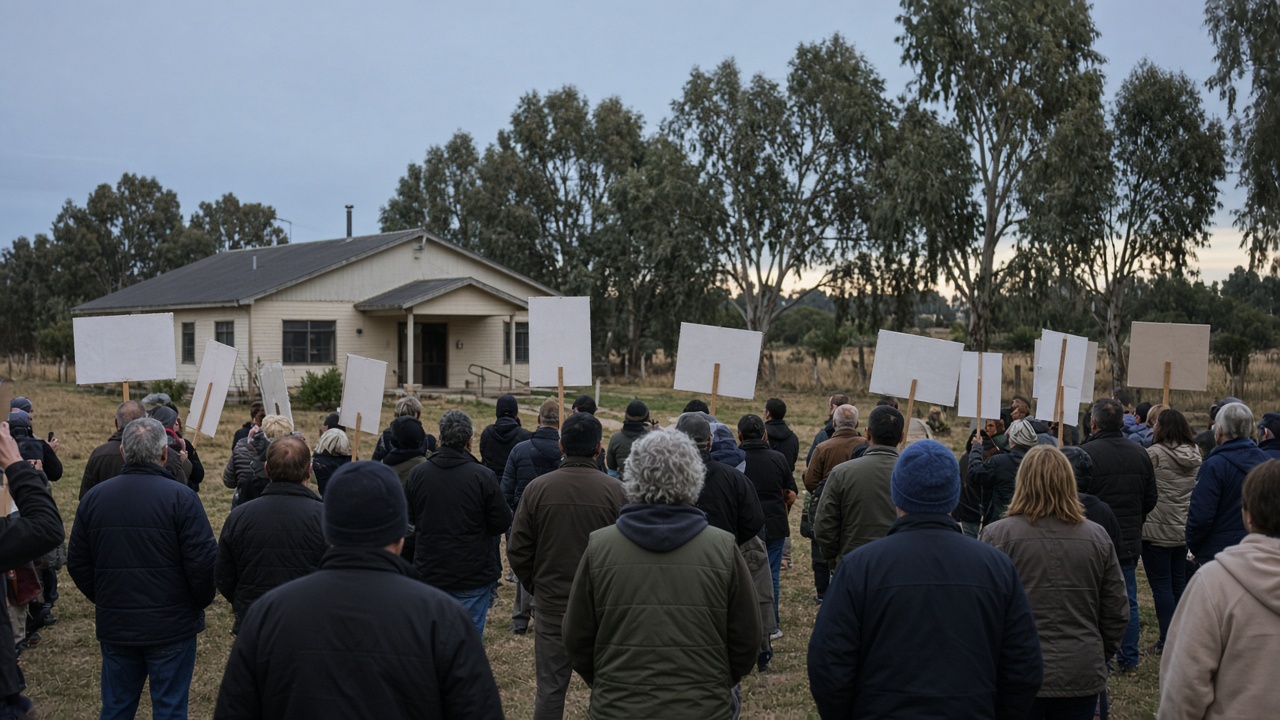
Residents of the Adelaide Hills filled a community hall in Mannum on Saturday to oppose a proposed 1,200-megawatt artificial-intelligence data centre on farmland at Tungkillo, turning a developer delay into a show of political force weeks before any formal planning application lands in South Australia.
Quantum DC wants to build a hyperscale campus across roughly 120 hectares on Collins Road, about 41 kilometres east of the Adelaide central business district, with a first construction stage pencilled in for 2028. The company postponed its own consultation sessions this week citing safety concerns, but locals held their own meetings instead, culminating in the Mannum rally backed by the Liberal Party, the Greens and One Nation.
What the company proposes
Chief executive Alby Tomassi said about 80 percent of electricity would come from two on-site substations tied into existing ElectraNet lines, supplemented by solar and wind contracts. A gas-fired plant would provide firming capacity, and captured rainwater would supply cooling rather than draws from the nearby Murray River or local groundwater, according to materials the company has circulated.
No development application is lodged yet. Tomassi said Quantum DC would not file until community sessions scheduled for Nov. 20 and 21 were complete, arguing the engagement is meant to hear objections before paperwork reaches Planning Minister Nick Champion’s department.
Why neighbours pushed back
Speakers at Mannum cited noise, light pollution, land use and water stress in a region that markets itself on wine, tourism and quiet ridgelines. Organisers said postponing official forums did not pause their campaign, and Saturday’s crowd included farmers who worry a 24-hour industrial load will reshape traffic on narrow Hills roads.
Crossbench leaders framed the fight differently but shared a halt-the-project message. Liberal upper house leader Nicola Centofanti said her party was not against data centres in principle but that community sentiment must count. Greens leader Robert Simms called for a moratorium on new facilities and inclusion of the sector in a state royal commission on energy and land use, while One Nation’s Carlos Quaremba pointed to recent interstate disputes over power-hungry computing hubs.
How the state says it will decide
Champion said any application would face a rigorous planning pathway that could land before the State Commission Assessment Panel or return to the minister’s desk depending on scale and infrastructure needs. He did not commit to approving or rejecting the Tungkillo site, stressing instead that power, water and bushfire constraints would be tested like any major industrial proposal.
Quantum DC’s promise to delay filing until late November gives opponents time to organise submissions, but it also keeps uncertainty hanging over land values along the eastern Hills corridor. Supporters of the investment argue South Australia needs compute capacity to retain AI-related jobs; opponents say the Murray-Darling fringe is the wrong place to trial a gigawatt-class load without a public environmental impact statement on the table.
What happens next
If consultations proceed as rescheduled, the earliest formal application could appear before year’s end, triggering statutory public comment periods and expert reports on noise and glare. Until then, Mannum’s rally functions as a pre-emptive veto campaign: major parties may differ on moratoriums, but all three crossbench groups present said they would fight a green light unless local water and grid impacts are independently verified.
For residents, the immediate question is whether postponed developer meetings will finally offer detail on gas backup and traffic management, or whether the Hills will keep rallying in place of a forum they did not trust to go ahead on the original dates.