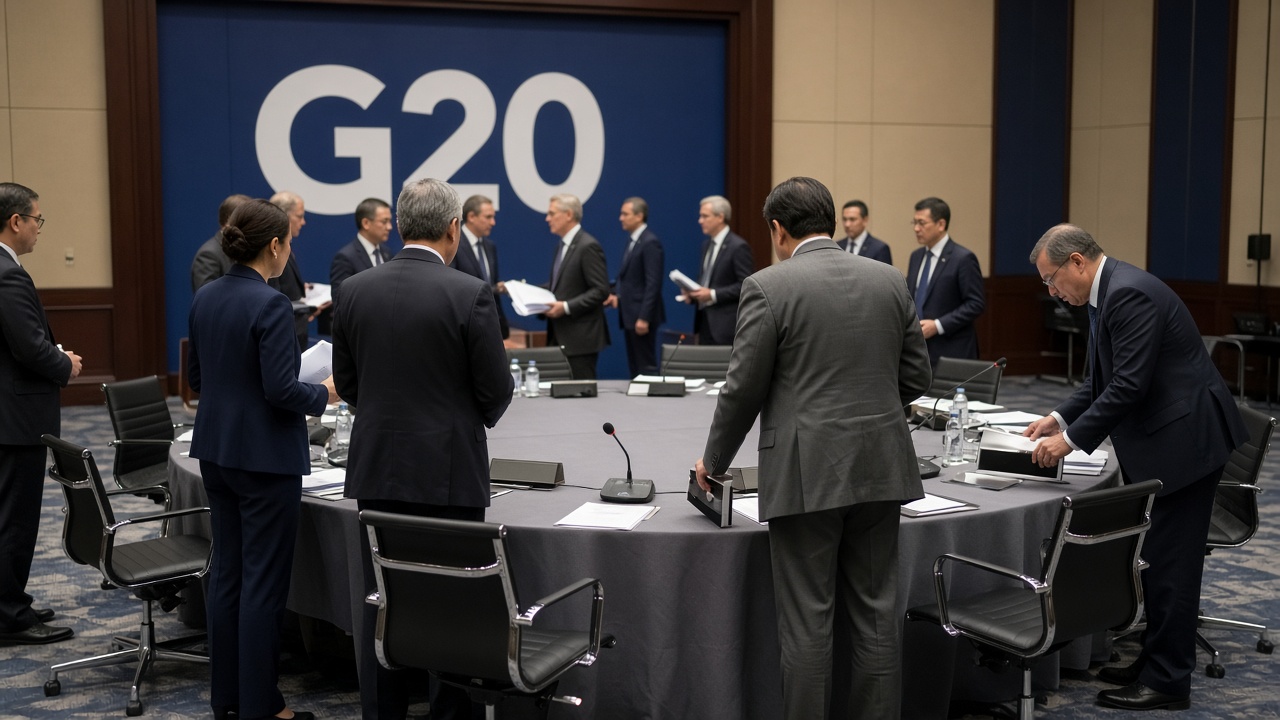
Foreign ministers from the Group of 20 ended a two-day meeting in Atlanta on Saturday without issuing a joint communique, a rare breakdown for a forum that usually papers over disagreements with broad language on trade and development.
U.S. Secretary of State Marco Rubio, who chaired the session as Washington holds the rotating G20 presidency, told reporters that participants had a long and frank exchange on Ukraine, energy security, critical minerals and freedom of navigation in the Strait of Hormuz and the Black Sea. He said many ministers recognized those issues as urgent, but they could not align on how to describe — let alone resolve — the wars and sanctions driving them apart.
What broke the consensus
According to China's Xinhua News Agency and other accounts from the closing hours, the meeting dissolved over familiar fault lines: Russia's war in Ukraine, the U.S. confrontation with Iran and Tehran's partial blockade of Hormuz shipping, and competing views on who should police global supply chains.
Rubio highlighted Hormuz and Black Sea transit as shared interests, echoing weeks of U.S. warnings that Iranian restrictions on tanker traffic have helped push oil prices higher. Several European and Asian delegations wanted explicit language backing Ukraine's territorial integrity and condemning Russian strikes on energy infrastructure, diplomats briefed on the talks said. Russia and China resisted wording that would isolate Moscow or blame Tehran for the Gulf crisis, leaving negotiators without a lowest-common-denominator paragraph.
Polish President Karol Nawrocki's parallel constitutional crisis also hung over the gathering. Warsaw's invited foreign minister told counterparts that a dispute at Poland's Constitutional Tribunal had spilled into street protests, underscoring how domestic upheaval is shrinking the space for multilateral compromise.
Side meetings still moved
Even without a communique, bilateral and mini-lateral sessions continued on the margins. Rubio met Japanese Foreign Minister Toshimitsu Motegi and South Korean Foreign Minister Cho Hyun, reaffirming support for Taiwan Strait stability and North Korean denuclearization — language Seoul and Tokyo have sought as Chinese pressure on Taiwan intensifies.
Iranian Foreign Minister Seyed Abbas Araghchi, speaking separately to Al Jazeera, called recent U.S. outreach a "positive step" but said Tehran had no plans to meet American officials while consultations with Qatari and Pakistani mediators continue. That message landed as Supreme Leader Ayatollah Ali Khamenei again warned of an immediate, unrestricted response to any U.S. or Israeli attack, keeping Hormuz at the center of G20 corridor chatter even though it never made it into a final document.
What happens next
G20 leaders are still scheduled to meet in South Africa later in November. Without ministerial agreed text, sherpas must decide whether to recycle Rubio's chair summary into a leaders' declaration or risk another empty chair.
For markets, the failure is symbolic rather than immediate: no new sanctions or tariff lines were announced in Atlanta. Traders nonetheless read the silence as confirmation that energy and security splits will outlast the U.S. midterm election cycle, leaving coordinated responses to Hormuz disruptions and Ukraine's winter power cuts for ad hoc coalitions rather than a united G20 front.