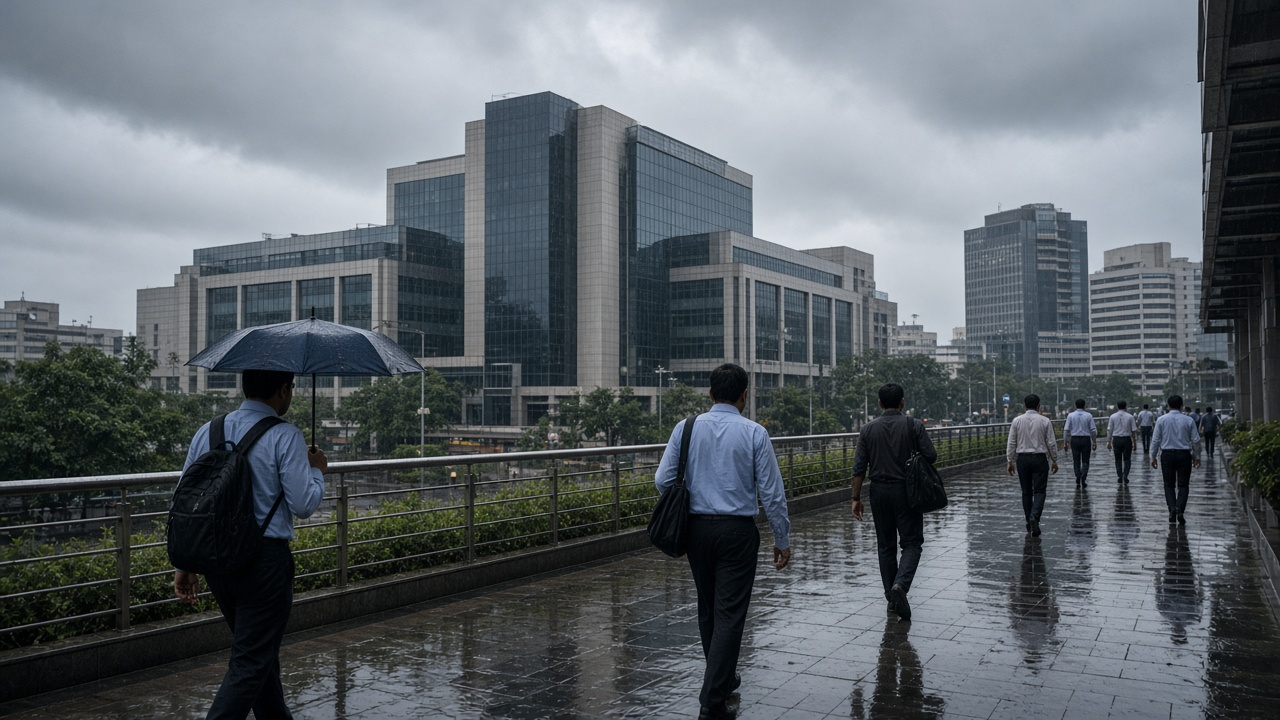
Indian equities closed lower on Friday, 31 October 2025, with the Nifty 50 finishing at 25,722.10 after a choppy session that opened firm and faded as private banks absorbed foreign selling and global cues turned cautious.
Benchmarks and breadth
The 50-share NSE gauge lost 155.75 points, or 0.60%, after touching an intraday high of 25,953.75 and a low of 25,711.20. The BSE Sensex dropped 465.75 points to 83,938.71. Mid-cap and small-cap indices slipped in line with the headline indexes, but market breadth was weak: on the NSE, 1,806 of 3,181 traded stocks ended in the red while 1,266 advanced. Only a handful of Sensex names—Bharat Electronics, Larsen & Toubro, Tata Consultancy Services, ITC, and State Bank of India—closed higher, while Eternal, NTPC, Kotak Mahindra Bank, ICICI Bank, Bajaj Finserv, and HDFC Bank sat among the deepest losers.
Sectorally, metals and media indexes bore the steepest declines, with some sub-indexes falling more than 11% on the day’s calculation, while oil and gas barely held positive territory. The volatility underscored how quickly early optimism—fueled in part by upbeat consumer earnings and easing trade rhetoric—gave way to profit booking across heavyweights that dominate index math.
Private banks vs PSU lenders
Selling concentrated in private lenders that carry large weight in both the Nifty 50 and sectoral bank indexes. The Nifty Private Bank gauge fell with the broader market, whereas the Nifty PSU Bank index rose about 1.5%, extending a week-long re-rating tied to reports that the government may lift the foreign direct investment cap in public-sector banks toward 49% from 20%. Traders said domestic institutions bought on dips—DIIs were net buyers of ₹7,068 crore on the day—but that bid rotated toward state-run names rather than the private heavyweights foreign funds have been trimming all year.
Analysts at Motilal Oswal noted that state-run banks outperformed even as benchmarks fell, a split rarely seen when credit growth narratives favor private lenders. Investors treated the FDI chatter as a potential capital and governance catalyst for PSU names, while private banks faced questions about margin compression after the Reserve Bank’s rate cuts and mixed September-quarter prints.
Foreign flows and global cues
Provisional exchange data showed foreign portfolio investors sold a net ₹6,769 crore of Indian shares on Friday, continuing a pattern that has seen overseas funds net sellers of roughly ₹2.40 lakh crore in 2025 so far. FIIs bought ₹11,532 crore and sold ₹18,301 crore in gross terms, while DIIs purchased ₹18,634 crore against sales of ₹11,565 crore. Analysts cited mixed third-quarter earnings, uncertainty over the U.S. Federal Reserve’s next rate move, and overnight weakness on Wall Street as reasons profit booking persisted even after strong results from some consumer names. Asian markets were mixed; European bourses traded lower during India’s afternoon.
Traders also tracked monthly derivative expiry flows, which often magnify last-hour moves in index heavyweights even when economic news is thin.
Index eligibility rules linger in the background
While Friday was not a semi-annual Nifty 50 reconstitution day—that cycle runs on the last trading sessions of March and September with four weeks’ notice—desks still traded around liquidity and free-float thresholds that determine membership. NSE Indices requires 100% trading frequency, impact cost of 0.50% or less for 90% of observations on a ₹10 crore basket, and free-float market capitalization at least 1.5 times the smallest constituent, with a cap of five replacements in a calendar year. The September 2025 reshuffle, effective 30 September, replaced Hero MotoCorp and IndusInd Bank with InterGlobe Aviation and Max Healthcare, a reminder that laggards with slipping liquidity can exit even between scheduled reviews. Additional reconstitution can occur when stocks lose derivatives eligibility, face trading suspensions, or undergo demergers. For fund managers, that framework mattered on a day when private banks underperformed: passive flows can amplify moves when eligibility scores deteriorate, even if the headline Nifty 50 membership list stays unchanged until the next scheduled review.