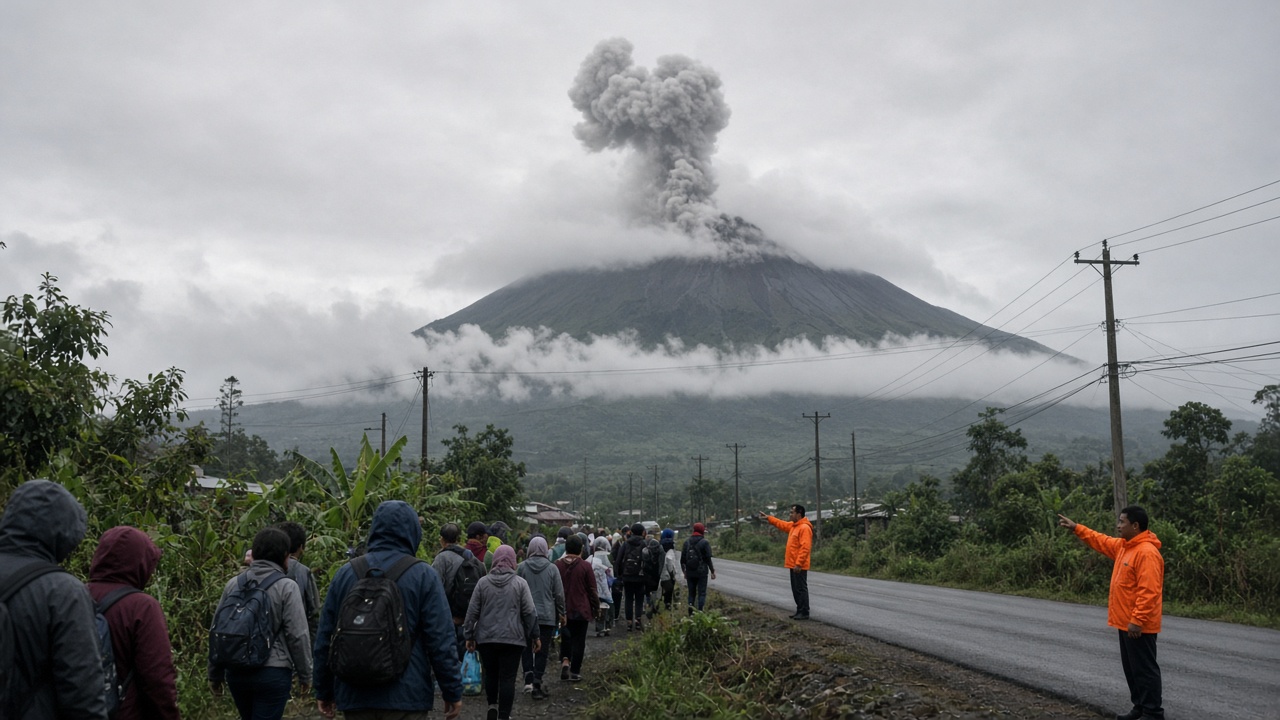
More than fourteen hundred people remained in evacuation centers across Albay province on Saturday after Mayon Volcano produced a moderately explosive eruption that Philippine authorities said marked a new phase of magmatic activity at the cone famous for its near-perfect symmetry.
The Philippine Institute of Volcanology and Seismology raised Mayon to Alert Level 3 on Friday when a gray plume rose roughly three kilometers above the crater at 11:53 a.m. local time. The burst lasted six minutes and triggered mandatory moves out of the six-kilometer permanent danger zone in Tabaco City, Camalig and parts of Ligao City, according to provincial disaster officials.
What changed overnight
Activity did not stop with the initial blast. Phivolcs cameras recorded a fresh ash emission at 5:17 a.m. Saturday from observatories on Ligñon Hill and at the Ligao station. That plume climbed about 200 meters before drifting west-southwest, a smaller column than Friday’s but enough to keep schools and farms on edge downwind.
In a 24-hour monitoring window ending Saturday, the agency counted 15 volcanic earthquakes and 30 rockfall events, crater glow, and sulfur dioxide output of 988 metric tons on Friday. Swelling continued on most of the edifice even as the northeastern flank briefly deflated. Aircraft remain barred from overflight, and entry into the permanent danger zone is prohibited.
How provinces are responding
Oscar Robert Cristobal, who heads the Albay Public Safety and Emergency Management Office, told the Philippine Daily Inquirer that 858 evacuees came from Tabaco, 584 from Camalig and 35 from Ligao. He said authorities cannot yet say when families may return because the volcano’s behavior remains uncertain. Police tightened cordons around the danger zone to block sightseers and farmers tempted to check livestock.
The provincial disaster operations center shifted to red alert for continuous coordination with municipal clusters. The provincial health office shipped 22,000 surgical masks to clinics in ash-prone barangays, and the Department of Social Welfare and Development began handing ready-to-eat boxes to families sheltering in schools such as Tagaytay Elementary in Camalig. Regional stockpiles listed more than 417,000 family food packs on standby late Friday.
What Phivolcs says could come next
Alert Level 3 signals a high level of unrest, not a single finished event. Phivolcs warned that rockfalls, ballistic ejecta, lava flows and moderate explosions remain possible, with lahars a particular risk if heavy rain hits freshly deposited ash on Mayon’s steep slopes. Friday’s main plume drifted west-southwest; Saturday’s shorter pulse followed a similar path, suggesting communities on that arc should plan for intermittent ashfall rather than a quick all-clear.
Legazpi City, Daraga, Guinobatan, Malilipot and Santo Domingo were monitoring outside the forced evacuation footprint but stand ready to expand orders if tremors intensify or gas readings jump. International briefings, including a Saturday summary from China’s Xinhua news agency, cited more than 1,400 displaced since the eruption began, aligning with Philippine shelter counts even as earlier Friday totals had listed more than 2,000 people moved at least once.
Why the world wire cares
Mayon sits in a densely populated Bicol corridor where past eruptions have buried villages and choked regional airports. The 2026 sequence is the first time in this cycle that magmatic eruption language has appeared in official bulletins, elevating the stakes for aviation routes between Manila and eastern Visayas and for humanitarian stocks pre-positioned after typhoon seasons. Donor agencies typically watch Alert Level 3 transitions for signs of a sustained effusive phase that could require weeks of camp support.
For now, Cristobal’s message to reporters was blunt: safety overrides schedules. Until Phivolcs sees a sustained drop in seismic energy and gas flux, the fourteen hundred in halls and gymnasiums are being told to treat Friday’s six-minute blast as the opening chapter, not the epilogue.