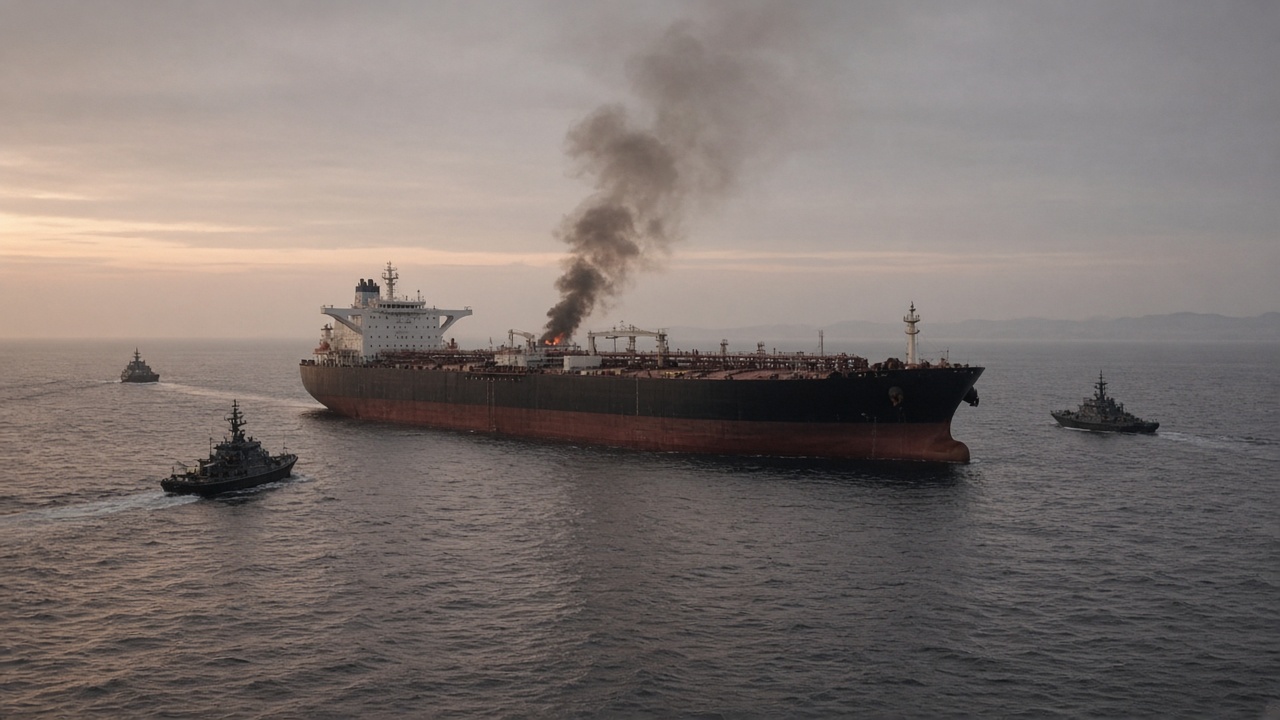
Iran’s Islamic Revolutionary Guard Corps Navy said Sunday that a supertanker was burning and a second tanker had been stopped after both struck naval mines while sailing what Tehran called an unauthorized route through the Strait of Hormuz with automatic identification systems switched off. The claim, carried on state broadcaster IRIB and the IRGC outlet Sepah News, escalates a shipping crisis that has simmered since U.S. and Israeli strikes on Iran in February and a stalled June memorandum on freedom of navigation.
One vessel “suffered a massive explosion and is burning,” the navy said in a statement reviewed by multiple international outlets. Both tankers had disabled navigation and identification systems in an attempt to pass covertly, according to the IRGC, which blamed owners for “full responsibility” if they ignored maritime warnings. Iranian officials did not name either ship or report casualties, and there was no immediate independent confirmation of damage extent or cargo status.
Separate UK alert and a busy weekend at the chokepoint
The Sunday announcements followed an earlier alert from the United Kingdom Maritime Trade Operations center, which reported that the master of a nearby tanker had seen another vessel struck by an unknown projectile in Hormuz waters. That incident was logged separately from the mine claims, underscoring how congested and contested the corridor has become for insurers and charterers routing crude and refined products to Asia and Europe.
Friday had already brought IRGC claims that two other tankers were damaged after ignoring radio warnings, plus a statement that an unmanned U.S. vessel was destroyed east of the strait—an assertion the Pentagon did not immediately confirm. Tehran has tightened transit rules since February, barring passage it associates with U.S. and Israeli interests, and has repeatedly warned masters to keep AIS transponders active.
Diplomatic track as flames draw market attention
Foreign Minister Abbas Araghchi said consultations continued on a Qatari-mediated proposal that could reopen the strait within two days if Washington answered outstanding questions. He told reporters Sunday that Tehran hoped the other side would “choose diplomacy over other paths,” but stressed no final agreement was in place. Mediators met Iranian officials for a third consecutive day, according to Iran International, as traders watched whether insurance premiums and charter rates would spike on Monday.
Any prolonged closure or repeated attacks on laden tankers would ripple quickly through Gulf producers and import-dependent economies. The IRGC statement warned that “any movement, infiltration, or provocative action” in areas under Iranian surveillance would draw a “decisive and proportionate response,” language that has preceded prior interceptions in the same waters.
What shippers are weighing overnight
Owners face a familiar checklist: keep AIS on and accept visibility, or risk being labeled violators if Iran enforces its rules; reroute around the Gulf at cost; or pause loadings until governments clarify escort or convoy arrangements. U.S. officials have not published a fresh military response to Sunday’s mine claims, leaving insurers to price uncertainty into Monday morning quotes.
For now, the IRGC’s account centers on mines, disabled transponders, and a supertanker still reported alight—facts that, if verified, would mark one of the most visible Hormuz incidents since the spring ceasefire talks. Verification from flag states, classification societies, and satellite firms is likely within hours, and markets will treat silence from owners as its own signal.