
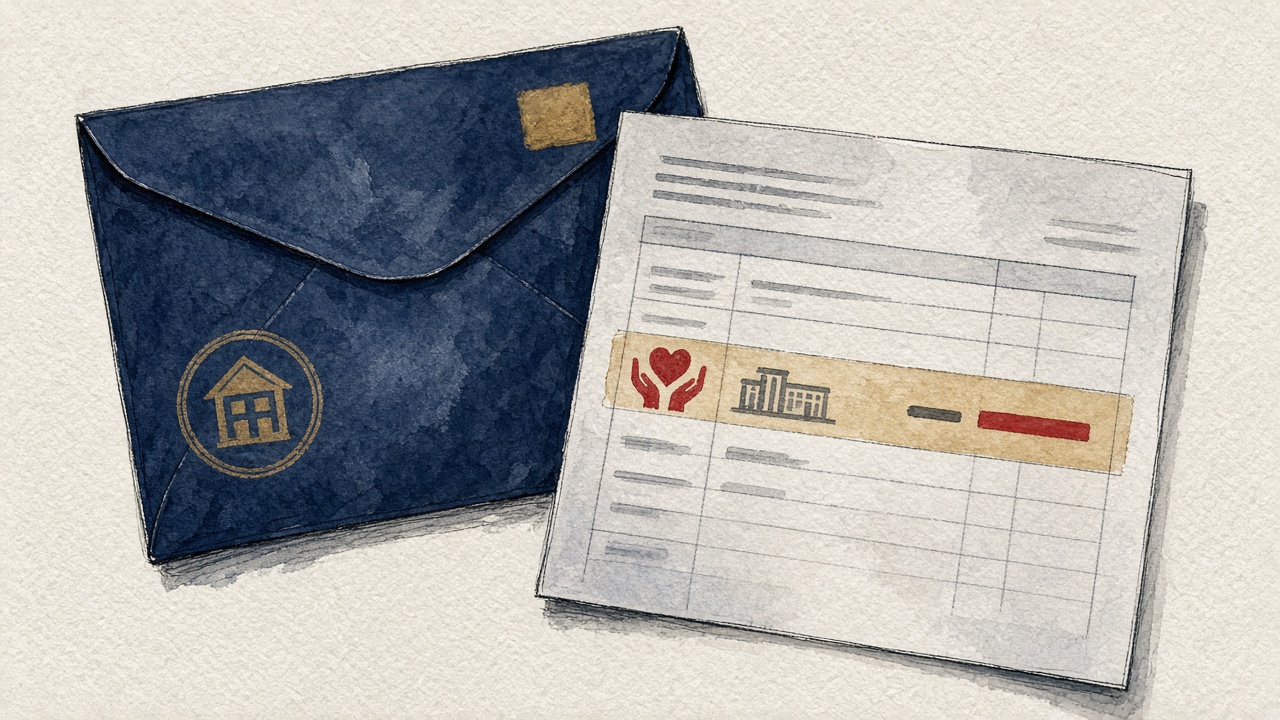
Every July, Yao City in Osaka Prefecture mails long-term care insurance premium notices to residents who have turned 65. The envelopes name an annual charge such as 85,070 yen for a household at the city’s standard income level 5. A few train stops away, a 42-year-old on employer health insurance never gets that letter. The city still collects from them every month through a separate line on the payslip labeled long-term care insurance, starting the month they turned 40.
Both payments fund the same program. They do not buy the same access. That gap is written into the Long-Term Care Insurance Act (Act No. 123 of 1997), which has split enrollees into two classes since the system launched on April 1, 2000. Understanding Japan’s kaigo levy means holding those two classes in mind at once: who collects the premium, who can be certified, and who actually consumes benefits this year.
The July letter and the silent payslip
Yao City’s English guide states plainly that the program requires enrollment of all adults aged 40 or over and is run by municipalities nationwide. For people 65 and older, the city sends Premium Amount Decision Notices every July. Those notices spell out income-graded annual amounts tied to municipal tax status. They are the visible face of Category 1 insurance, the class whose members the Ministry of Health, Labour and Welfare counts as primary insured persons.
Category 2 residents aged 40 through 64 never see that July bill. Their premiums ride on medical insurance contributions instead, calculated from standard remuneration and the long-term care premium rate, with employers paying half for workplace plans. The Ministry’s white paper describes the formula as standard remuneration and standard bonus multiplied by the long-term care insurance premium rate, borne partly by business operators. The money leaves quietly long before anyone asks whether they might need home help themselves.
The split collection method confuses even people who read their payslips carefully. Category 1 money is municipal and pension-linked. Category 2 money is channeled through health insurers, pooled nationally through the Social Insurance Medical Fee Payment Fund, and returned to municipalities as lump-sum grants. You can live in Yao, work in Osaka, and still see the deduction on the same health-insurance statement as outpatient copays.
Which raises the question most workers only ask when the deduction first appears: if this is nursing-care insurance, why am I paying at 40 when ordinary aging care is still decades away?
Three guesses that feel true
The obvious story is personal prefunding. You pay young so your own future bed in a nursing home is covered, like a public pension account with caregivers instead of cash. A second story treats the levy as just another health tax folded into shakai hoken, invisible because the rate is small beside medical premiums. A third assumes employers eat the whole cost because the line sits on the company insurance statement and half the premium is employer-paid.
Each story contains a grain of truth and misses the architecture. At launch, national planners expected premiums to cover half of costs, with Category 2 paying about 33 percent of premium revenue and Category 1 about 17 percent, according to the National Institute of Population and Social Security Research overview written as the system went live in 2000. Employers were never meant to carry the entire Category 2 share, and the money was never designed as individual savings.
Search results still repeat the prefunding myth because it matches the name “insurance.” The annual statistics tell a different story: benefit costs keep rising with service use by people already certified, while Category 2 certification counts stay tiny. If the program were prefunded, you would expect benefit spending on Category 2 members to resemble their cumulative premiums. It does not.
Why it is not a personal savings account
Benefit spending shows where the yen goes. Ministry annual reports track insurance benefit costs excluding user copays in hundred-million-yen units. That series rose from 90976 in fiscal year 2015 to 105100 in fiscal year 2022, the year whose accounts closed at 9.967 trillion yen of benefits on the same basis. The bill keeps climbing because today’s services are consumed today, mostly by people already certified at 65 or older.
The chart’s steepest climb coincides with aging of Category 1 users, not with a wave of middle-aged claimants. Home-care person-months in fiscal year 2022 totaled 48.53 million for Category 1 users against 1.06 million for Category 2 users. The working-age share of service volume is measured in single-digit percents even though working-age payers outnumber certified elders on the rolls.
Category 2 premiums supply a large slice of the premium pool nonetheless. In the ninth plan period covering the ninth plan period beginning in fiscal year 2024, Category 2 premium revenue is about 3.6 trillion yen, roughly 27 percent of total premium income according to the Ministry’s fiscal-structure materials. Those are current contributions flowing into a program whose total benefit costs already approached 10 trillion yen annually before the latest benchmark increase.
If the system worked like a private savings plan, Category 2 benefit draws would track individual balances. They do not. Category 2 benefit costs were 1,627 billion yen in fiscal year 2022, a small fraction of the 9.967 trillion yen spent that year. Working-age payers mainly finance care happening now, especially Category 1 home and facility services.
The birthday that splits the law in two
The law draws a hard line at 65. Category 1 insured are residents aged 65 or older domiciled in a municipality. Category 2 insured are medical-insurance members aged 40 to 64 in that municipality. Turn 40 as an insured employee and you automatically join Category 2, the secondary insured class defined in the English translation of the Act. Turn 65 and you switch to Category 1, with municipalities collecting income-graded premiums, usually withheld from pension benefits starting the month of the 65th birthday.
Eligibility diverges just as sharply. A primary insured person may receive certification for needed long-term care or support regardless of cause. A secondary insured person may receive services only when that need stems from age-related diseases listed in government rules, currently sixteen conditions such as amyotrophic lateral sclerosis, presenile dementia, and terminal cancer. The Ministry pamphlet lists each disease by name, including spinocerebellar degeneration and osteoporosis with fracture alongside the better-known cancer and ALS entries.

The 2000 enforcement notice from the Ministry restates the test in legal Japanese: a person aged 40 to 64 must be in a condition of need for long-term care whose cause is a specified disease arising from age-related physical or mental change. Ordinary senile dementia at 64 therefore fails the gate unless a doctor certifies presenile dementia under the specified-disease rules. At 65, the same functional decline can qualify under the broader Category 1 standard. The premium did not change. The legal test did.
Presenile dementia’s inclusion surprises readers who assume dementia equals automatic access. It is on the list precisely because it strikes before 65. Everything else that looks like “normal old age” waits for the birthday that moves you into Category 1, when certification no longer asks which disease caused the decline.
Residents, 40-years-old or over, are to be insured. Those aged 40–64 are more likely to require care themselves due to age-related diseases and their parents are also more likely to require care with advancing age.
One payer in three hundred
How many Category 2 payers ever pass the disease test? At the end of fiscal year 2022, only 130,000 Category 2 insured held long-term care or support certification, compared with 6.81 million certified Category 1 insured. With about 41.88 million Category 2 payers on the rolls that year according to medical-insurer reports summarized by the Ministry, the certified share among working-age contributors was about 0.31 percent.
Among Category 1 insured, certification reached 19.0 percent nationally at the same date, the figure the FY2022 annual report highlights as the average share of primary insured persons who were certified. Put differently, roughly one elder enrollee in five was in the system, against fewer than one working-age payer in three hundred.
Gender breakdowns in the same report show Category 2 certification remains rare for both men and women, while Category 1 certification concentrates among older women. The imbalance reflects longevity and facility use, not a different premium formula for daughters versus sons. Category 2 payers fund the same elder skew whether they are men or women on the payslip.
Service counts tell the same story at larger scale. Fiscal year 2022 home-care person-months totaled 48.53 million for Category 1 users against 1.06 million for Category 2 users. Category 2 money enters at payroll scale and exits only when a rare disease pathway opens, or when a certified Category 2 user receives preventive services tied to an approved condition.
Where the Category 2 yen actually goes
Premium formula explains why employers notice the charge. Category 2 long-term care premiums multiply standard remuneration by the long-term care rate, with businesses paying half for employees. All secondary insured pay 10 percent of service costs as copay regardless of income, unlike higher copays that can apply to wealthy Category 1 users whose pension and wage income cross Ministry thresholds.
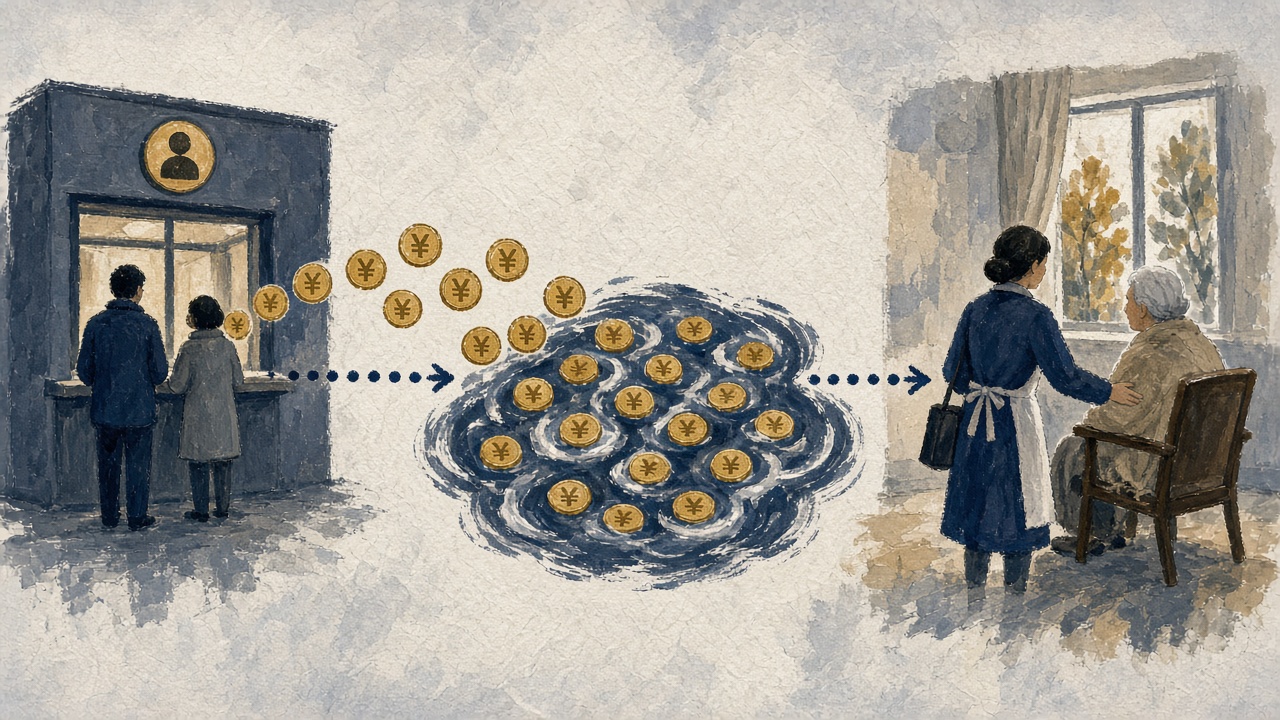
Once collected, Category 2 premiums follow the same grant route as other insurer levies, landing in municipal budgets that pay providers for visits, day services, and beds this month. Category 2 benefit costs of 1,627 billion yen in fiscal year 2022 are the portion of that spending attributed to certified working-age users, still dwarfed by Category 1 draws.
The Ministry argues that charging from 40 is fair because workers may need early care and often support aging parents. That rationale appears in official brochures and in the 2000 IPSS summary, which says the program is designed to share the burden of caring for the elderly among all members of society and lessen the burden on families. The moral claim is real. It does not change the arithmetic: Category 2 is a cross-subsidy with a narrow benefits door, not a timed escrow that unlocks at retirement.
Policy debates sometimes propose raising the entry age or widening Category 2 diseases. None of that alters today’s rulebook: pay from 40, certify ordinary aging at 65 unless a listed disease intervenes.
July again, with different post
Back in Yao City, the calendar divides neighbours. A resident who turns 65 moves from the silent payslip to the July notice cycle. Municipalities set Category 1 amounts against income; the national benchmark for the ninth plan period averages 6,225 yen per month, up from 6,014 yen in the eighth period according to the Ministry’s 2024 announcement. At level 5 on Yao’s FY2024 table, that municipal math produced an annual bill of 85,070 yen for the standard case in the city’s guide.

Category 1 insured at fiscal year 2022 year-end numbered 35.85 million, nearly all of them eligible for certification on age grounds alone. Their former Category 2 selves helped pay for the pool from age 40 until 65, usually without certification, unless one of the sixteen diseases intervened. When the July envelope finally arrives, it is not a new program. It is the same insurance with the income-graded bill they were told would come at retirement.
The July envelope and the payslip line both say long-term care insurance. One arrives with the birthday at 65. The other began at 40. Only the law explains why they never meant the same promise.