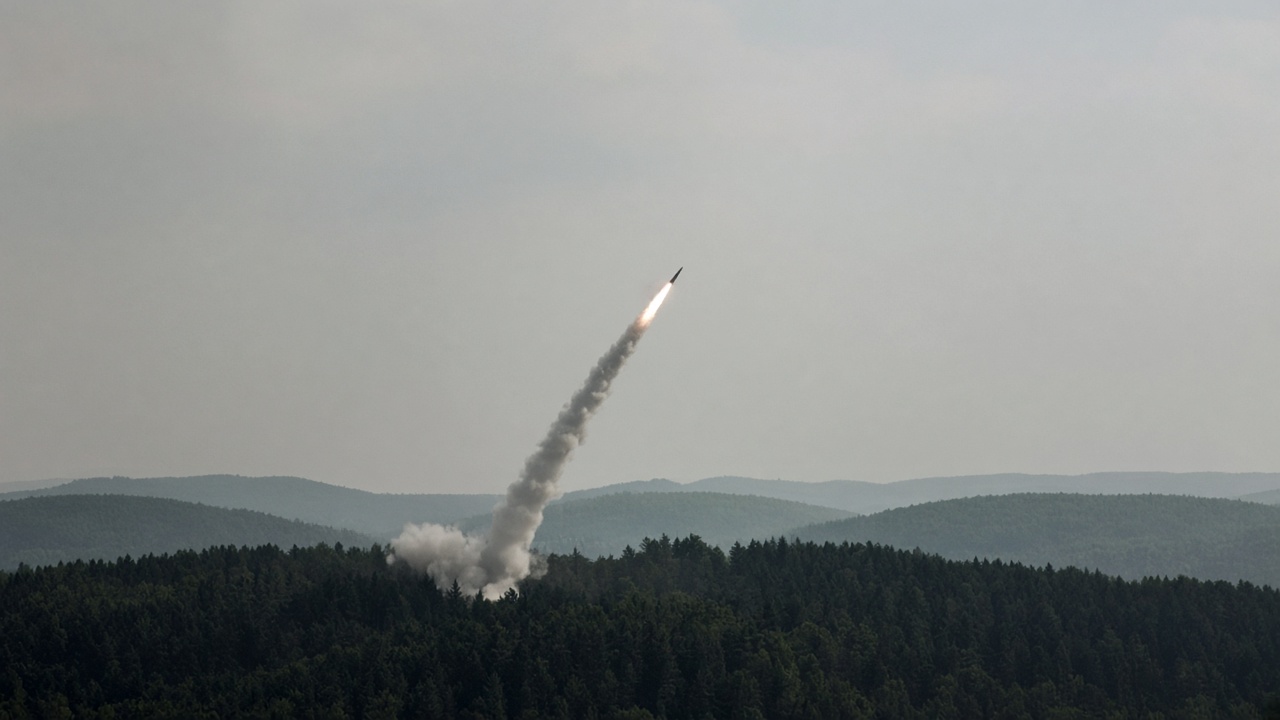
North Korea tested a cluster-bomb warhead for tactical ballistic missiles on Saturday and said it would field four types of cluster munitions by year-end, while South Korea's Joint Chiefs of Staff said allied sensors tracked the launch before state media published triumphal footage Sunday morning.
The Korean Central News Agency said the Missile Administration fired the weapon to judge combat adaptability and confirmed that a "Standard Type 2" warhead could "turn into ashes" an area of 12 to 13 hectares at maximum density. A senior official quoted by KCNA said units would soon choose among four warhead categories based on target type.
What Seoul saw first
South Korea's Joint Chiefs told reporters Sunday the missile flew toward the Yellow Sea from northwestern Chongju County. That disclosure pattern—public confirmation a day later rather than an immediate bulletin—differs from many past North Korean ballistic tests and suggests officials prioritized verifying payload claims before responding to KCNA's still images.
The statement emphasized continuous information sharing with the United States and a maintained readiness posture before the launch. Analyst Shin Jong-woo of the Korea Defense and Security Forum told Yonhap the platform likely resembled the Hwasong-11 Ra short-range system Kim Jong Un inspected during an April cluster test with his daughter Ju-ae present.
Why cluster warheads matter on the peninsula
Cluster munitions disperse dozens or hundreds of submunitions across a wide footprint, raising legal and humanitarian scrutiny under international conventions South Korea has joined but North Korea rejects. Pairing them with maneuverable tactical missiles shifts the threat from symbolic long-range launches to weapons that could saturate front-line airfields, logistics nodes or port facilities within minutes of warning.
April's Hwasong-11 Ra cluster trial already signaled Pyongyang's interest in combining precision short-range rockets with area effects. Saturday's test, disclosed while Foreign Minister Cho Hyun was returning from Atlanta, reads as a deliberate contrast to trilateral calls for complete denuclearization issued by South Korea, the United States and Japan on the G20 sidelines.
Diplomatic backdrop in Atlanta
Cho used the foreign ministers' meeting to restate Seoul's account of a September land-mine blast inside the Demilitarized Zone that wounded three South Korean soldiers, urging Pyongyang to accept military talks even as the North denies planting the device. He also warned that deepening North Korean support for Russia's war in Ukraine carries security consequences for Northeast Asia.
U.S. Secretary of State Marco Rubio said separately that President Donald Trump remains willing to meet Kim if talks address allied concerns, though no summit date exists. Cluster warhead messaging therefore lands in a narrow window between mediation speculation and renewed pressure on Hormuz-related shipping routes that Cho linked to South Korean naval contributions.
What commanders watch next
Seoul will parse debris signatures and radar tracks to see whether Saturday's test reused April hardware or introduced a new dispersal pattern. If KCNA's pledge to supply four cluster types to field units by December holds, expect more Yellow Sea or East Sea launches designed to stress Patriot and Terminal High Altitude Area Defense batteries without crossing thresholds that trigger immediate United Nations Security Council action.
For now the Joint Chiefs' emphasis on pre-launch tracking is meant to reassure a domestic audience that intelligence fusion still works even when North Korea controls the publicity timeline. The operational question is whether cluster-equipped tactical missiles become routine in North Korea's winter training cycle, not whether a single Saturday shot changed the balance overnight.