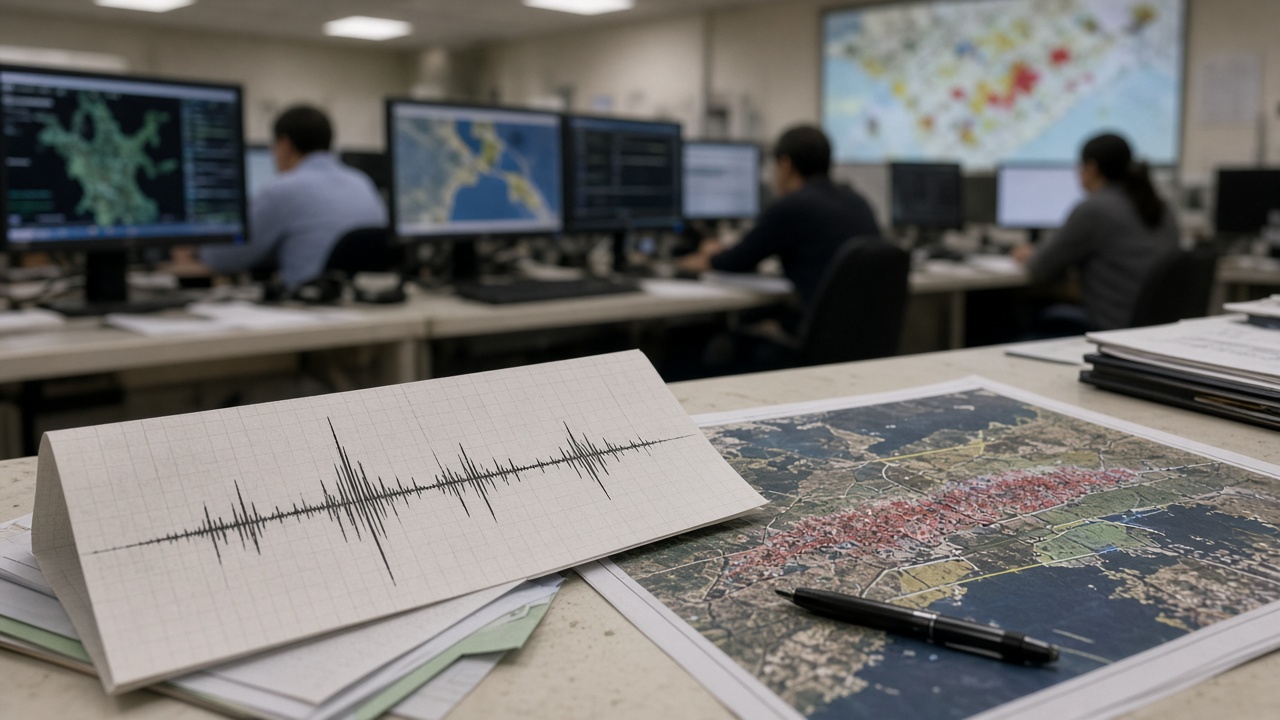
A magnitude 6.1 earthquake struck off the southeast coast of Mie Prefecture at 7:15 a.m. Japan Standard Time on Sunday, the Japan Meteorological Agency said, shaking communities from central Honshu to northeastern prefectures without triggering a tsunami warning.
What JMA recorded
The agency located the hypocenter at latitude 33.7 degrees north and longitude 137.1 degrees east, about 350 kilometers deep. That depth placed the event in the Pacific plate subduction zone rather than along a shallow inland fault, a profile that typically limits surface shaking and structural damage.
Maximum seismic intensity reached 3 on the Japanese Shindo scale in Fukushima Prefecture and in parts of Mie, Aichi and Shizuoka, according to the agency's revised bulletin issued at 7:23 a.m. Mie Prefecture's disaster portal published the same parameters for local officials. More than 700 seismic stations contributed to the solution, and the agency's centroid moment tensor listed a moment magnitude of 6.0.
JMA's tsunami section said there was no concern for destructive waves. Long-period ground motion monitors did not register level 1 or higher shaking in populated areas, suggesting office towers and port facilities avoided the slow sway that can damage tall buildings even when short shaking feels modest.
Early response
Prime Minister's Office disaster channels issued the standard prompt for residents to check local advisories, but prefectural governments in Mie and neighboring Aichi reported no immediate requests for fire or ambulance surges. Central Japan Railway said it ran emergency track inspections on Tokaido Shinkansen segments; services resumed after brief speed restrictions once lines were cleared.
Chubu Electric Power said nuclear reactors at Hamaoka, offline for years, were unaffected, and that fossil and hydro plants in the region continued normal output. Oil terminals at Yokkaichi reported no tank alarms.
Context for residents
Deep offshore quakes of this magnitude occur periodically along the Nankai Trough monitoring zone. Sunday's event was stronger than a magnitude 5.5 shock that hit Chiba in late October, which had produced Shindo 5-lower shaking closer to Tokyo. Because today's epicenter sat far offshore and deep, many residents in Nagoya and Osaka felt only a brief tremor or nothing at all.
Municipal disaster apps in Mie urged households to confirm evacuation routes ahead of Typhoon season's late tail, a reminder that earthquake and storm preparedness overlap on the Pacific coast. Schools scheduled for sports festivals opened on time after principals walked campuses for cracked walls or toppled equipment.
Monitoring continues
JMA said it would watch for aftershocks but noted that deep events seldom generate prolonged sequences near populated coastlines. Seismologists interviewed by public broadcaster NHK emphasized that the lack of tsunami risk did not eliminate the need to review maritime rules: fishing fleets already at sea should listen for follow-up advisories if aftershocks cluster closer to shore.
Construction ministries said they had not activated the special inspection regime used after shallow urban quakes. Rail and expressway operators completed accelerated checks by mid-morning and reported no deformations.
What to watch
Officials will incorporate Sunday's shock into weekly Nankai Trough scenario drills scheduled later in November. If aftershocks migrate upward toward the trench, coastal municipalities could tighten harbor closures even without a tsunami warning.
For now, the headline is restraint: a numerically strong earthquake that Japan's monitoring network captured in seconds, rattled nerves across several prefectures, and left emergency lines quiet by lunchtime.