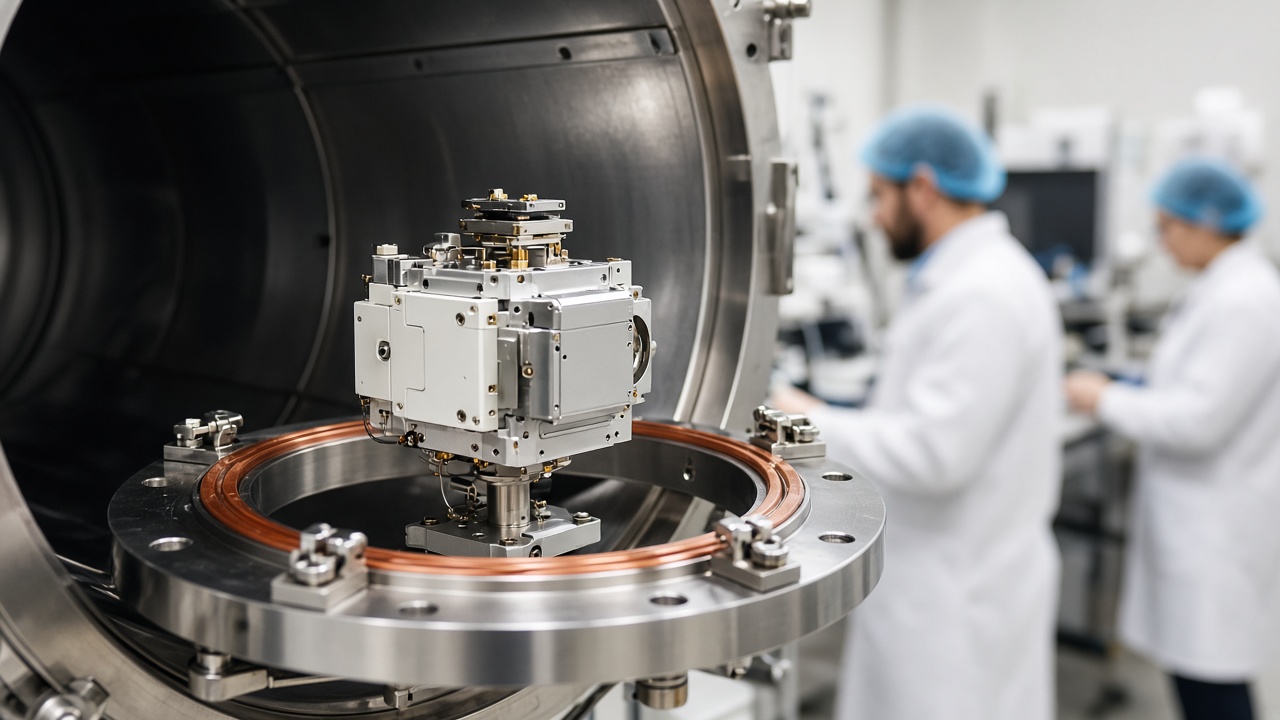
Engineers at National Central University finished thermal-vacuum qualification on a shoebox-sized ionospheric probe that Taiwan Space Agency planners aim to launch aboard a domestic rocket in January, extending a university-led lineage of upper-atmosphere sensors flown since 2017.
Instrument details
The probe measures electron density and scintillation along low-inclination orbits, data useful for GPS correction services and space-weather alerts that affect HF communications across the Taiwan Strait. NCU’s Space Payload Laboratory bolted the sensor suite to a flight spare bus for fourteen-day cycling between minus 40 and plus 60 degrees Celsius while vacuum pumps held chamber pressure below 10⁻⁵ torr.
Project lead Professor Lin Wei-ying said vibration tests at Hsinchu facilities already passed in September; thermal-vacuum was the last major ground milestone before integration with the launch adapter.
Launch partnership
TASA has not published a firm launch date but told participating universities to freeze firmware by December 10. The January window aligns with historically calmer upper-level winds at the planned coastal launch site, though typhoon seasons have slipped schedules before.
Ministry of Science and Technology grants cover roughly two-thirds of the mission cost, with NCU alumni donations funding student engineer stipends. Undergraduates built wire harnesses and wrote telemetry parsers as capstone projects.
Why ionospheric data matters here
Taiwan relies on satellite timing for maritime navigation, disaster communications, and precision agriculture in outlying islands. Scintillation events during solar maximum years can degrade GNSS fixes for harbor cranes in Kaohsiung and fishing fleets off Penghu.
Central Weather Administration forecasters said assimilating NCU measurements into regional models could improve lead time on equatorial plasma bubble alerts that disrupt evening flights over the South China Sea.
Risk items
Supply chains for radiation-hardened analog front ends tightened after export controls on certain gallium arsenide components. NCU swapped in a domestically packaged alternative after a six-week delay, preserving mass budget margins.
Software teams still must pass cybersecurity reviews for ground-station interfaces at NCU’s Taoyuan campus and TASA’s S-band network. Penetration testers flagged a logging verbosity issue patched last week.
After launch
Science data will publish openly after calibration, a policy NCU adopted to cooperate with Japan’s small-sat community studying similar latitudes. Undergraduates will operate passes during business hours with faculty override for anomaly responses.
If January launch holds, the probe becomes another brick in Taiwan’s quiet space-science stack—not headline military hardware, but practical monitoring for an island economy that still listens to the sky.
Student operators will publish anomaly logs in Mandarin for classroom use, extending NCU’s tradition of training engineers who later join TASA contractor teams.