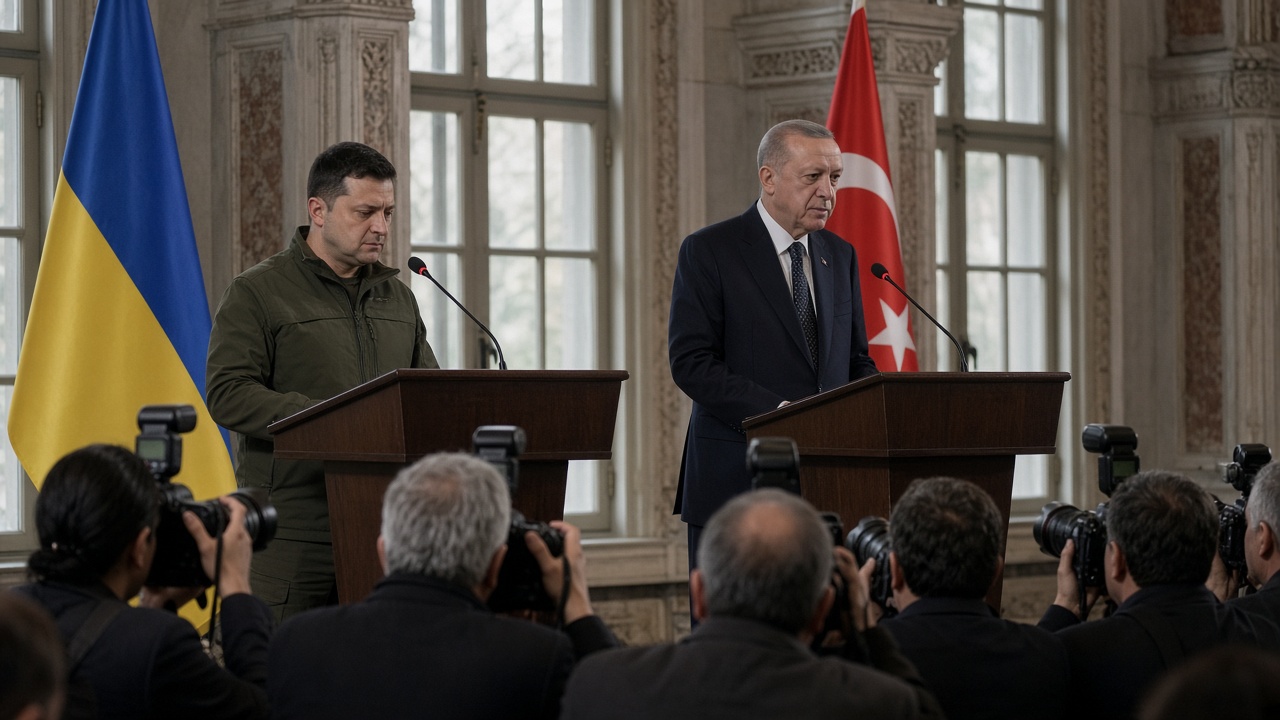
Ukrainian President Volodymyr Zelenskyy said Saturday that he and Turkish President Recep Tayyip Erdogan agreed to work on establishing a new Black Sea grain corridor, reviving a trade route that once moved millions of tonnes of food exports before Russia’s full-scale invasion disrupted shipping and insurance markets.
Speaking at a joint news conference in Istanbul after bilateral talks, Zelenskyy said Erdogan backed efforts to keep navigation safe in the Black Sea and to restore conditions that allow Ukrainian farmers and ports to reach global buyers. Türkiye has long positioned itself as a mediator with access to both Kyiv and Moscow, and its control of the Bosporus gives Ankara decisive say over warship movements that can indirectly shape commercial risk in the region.
What changed on Saturday
The agreement does not by itself reopen a corridor. Zelenskyy described it as a commitment to joint work rather than a signed operational plan with start dates, escort rules, or inspection regimes. Still, the public alignment matters because the previous UN- and Türkiye-brokered grain initiative collapsed amid wartime strikes on port infrastructure and disputes over which cargoes qualify for safe passage.
Erdogan’s government has repeatedly offered to host negotiations and to apply diplomatic pressure for humanitarian shipping, even as Ankara maintains economic ties with Russia that Western capitals criticize. Saturday’s language emphasized “safe navigation” and “normal living conditions,” phrasing Kyiv uses to link export revenue with civilian energy and social spending inside Ukraine.
Why grain routes still shape the war economy
Before the invasion, Ukraine ranked among the world’s largest exporters of wheat, corn, and sunflower products. When bulk carriers stopped calling at Odesa and other ports at pre-war volumes, global prices spiked and import-dependent countries in North Africa and the Middle East faced budget shocks. Any corridor that lowers insurance premiums and clarifies which lanes are considered combat-free can restore partial flows even while fighting continues elsewhere along the coast.
Western officials have tied food security to sanctions design, arguing that Russia should not profit from blockades while exporting its own agricultural goods through alternate routes. Moscow, for its part, has demanded relief on its own exports and banking channels as part of any revived deal. Türkiye’s mediation role sits in that gap: credible enough to talk to both sides, yet constrained by NATO membership and domestic inflation politics that make cheap food imports a priority at home.
What happens next
Diplomats in Kyiv and Ankara will now need to translate political agreement into technical steps: mine-risk surveys near port approaches, coordination with insurers, and a mechanism to verify cargo manifests without giving either military side targeting data. Zelenskyy gave no timetable Saturday, and Turkish officials did not announce a parallel call with the Kremlin in the same appearance.
Until those details exist, Ukrainian grain will continue to move primarily by river, rail, and smaller Danube routes that raise transport costs. Farmers heading into winter storage decisions will watch whether Saturday’s pledge produces escorted convoys or remains another statement of intent in a war where shipping lanes have been treated as bargaining chips as often as humanitarian lifelines.