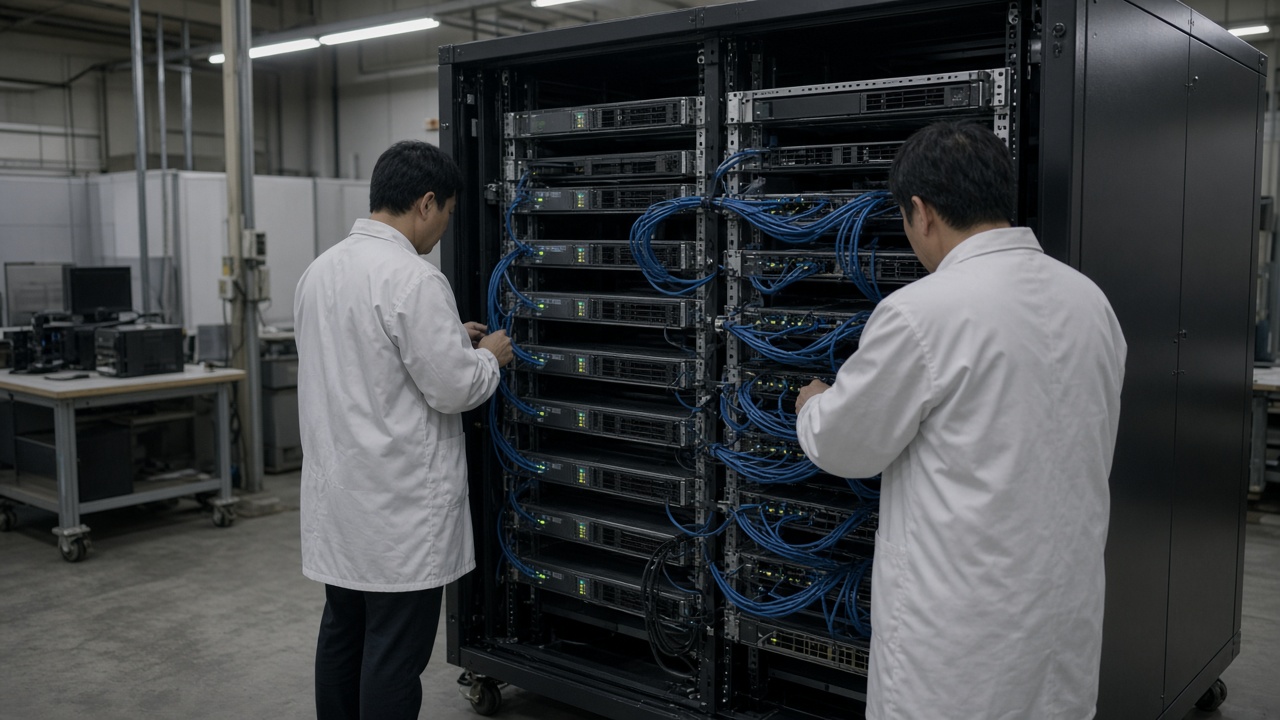
Aspeed Technology said Monday that its next-generation baseboard management controller cleared ODM qualification for Nvidia B300 server racks, a step two Taiwan system builders need before they can ship burn-in units to hyperscaler labs in November.
What cleared and who cares
The Hsinchu chip designer told the Taiwan Stock Exchange that AST2600-A3 samples finished a 720-hour stress loop at a Taoyuan ODM without logging uncorrectable memory errors on the management plane. That matters because B300 trays run hotter than prior H100 generations, and buyers treat BMC firmware as part of the safety envelope, not a commodity add-on.
Management named two unnamed rack integrators—both listed ODMs with existing AI server lines—as the first customers taking qualified parts this week. Aspeed did not disclose unit pricing, but said gross margin on the new SKU should track its existing server BMC portfolio rather than the richer margins it earns on graphics-adjacent chips.
Why Taiwan fabs the management layer
Baseboard controllers sit on every AI tray, handling power sequencing, thermal telemetry, and remote recovery when a GPU hangs. When hyperscalers qualify a new accelerator generation, they typically re-run BMC firmware through the same checklist as the GPU itself. A delay at Aspeed therefore shows up as empty slots in ODM shipping schedules even when GPU silicon is available.
Aspeed shares, listed as 5274 on the TWSE, have traded with the AI server cycle for two years. Investors watch qualification notices because they precede revenue by one to two quarters: ODMs stock BMC parts before they commit rack build plans to customers.
Retail holders on Taiwan’s bulletin boards debated whether Monday’s notice was priced in after a September leak of burn-in photos, but volume on 5274 still cleared its twenty-day average as foreign desks trimmed short exposure. Credit analysts said Aspeed’s net cash position gives it room to discount early A3 lots if ODMs bundle BMC with board-level management kits on promotional AI trays.
Competitive field
American rivals still dominate high-end x86 management, but Taiwan ODMs prefer Aspeed for ARM-based AI trays because firmware stacks are already integrated in their reference designs. Monday’s notice explicitly mentioned side-band management over PCIe Gen5, a requirement B300 vendors published in platform guides this fall.
The company cautioned that hyperscaler acceptance tests can still fail for reasons outside the BMC—cable routing, liquid leak sensors, or GPU VRM tuning. Qualification at the ODM is necessary, not sufficient, for volume shipments.
Two contract manufacturers told exchange watchers privately that they will publish their own customer advisories once tray integration tests finish, likely mid-November. Those advisories typically list firmware version strings operators must flash before accepting racks at datacenter loading docks.
Field service engineers at one ODM said they logged shorter mean-time-to-recovery on hung GPU nodes after the A3 branch added a dedicated side-band reset that avoids full tray power cycles. That improvement matters for hyperscalers running mixed-vendor clusters where a hard reboot can evict unrelated tenants.
What to watch next
Aspeed said it will publish October revenue on the exchange timetable later this week. Analysts on the Taipei conference call circuit expect server BMC mix to rise as a percentage of sales even if consumer-related lines stay flat. If the two ODMs named in Monday’s filing begin rack shipments in December, the chip designer’s first-quarter guidance could move independently of handset or PC demand—a split investors have wanted to see for several quarters.
Exchange filings also flagged a firmware branch numbered 2.14.x that adds redundant management paths for liquid-cooled manifolds, a detail rack operators asked for after summer leak tests. ODM program managers said they will freeze that branch for production once hyperscaler labs sign regression logs on in-band and side-band recovery scenarios.
Supply-chain brokers in Taoyuan said spot AST2600-A3 lead times shortened from nine weeks to six after the qualification notice, though they cautioned that GPU tray shortages could still reorder priorities if customers defer rack builds into January. Aspeed’s investor relations desk scheduled a Taichung site tour for buy-side analysts who want to see burn-in bays without entering customer clean rooms.