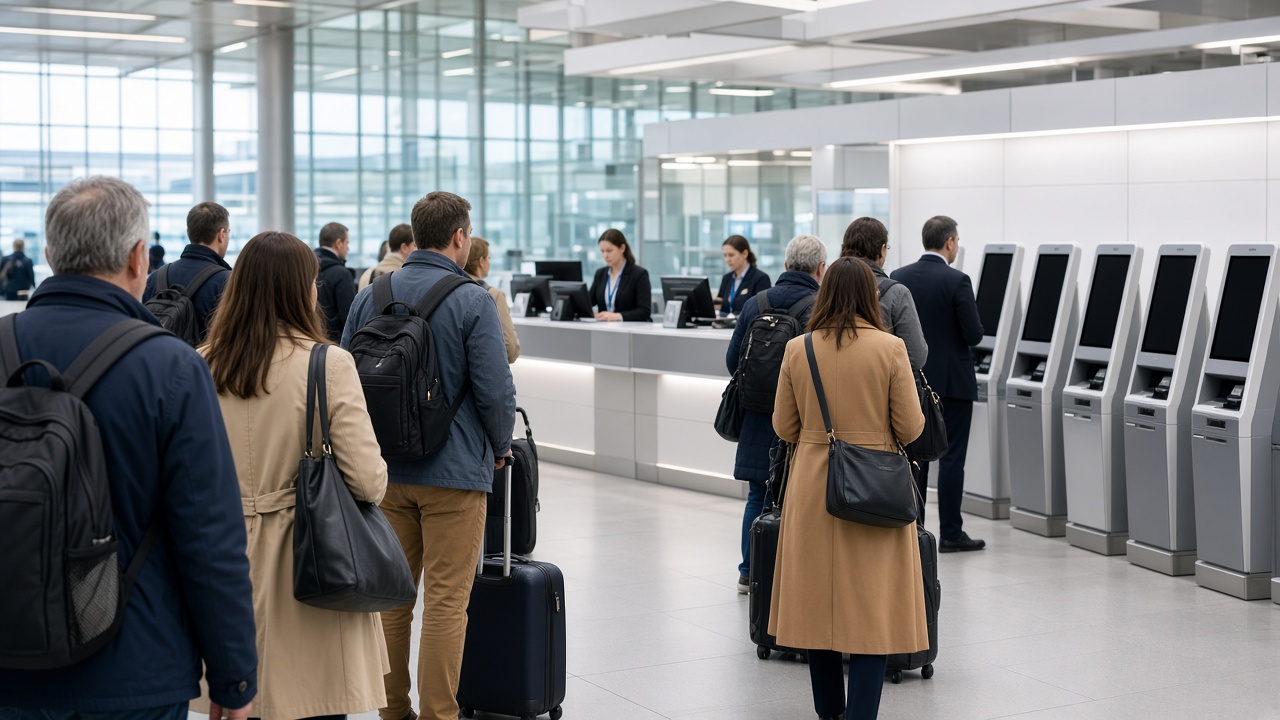
Changi Airport’s self-service check-in kiosks failed across all four terminals on Monday morning, forcing airlines to fall back on manual counters and slowing queues until Advance Passenger Processing systems recovered shortly before 11 a.m., Changi Airport Group (CAG) said.
When systems dropped
CAG told reporters the disruption began around 8:30 a.m. because of a “global disruption in Advance Passenger Processing systems.” APP platforms validate passenger data against airline and border requirements before boarding passes are issued; when the backbone fails, kiosks cannot complete check-in even if local networks are healthy.
“Other airports were similarly affected,” CAG added, without naming carriers or foreign hubs. Ground teams redirected passengers to staffed counters while technicians worked with airlines and the APP vendor to restore service.
What travellers saw
At Terminal 3, automated kiosks at Garuda Indonesia counters were dark during the outage; passengers on the late-morning Jakarta service were steered into a separate queue for accelerated bag checks. At Terminal 4, Korean Air and Cathay Pacific self-service rows displayed maintenance messages around 10:30 a.m., with staff handing boarding passes manually.
CAG said check-in for all affected airlines returned to normal at about 11 a.m., roughly two and a half hours after the first failures. The group said airport staff assisted airlines and passengers on the floor throughout the window, but did not quantify total delays or missed connections.
Why APP matters in Singapore
Changi has pushed kiosk and biometric flows to keep terminal dwell times predictable as passenger numbers rebound. APP sits upstream of those touchpoints: without it, airlines cannot electronically confirm exit approvals, visa checks or advance passenger information filings that Singapore’s Immigration & Checkpoints Authority expects before boarding.
Monday’s failure was therefore visible at every self-service row even though runway operations and security screening continued. Airlines with tighter turnaround windows—especially regional narrow-body services—felt the squeeze first because manual check-in consumes counter space that kiosks normally absorb.
Regulators and next steps
CAG did not identify the APP provider in its initial statement. Aviation analysts said investigators will want to know whether the outage stemmed from a software release, certificate expiry or an upstream database cluster, and whether redundant paths exist for hub airports that depend on kiosk-heavy processing.
For passengers, the practical lesson from Monday is to arrive earlier when global reservation or processing platforms glitch: Changi’s physical infrastructure kept running, but the digital gate on boarding passes did not. Travellers who checked in on airline apps before reaching the terminal were generally unaffected, while those relying on airport kiosks bore the longest waits.
CAG said it would work with airlines to review contingency staffing levels for future APP incidents, while carriers filed delay codes with IATA categories tied to central-system failures rather than local weather or air-traffic control. Immigration checkpoints continued processing arriving passengers on separate systems, limiting the outage to outbound check-in halls rather than the entire airport campus.