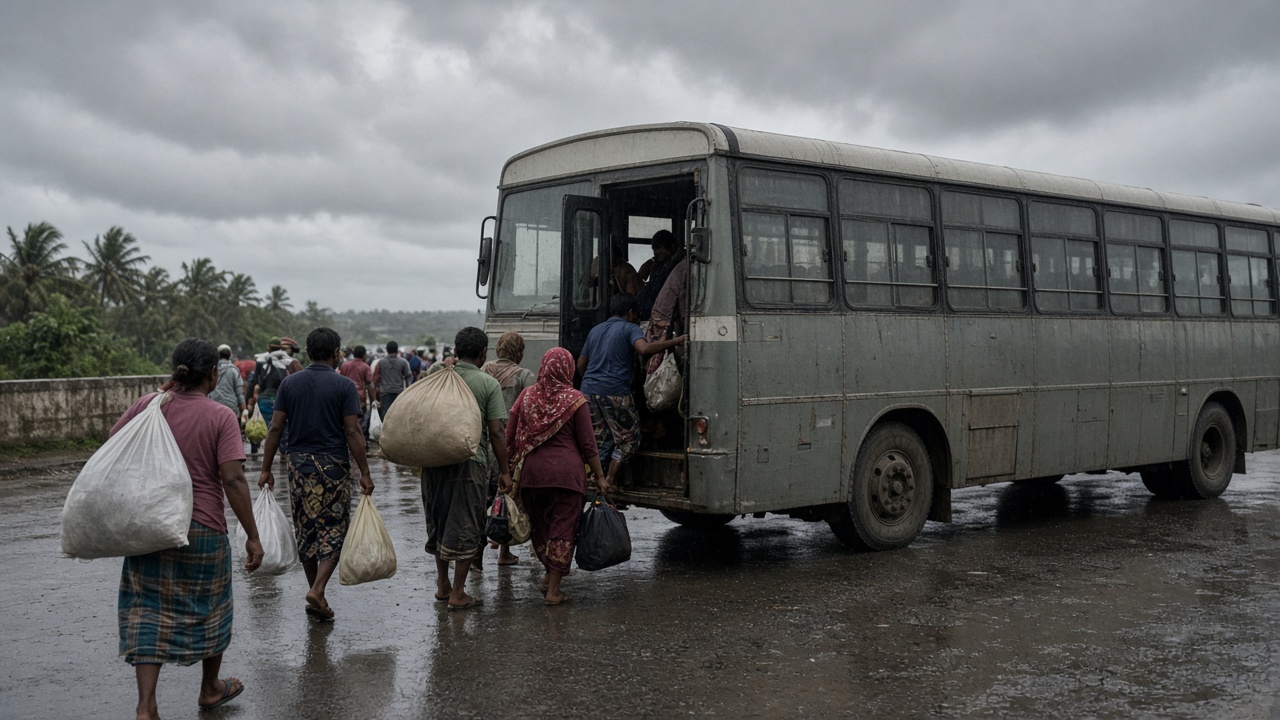
Indian disaster agencies rushed evacuations along the Bay of Bengal coast on Monday as Cyclone Murasu tracked toward a midnight landfall between Nellore and Narsapur, barely six days after Cyclone Arnab killed six people and flooded districts still draining water.
The India Meteorological Department said Murasu would cross south Andhra Pradesh as a severe cyclonic storm with sustained winds of 100 to 110 kilometers per hour and gusts to 120 km/h between 11:30 p.m. Monday and 4 a.m. Tuesday, local time. The storm’s name translates to “war drum” in Tamil, underscoring how quickly the region must shift from Arnab’s cleanup to Murasu’s warnings.
Andhra Pradesh counts the next surge
Prakhar Jain, managing director of the Andhra Pradesh State Disaster Management Authority, told Reuters that about 2,000 people were already evacuated by Monday and officials planned to move roughly 30,000 from low-lying coastal blocks. Chief Minister N. Chandrababu Naidu directed departments to pre-position relief teams and warned that 6,000 to 8,000 electrical poles could topple, threatening power restoration timelines.
Deputy Chief Minister Pawan Kalyan posted on X that Nellore, Prakasam, Bapatla, and Krishna districts face the heaviest impacts. Six National Disaster Response Force teams and seven state teams deployed ahead of landfall, with three NDRF units shifted from Tamil Nadu, news agencies reported. Schools closed across Andhra Pradesh, Tamil Nadu, and Odisha as squalls extended inland.
Odisha still recovering from Arnab
Neighboring Odisha moved 160,021 residents from Ganjam, Gajapati, Malkangiri, Koraput, and Kandhamal districts against a target population of 333,752, The Hindu reported from Bhubaneswar. Ganjam alone accounted for 151,434 evacuees, reflecting flood damage that Arnab’s rains left behind. Revenue and Disaster Management Minister Suresh Pujari said eight districts could see heavy rainfall as Murasu’s outer bands arrive.
Officials told The Print that 1,139 shelters could house about 333,000 people and that nodal officers were broadcasting warnings by loudspeaker. Disaster managers also shifted 1,068 pregnant women to safer facilities, a standard precaution when storm surges coincide with saturated rivers.
Forecast and comparison to Arnab
Meteorologists said Murasu should weaken faster than Arnab, which struck the same coastline on Oct. 28 with higher intensity and destroyed dozens of homes and crops. Even so, Murasu’s landfall window overlaps with high tides and saturated soil, raising landslide risks in the Eastern Ghats.
The IMD projected light to moderate rain across Andhra Pradesh on Nov. 2–3 with isolated extremely heavy totals, plus heavy bursts in southern Odisha, Telangana, and Chhattisgarh through Wednesday. Fishermen were ordered off the water in Nellore, and collectors were told to keep coastal staff on duty through the night.
What happens after landfall
Power utilities and railway controllers will watch pole damage estimates from Naidu’s briefing while NDRF teams fan out with boats and medical kits. If Murasu follows its projected track near Ongole, Andhra’s industrial corridor could face brief shutdowns, but officials said the priority remains zero casualties after Arnab’s six deaths.
Odisha’s evacuation pace suggests administrators expect to shelter the full 333,000-person target before 10 p.m., buying time for Murasu’s eyewall to cross the border and weaken over land. For communities still drying furniture from Arnab, the second cyclone in a week is a test of whether India’s east-coast warning system can outrun the monsoon’s most violent corner.