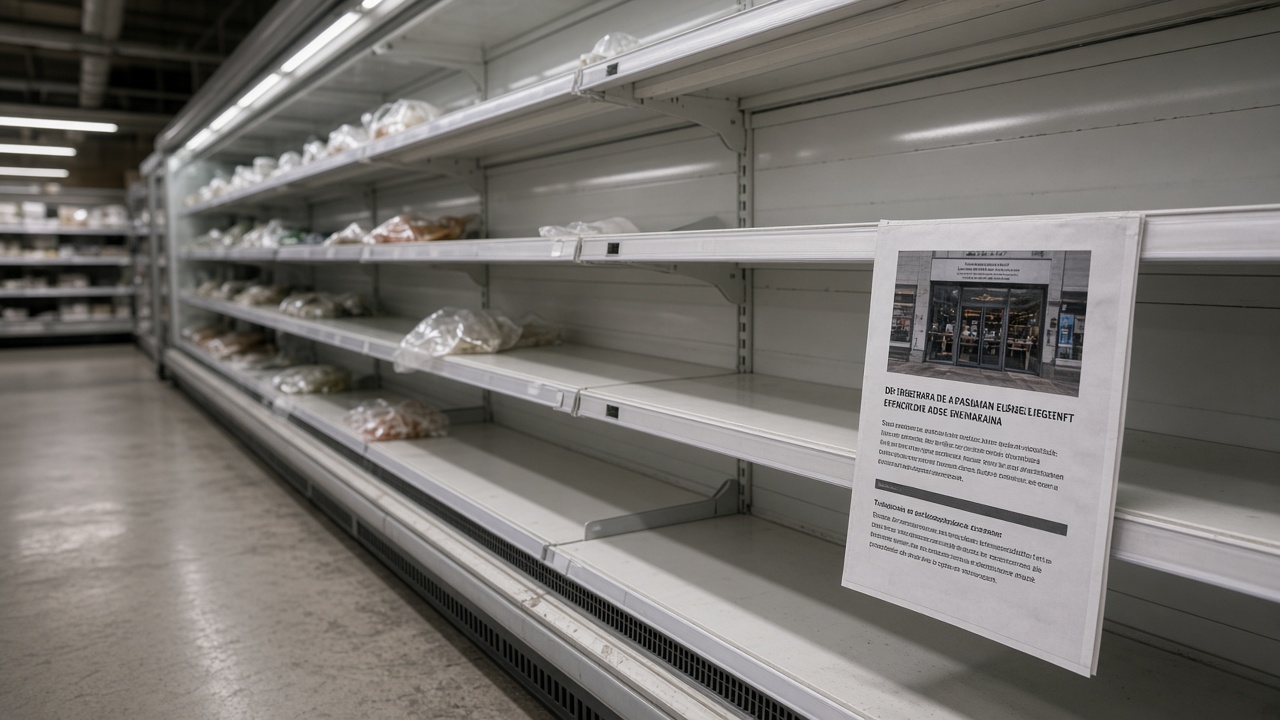
Supermarket chains across at least seven European countries woke on Monday to warm freezers and empty chilled aisles after an overnight cyberattack remotely switched refrigeration evaporators into defrost mode, the same technique that wrecked French stores last month.
Ahold Delhaize said cooling systems failed at dozens of its Delhaize shops in Belgium and Luxembourg. Reporters at a store northeast of Brussels found bare refrigerator cases and a printed notice apologizing that cyberattacks had left chilled and frozen shelves empty. Carrefour, Intermarché, Colruyt’s Spar franchise, IKEA’s Bergen outlet near Mons, and independent butchers all reported similar failures in Belgium alone, with Belgian media putting the national store count near 75.
Same playbook as the French wave
Stephan Moelans, chief executive of Belgian refrigeration installer Sabcobel, which manages Delhaize’s systems, told the Belga news agency that attackers used the identical mechanism seen in early October, when hundreds of French supermarkets lost millions of euros of stock. Moelans said his teams had worked through the night to disconnect compromised units from the network and warned that software patches alone cannot close the gap without physical hardware changes.
“The simplest solution is to manage the fridges over a secure internet connection,” Moelans added, noting that most customers moved to remote maintenance after the French incident. That convenience, however, leaves evaporators exposed to anyone who can reach the control layer.
From Flanders to the Baltic
Outside Belgium, Swedish grocers ICA and Coop, Dutch Ahold Delhaize operations, retailers in Ireland, Estonia, Finland, and Luxembourg all confirmed temperature spikes. Engla Ingwall, sales manager at an ICA franchise in Stockholm, told Reuters the attack hit around 2 a.m. local time but staff only noticed hours later. “Everything is destroyed,” she said. Estonian supplier Kitman Coldtech told public broadcaster ERR that one chain’s cases were driven to 50 degrees Celsius.
In Flanders, a Delhaize manager in Hoeilaart told Het Laatste Nieuws the branch lost roughly €100,000 of produce, a figure that did not yet include revenue from keeping the shop closed. Carrefour said only 15 of its 700 Belgian stores were affected and that contingency steps kept locations trading. Colruyt confirmed five Spar Q8 sites were hit.
Investigations and attribution gaps
Belgium’s federal prosecutor opened a formal investigation on Monday, a spokesperson confirmed to Brussels Times, without identifying any party. The Centre for Cybersecurity told Euronews it was aware of the incident but had no attribution details, and officials cautioned the operator behind the defrost commands might never be identified.
Retailers must now reconcile food-safety rules with insurance claims while engineers decide whether to isolate every internet-connected condenser. Moelans said Sabcobel had spent weeks hardening customer systems after October, yet Monday’s cascade showed how quickly a repeated exploit can spread when physical retrofits lag behind disclosure.
What shoppers see next
Chains that kept doors open leaned on dry groceries and apologized at the dairy case. Until investigators trace the command path, European grocers face a blunt choice: accept remote-service risk or pay for offline retrofits store by store. Either way, Monday’s spoilage bill adds to the October losses and turns refrigerated logistics into a front-line cybersecurity problem.