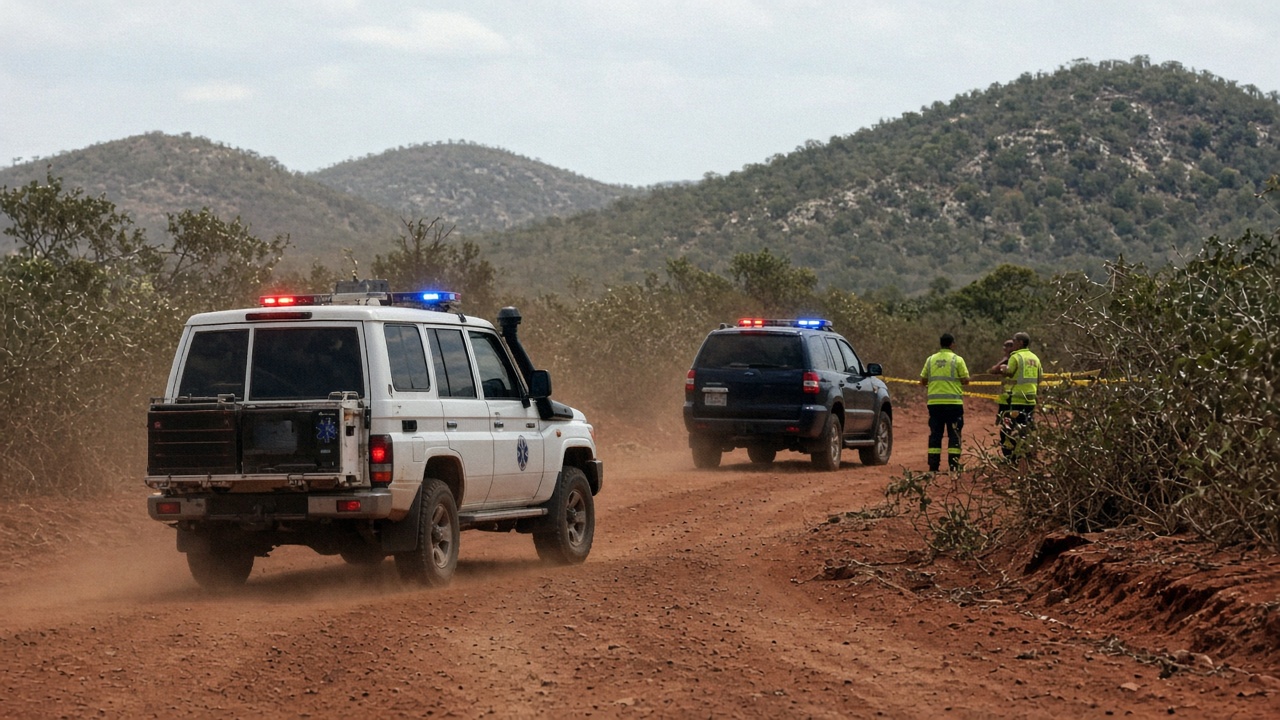
A 44-year-old man died on Monday after a boulder crushed him while he was fossicking on a remote track near a Far North Queensland goldfield, paramedics said, in a rare fatal accident that has renewed warnings about unstable ground in the state’s amateur prospecting belt.
Queensland Ambulance Service crews were called to the scene on Monday afternoon. ABC News reported that emergency services reached the track but the man died where he was found; police have not released his name pending next-of-kin notification.
What responders faced
Fossicking — searching creek beds and old diggings for gemstones or alluvial gold under permit — draws hobbyists into steep, often unsealed tracks west and north of Cairns. Incidents involving rock falls are uncommon but not unknown during wet-season weather when saturated slopes shift.
Monday’s call did not involve a mine regulated under Queensland’s formal resources regime; it occurred on a recreational track, meaning the immediate investigation sits with Queensland Police and the coroner rather than Resources Safety and Health Queensland, which oversees commercial sites.
Permits and safety expectations
The Department of Resources issues fossicking licences for designated fields and publishes safety guidance on working faces, tethering equipment and checking overhead rock after rain. Authorities routinely remind prospectors to carry communication devices because mobile coverage thins quickly beyond the coastal range.
No other injuries were reported at the scene. It is not yet clear whether recent storms contributed to the fall; the Bureau of Meteorology had flagged showers across parts of the tropics ahead of the Melbourne Cup week public holiday, when many Queenslanders travel inland.
What happens next
Police will prepare a report for the coroner, the standard path for sudden deaths on public land. If witnesses come forward, investigators may reconstruct how the boulder moved; without heavy machinery on site, fossicking fatalities usually hinge on terrain assessment rather than equipment failure.
For local communities that rely on tourism around historic gold towns, the death is a sobering counterpoint to promotion of outdoor adventure: the same gullies that attract weekend diggers can shed rock without warning after weeks of heat and a burst of rain.
Authorities have not announced any immediate closure of the field; any restriction would follow consultation with traditional owners and the department that administers the fossicking permit map for the area.
Queensland Police said they would release further details once formal identification was complete and family members had been notified. The ABC understands the man was fossicking alone; whether anyone else was in the area when the rock moved has not been confirmed.
Rescue helicopters are sometimes tasked to similar remote tracks when ground ambulances cannot reach a patient quickly. On Monday, crews apparently reached the man by road, suggesting the track remained passable despite its isolation from Cairns hospitals more than an hour away by car.
Fossicking groups on social media have begun sharing reminders to check overhead rock after wet weather and to tell someone a precise location before heading onto unmarked diggings, a low-cost habit that emergency planners say saves critical minutes when a phone signal finally appears on a ridge.