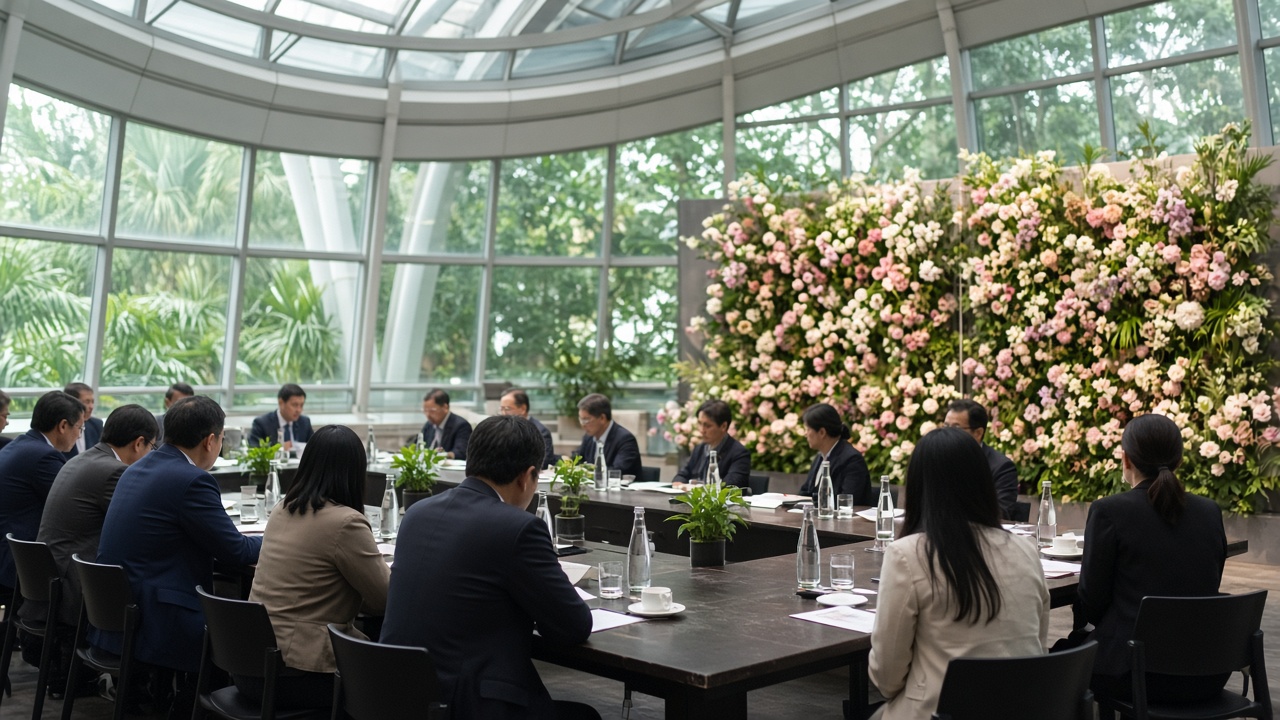
Singapore's Minister for National Development Chee Hong Tat and Malaysia's Minister of Economy Akmal Nasir opened the first Johor-Singapore Cooperation Ministerial Committee on Monday at Flower Field Hall in Gardens by the Bay, releasing investment totals that will shape how both governments sell the cross-border zone to factories, logistics operators and financial firms.
The committee said approved investments under the Johor-Singapore Special Economic Zone reached RM88.83 billion (about S$28.1 billion) in that window. Malaysian Investment Development Authority figures show roughly 45 percent, or RM40.3 billion, already implemented, with 12,796 jobs tied to those live projects. Approved pipelines could eventually support 28,755 positions if they fully ramp up.
Who sits on the panel
Both sides agreed the committee will include Malaysia's ministers of economy and investment, trade and industry, Johor's menteri besar, and Singapore's ministers for national development, energy and trade, and transport. Senior Minister of State for Transport and National Development Sun Xueling joined Chee at the inaugural session alongside Johor Chief Minister Onn Hafiz Ghazi.
The grouping replaces ad hoc coordination with a standing calendar for land use, customs facilitation and the eleven sectors both countries want third-country and Singapore firms to enter — from manufacturing and logistics to food security, tourism, energy, the digital economy and health.
What the money is supposed to buy
Officials pointed to Malaysia's Budget 2027 lines supporting the zone, including Nexus Sedenak as an industrial and supply-chain hub, upgraded transport links, strategic investment facilitation and financial-services work around Forest City. Singapore's side emphasised institutional frameworks rather than fresh grants: the joint statement focused on getting regulators, ports and immigration lanes aligned so approved dollars can move from boardroom slides to concrete and hiring.
Chee and Akmal told reporters after a doorstop that the RM88.83 billion headline is only as credible as implementation data. With less than half the approved sum deployed, the committee's next tests are milestone reporting on Sedenak road packages, RTS Link hand-offs and whether small and medium enterprises can access the same incentives multinationals already booked.
Five-year promise
When leaders launched the zone in January 2025 they targeted global investment flows and 20,000 skilled jobs within five years. Monday's job count from implemented projects remains below that pace, but the 28,755 potential roles in the approved pipeline give planners room — if conversion rates improve.
The zone spans 3,571 sq km across nine flagship areas. Monday's meeting did not announce new tax holidays; instead it catalogued progress and locked in membership for future sessions, signalling that Johor-Singapore economic integration will be managed as a bilateral cabinet track rather than a one-off summit announcement.
Cross-border commuters watching
White-collar workers who already split weeks between Jurong and Johor Baru will parse Monday's numbers for signs that visa facilitation and tax incentives are keeping pace with factory announcements. The joint statement mentioned ongoing Budget 2027 support but did not release new crossing-hour statistics for the Causeway, leaving commuters to rely on existing autogate expansions.
Business groups on both sides have asked for a single digital portal to track incentive approvals; the ministerial committee charter references institutional frameworks but leaves portal design to future technical working groups.