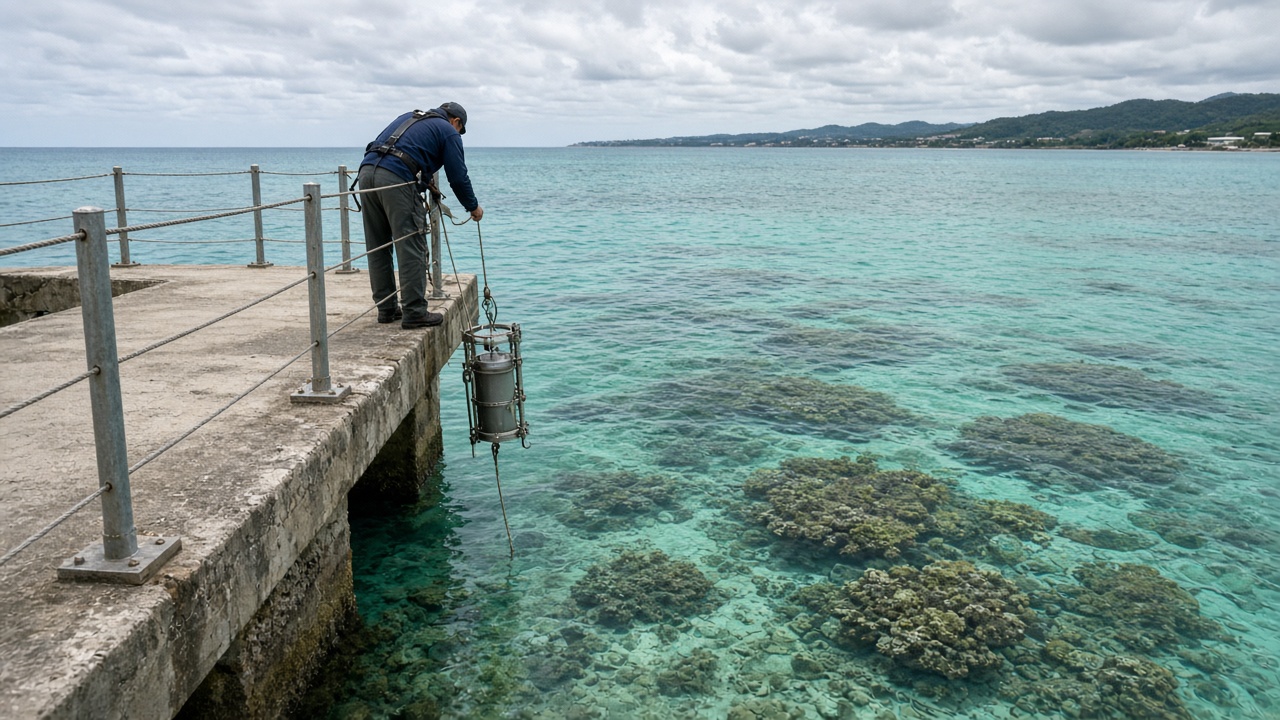
Technicians at Kenting’s marine laboratory recorded a surface pH of 7.89 at a fixed nearshore buoy Monday, the lowest reading since the 2019 mass bleaching summer, even as diver surveys show only patchy coral stress this fall.
What the number means
The Ocean Affairs Council publishes pH alongside temperature and turbidity at ten Penghu and Kenting stations. Monday’s dip sat 0.06 units below the October mean, tied to a warm eddy that lingered after Typhoon Kong-rey’s offshore track. Acidification alone did not trigger a bleaching alert; heat stress days remain below the three-week threshold park ecologists use.
Lab chemists said the reading is a surface snapshot, not a monthly average, and that bottle calibrations run every six hours against a secondary probe on the same buoy. Similar dips appeared in November 2020 without follow-on bleaching, which park staff cite when briefing tour operators.
Remote sensing teams compared satellite sea-surface color with buoy readings and found Monday’s dip aligned with a narrow nearshore band rather than offshore reefs, a pattern that suggests localized runoff rather than basin-wide acidification.
Reef checks on the ground
Divers at Nanwan transects reported five percent partial bleaching on staghorn colonies, far below the forty percent white coverage seen in August 2019. Museum staff said sediment from harbor dredging last month may have shielded some slopes from sunlight spikes, complicating simple comparisons.
Outplanting teams paused new coral fragments on the eastern slope until pH stabilizes above 7.91 for two consecutive weeks. Night snorkel tours must stay on marked lanes so researchers can finish the quadrat series without fin damage to recovering colonies.
Monitoring next steps
The lab will add weekly bottle samples to the buoy logger through December. Snorkel tour operators received a bulletin to avoid anchoring on the transect lines. Council officials plan a public dashboard update after the next spring tide series.
Volunteer divers from a local university will replicate quadrat photos taken in 2019 so ecologists can compare color-card scores without relying on single-day pH spikes. Park headquarters said entrance fees will not rise this season, but tour boats must carry the new anchoring map distributed Monday.
Marine biology graduate students will log paired temperature readings at five-meter intervals along Nanwan slopes, data council scientists said helps separate heat stress from acidification signals. Kenting town officials scheduled a merchant briefing Thursday to explain why certain mooring buoys moved fifty meters seaward.
Insurance pools that cover dive shops asked for weekly pH bulletins after Monday’s low reading, even though policies still exclude mass bleaching events. Operators said they will post bulletins in Mandarin and English at ticket counters without alarmist wording.
County tourism officials said they will not cancel winter swim programs but will require guides to carry handheld pH strips for spot checks before entering sensitive transects, a low-cost backup if buoys drift out of calibration.