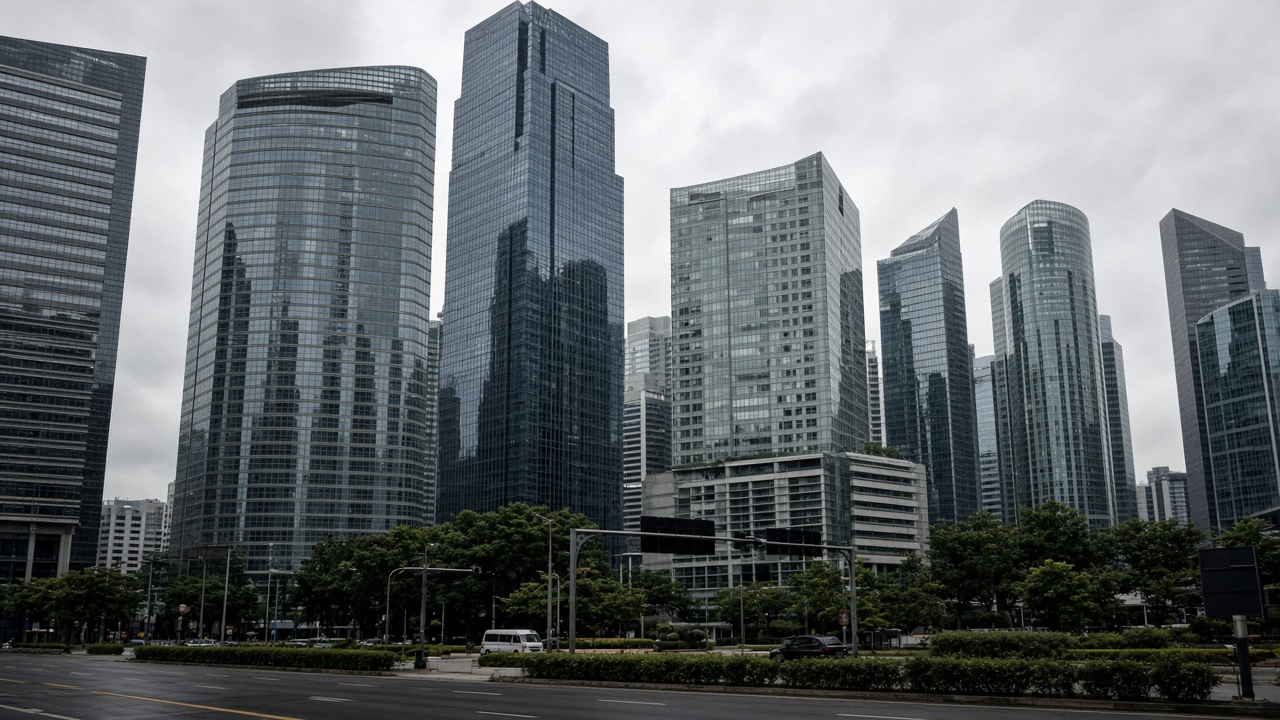
Singapore's benchmark Straits Times Index gave up 72.91 points on Monday to close at 5,303.83, a 1.4 percent drop driven by the three local lenders that usually anchor the index.
OCBC was the weakest blue chip, falling 3.3 percent or S$0.97 to S$28.32. DBS slipped 1.9 percent to S$71.71 and UOB lost 1.7 percent to S$40.66. Jardine Matheson bucked the trend with a 2.1 percent gain in US dollar terms, but the banking block's weight pulled the headline index lower.
Broader market tone
Business Times data showed 310 decliners against 276 gainers on the full market, with 935.9 million securities worth S$2.4 billion traded. Addvalue Technologies topped volume by shares; DBS led by value with S$793.6 million changing hands.
Within the iEdge Singapore Next 50 index, CSE Global rose 4 percent while supermarket operator Sheng Siong sank 9.4 percent, illustrating how Monday's risk-off mood hit defensives as well as cyclicals.
Regional context
Hong Kong's Hang Seng edged up 0.4 percent, Japan's Nikkei 225 fell 0.3 percent, Korea's Kospi jumped 2.2 percent and Malaysia's KLCI added 0.2 percent. Singapore's bank-heavy index therefore underperformed several neighbours despite similar overnight technology sentiment.
Analyst read-through
Jefferies analysts Joanna Cheah and Ang Wei Han said Monetary Authority of Singapore banking statistics for September reinforce a constructive loan-growth outlook that could offset margin pressure. They prefer DBS for earnings resilience and UOB for potential catch-up if asset quality stays contained, while keeping a hold on OCBC citing weaker Great Eastern contributions and moderating wealth fees after a strong second quarter.
For retail investors watching CPF-linked portfolios or bank dividends, Monday's price action is a reminder that STI direction still tracks the trio's deposit repricing story even when quarterly earnings are weeks away.
CPF and retail exposure
Many Singapore households hold local banks through CPF investment schemes and ordinary brokerage accounts. A 3.3 percent single-day move in OCBC does not trigger circuit breakers, but it feeds into month-to-date returns for passive STI trackers popular with first-time investors.
Property-linked counters and REITs were mixed, preventing a broader capitulation despite the bank drag. Traders said afternoon volumes thinned after regional markets closed, a typical Monday pattern when US catalysts wait for overnight futures.
Reporting from Singapore desks on Monday evening noted that readers will see follow-up pieces when ministries release implementation dashboards; until then, the published figures and market closes above remain the best verified benchmarks for the day's news.
Editors will update online chips if agencies revise totals after market hours or if parliamentary answers add detail in the coming sitting week.