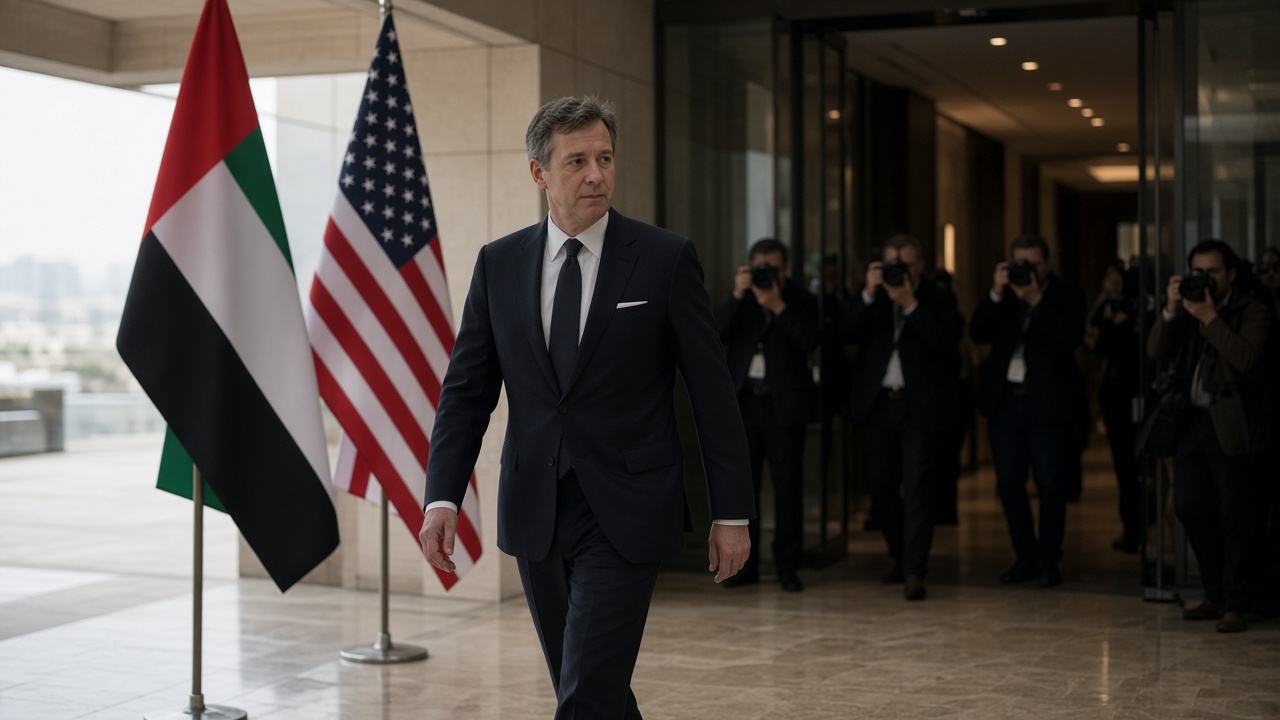
U.S. special envoy Steve Witkoff said Monday that the United States will mediate working-level negotiations between Ukraine and Russia in Abu Dhabi on November 10 and 11, reviving a trilateral channel that stalled when Washington’s focus shifted to the war with Iran earlier this year.
In a statement posted on social media, Witkoff said discussions would cover post-war security arrangements, de-escalation, humanitarian measures, and next steps toward ending Russia’s full-scale invasion. He added that Kushner, who has partnered with him on Middle East and Ukraine diplomacy, is expected to represent the United States alongside him in the Emirati capital.
What changed on Monday
The announcement gives a fixed venue and calendar date to a process that Ukrainian and Russian officials had described only in broad terms after Witkoff’s separate meetings with President Volodymyr Zelensky and President Vladimir Putin in October. A senior U.S. official told Reuters the Abu Dhabi session would build on contacts in Kyiv, Oslo, and St. Petersburg rather than open an entirely new track.
Witkoff framed the meeting as an extension of President Donald Trump’s effort to end Europe’s deadliest conflict since World War II. Trump campaigned on a rapid settlement but has spent much of his second term balancing pressure on Kyiv with selective sanctions relief for Moscow, including steps that eased constraints on Russian diesel sales that the Kremlin had welcomed.
Why the last round stopped in February
The previous U.S.-mediated trilateral talks were held in Geneva in February, before American and Israeli strikes on Iran drew U.S. diplomatic bandwidth away from Ukraine. Arab News noted that negotiators had been seeking momentum before winter fighting hardened front lines, and that Monday’s date lands less than a week after U.S. midterm elections that Zelensky warned could coincide with another Russian strike on energy and logistics targets.
Secretary of State Marco Rubio told reporters at a G20 foreign ministers’ meeting on October 31 that he did not know whether a negotiated peace was achievable, adding that no one at the gathering claimed a settlement was imminent. The Abu Dhabi timetable therefore restarts talks without resolving the underlying gap between Moscow’s territorial demands and Kyiv’s insistence on a ceasefire along the current front line.
Brussels and reconstruction money
Witkoff said lower-level U.S. officials would meet in Brussels this week with France, Germany, the United Kingdom, the European Union, and NATO to discuss security guarantees for Ukraine, Europe’s post-war security architecture, and economic support for reconstruction. Ukrainian officials have said any durable deal must include guarantees that cannot be dictated by Russia, while the Kremlin has rejected ceasefires that would freeze Ukrainian forces short of Moscow’s objectives in Donetsk and Luhansk.
The Kyiv Independent reported that Zelensky had floated one or two technical rounds before any summit involving Trump and Putin, who have not met directly since the 2022 invasion. U.S. officials portrayed Abu Dhabi as the next technical step rather than a leaders’ breakthrough.
What happens before November 10
Diplomats on all three sides will watch whether Russian aerial campaigns ease and whether Ukraine’s partners sign off on the American sequencing. Putin aide Yury Ushakov said last month that Russia was ready in principle to resume trilateral talks after Witkoff’s St. Petersburg visit, which also preceded the release of American citizen Stephen Hubbard. None of those gestures has yet produced a published ceasefire text.
Working groups in Abu Dhabi will have to translate broad agenda items into verifiable limits on strikes, prisoner exchanges, and maritime corridors if negotiators hope to move from process to substance. For now, the headline is procedural: a date, a host city, and a U.S. team willing to sit between delegations that remain far apart on territory and security.