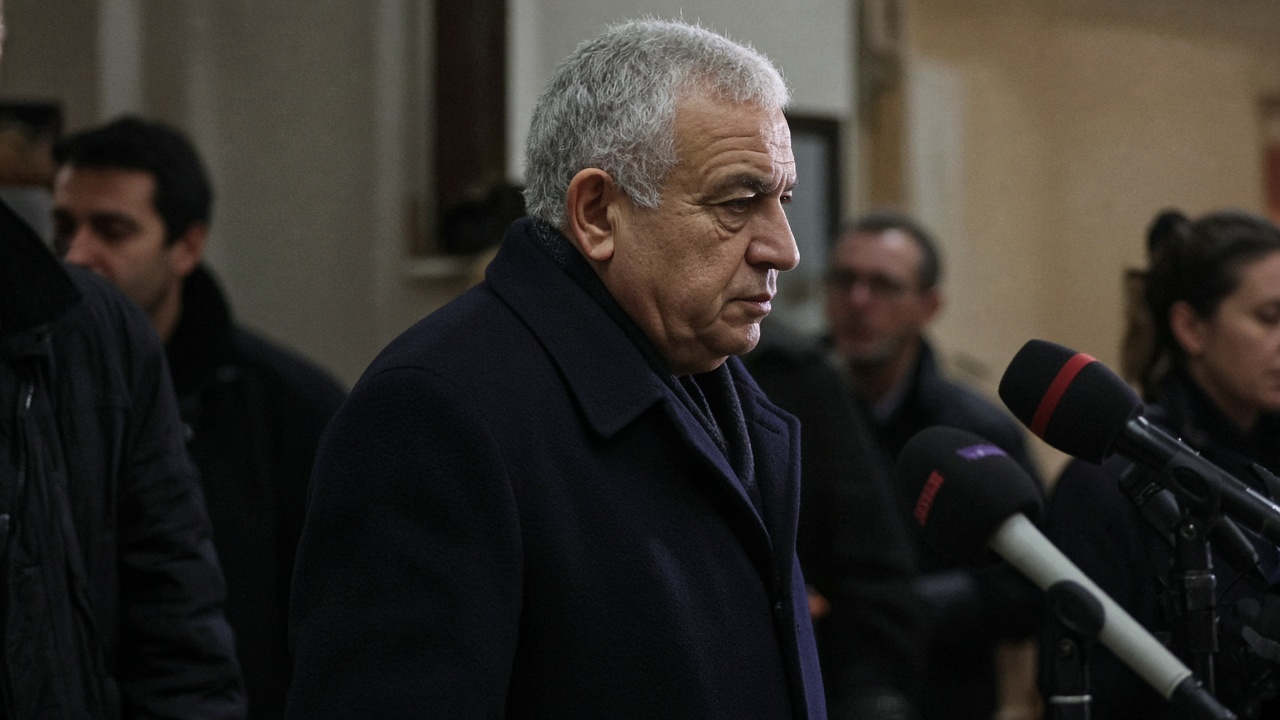
JERUSALEM — The five party leaders trying to unseat Prime Minister Benjamin Netanyahu agreed Tuesday to recommend former military chief Gadi Eisenkot when President Isaac Herzog opens mandate consultations on Wednesday, and to begin drafting the agreements for a replacement government without waiting for the new Knesset to settle in.
The joint statement after a 70-minute meeting in Herzliya said the bloc would work to replace what it called the “October 7 government” with a national emergency government “as soon as possible.” Negotiating teams were told to start on guiding principles and coalition contracts immediately, while parliamentary leaders coordinate moves from the opening days of the 26th Knesset, including electing a new speaker.
What the bloc agreed — and what it did not
All five parties — Eisenkot’s Yashar, Naftali Bennett’s B’Yachad, Avigdor Liberman’s Yisrael Beytenu, Yair Golan’s Democrats and Yair Lapid, who holds the second slot on the B’Yachad list — said they would back Eisenkot for the first mandate Herzog can award after he hears faction recommendations.
They also stood by four principles Eisenkot set out over the weekend, including recognition of Israel as a Jewish state and treating Hamas as a terrorist organization. Those conditions could complicate reliance on Arab-led parties, whose 19 seats sit outside both Jewish-led blocs after the October 27 election.
Netanyahu’s bloc won 53 of the 120 seats; the change alliance took 48. A majority requires 61. Arab parties split between the Joint List, with 11 seats, and Ra’am, with eight. Yousef Jabareen, who leads the largest Arab-led faction in the incoming parliament, has argued the opposition must accept that arithmetic if it wants Netanyahu out.
Arab seats and the arithmetic
Only Golan has openly backed cooperation with Arab-led parties, calling exclusion racist. Eisenkot has focused on ultra-Orthodox factions as potential partners and has not publicly ruled out external support from Arab lawmakers or a unity arrangement with Likud, though allies say he worries Netanyahu could outmaneuver a broad coalition.
Herzog must consult faction heads Wednesday and Thursday before naming a lawmaker to form a government. Eisenkot could collect the most recommendations if Arab factions add their names, but the opposition statement did not resolve whether those votes would come with policy concessions.
Pressure from bereaved families and the calendar
After the Herzliya session, Eisenkot met bereaved families and victims of the October 2023 attacks, who handed him a letter urging him to “swear in the Knesset and establish a change government.” Bennett told reporters the bloc had “no time” and must move with “great urgency,” including taking control of parliamentary committees quickly.
The change leaders also condemned what they described as Likud efforts to delegitimize the Central Elections Committee and the count itself. Netanyahu’s side has not conceded the path to another term, and Herzog’s choice this week only starts a clock — the nominee typically has weeks to assemble a majority before the mandate can pass to someone else or Israel faces another election.
For now, the measurable shift is procedural: a single recommended prime minister-in-waiting across five parties that spent the campaign sniping at one another, and parallel negotiation teams tasked with turning that recommendation into 61 signatures on paper.