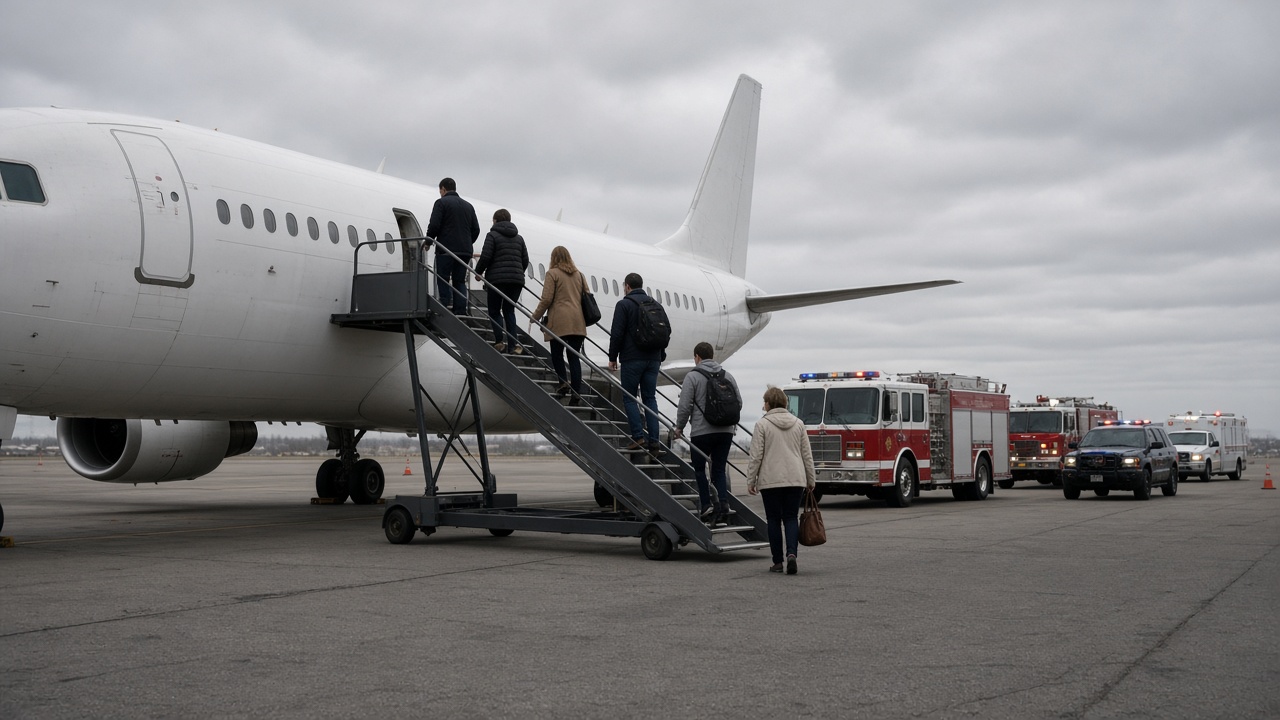
European aviation security teams spent Tuesday chasing a fresh wave of emailed bomb threats that forced diversions, runway inspections and, in at least one case, an Italian Air Force escort—yet every search so far has come up empty, according to airlines and police officials across the continent.
The disruption stretched into a third straight day of hoaxes after a Wizz Air flight from London Luton to Sofia was diverted to Budapest on Monday. On Tuesday, authorities said threats touched routes linked to London Heathrow, Manchester, Copenhagen, Lisbon, Dublin and Tel Aviv, with carriers including LOT Polish Airlines, Ryanair, Scandinavian Airlines and Wizz Air confirming security activations.
Heathrow and Manchester departures diverted
A LOT Boeing 737 MAX carrying 181 people from Heathrow to Warsaw Chopin airport was diverted to Warsaw Modlin after a threat was reported in flight, Modlin airport said. The jet landed at 10:01 a.m. local time and was parked in an isolated area while bomb-disposal teams and police searched the cabin and hold. Passengers were eventually bussed to the arrivals hall; Modlin reopened once specialists cleared the aircraft.
Separately, a Ryanair flight that left Manchester for Murcia in southeastern Spain landed under emergency protocols at Corvera airport, Murcia regional government delegate Francisco Lucas said on social media. Lucas later said Spain’s Civil Guard found no explosives after inspecting the jet, which carried 121 passengers and crew, and that normal operations resumed. A passenger who identified herself as Sara told BBC Radio 5 Live that travelers were not told what was happening until fire engines and a bomb squad appeared on the apron and crew ordered an evacuation.
Rome, Sofia and Warsaw see parallel scares
Italian authorities searched two Ryanair aircraft at Rome Fiumicino after anonymous tips, including one flight from Dublin that Italian media said was escorted by Air Force fighters until landing. In Sofia, counterterrorism officers met an arriving aircraft after an emailed threat, Bulgaria’s BTA news agency reported. Polish officials said two Warsaw-bound flights faced threats; one Copenhagen-to-Warsaw SAS service landed normally after Danish media reported a scare, while the LOT Heathrow diversion triggered the temporary Modlin shutdown.
German police told The Associated Press that several Tuesday threats proved to be hoaxes but still required full security responses because airlines cannot ignore credible-sounding warnings mid-flight. Berlin said impacted carriers included LOT, SAS, Wizz Air and Ryanair, and that no injuries were reported.
What investigators know—and what they do not
Officials have not publicly linked the emails to a single group or motive, and no arrests were announced by late Tuesday in Europe. Security analysts note that copycat hoaxes often spike after high-profile diversions because senders can trigger costly chain reactions with little risk.
Airlines said they are cooperating with national police and aviation regulators. LOT and Ryanair did not immediately detail compensation policies for passengers whose journeys were extended by several hours on the ground. Heathrow and Manchester declined to comment on operational impacts beyond confirming that affected flights followed established threat procedures.
European Union transport ministers have scheduled no emergency session, but the International Air Transport Association has long warned that false threats still burn fuel, tie up bomb squads and rattle crews at a moment when the industry is already managing tight schedules and higher security staffing costs.
For travelers, the practical effect is layered delay: even cleared aircraft must be released by police, bags rechecked in some jurisdictions, and crews must respect duty-time limits before continuing. Until investigators trace the senders, carriers said they will treat each new email as real—a stance that protects safety but virtually guarantees more tarmac waits if the hoax cycle continues.