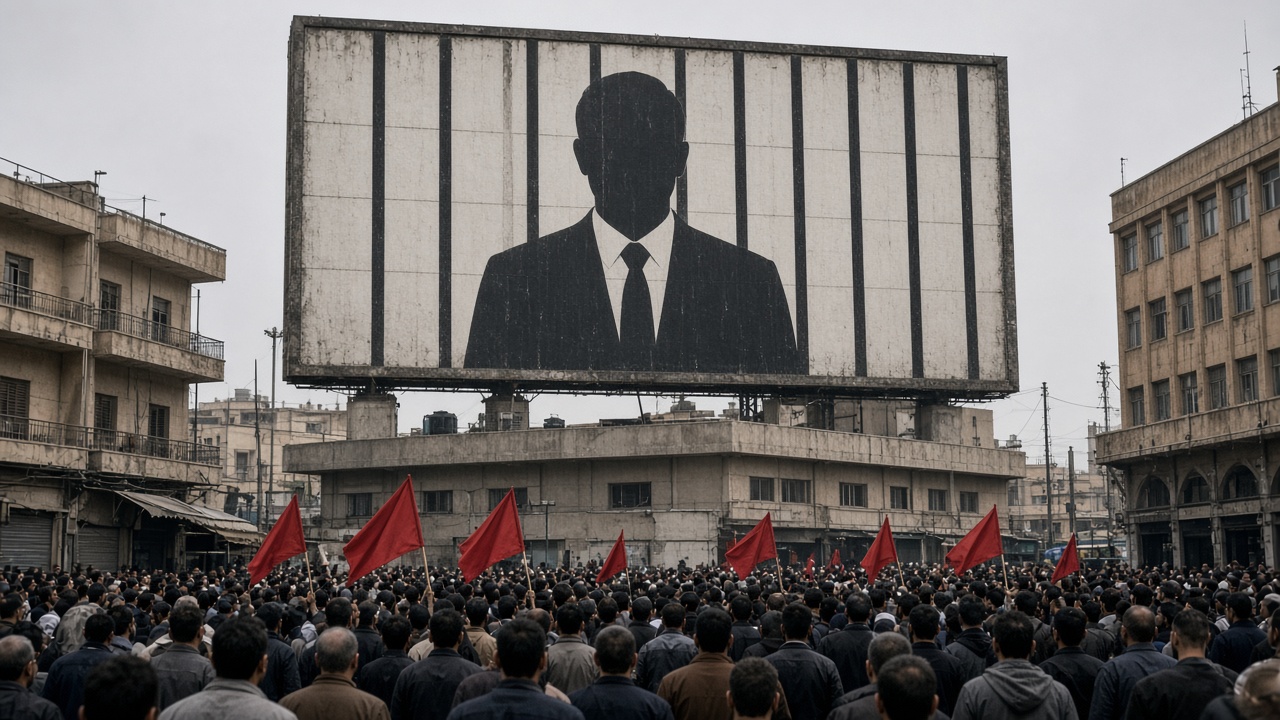
Iran unveiled a towering billboard over Enghelab Square in Tehran on Tuesday pledging to kill U.S. President Donald Trump, pairing the English-language threat with an image of Trump bowing behind prison bars. The installation landed on the day Americans opened polls for midterm elections that will shape the final two years of Trump’s presidency and how much room a Republican or Democratic Congress would give him on war-and-peace decisions in the Middle East.
What appeared in the capital
Photographs published by international news agencies show the main display reading “We will kill Trump” in English above the barred portrait. A second billboard nearby depicted Trump, U.S. Vice President J.D. Vance, special envoy Steve Witkoff and Israeli Prime Minister Benjamin Netanyahu with bloodied faces and torn suits against faded American and Israeli flags, according to reporting from AFP and other outlets on the ground.
Dozens of people gathered in the square waving red flags and carrying banners that read “There will be blood,” journalists reported, framing the scene as public mourning and rage over Supreme Leader Ayatollah Ali Khamenei, who was killed in U.S.-Israeli strikes on Feb. 28 that opened the current regional war. Similar anti-Trump street art has appeared repeatedly in Tehran since those attacks, but Tuesday’s wording explicitly promised lethal action against a sitting U.S. president.
Street theater and secondary sites
Reporting from The Media Line and European outlets described additional propaganda beyond static billboards, including an open-air exhibition in Tajrish Square with paintings of Trump and a life-size mock prison cell occupied by an actor impersonating the president. One painting showed Trump’s bloodied face on the ground with a foot pressed to his head, imagery that state media have used before to dramatize Iranian claims of victory over Washington.
Iranian officials did not immediately publish a formal statement tying the displays to a specific military or legal policy. The messaging nonetheless functions as domestic reinforcement at a moment when Iranian negotiators have floated conditional steps to reopen the Strait of Hormuz and when global oil markets remain sensitive to any sign that fighting could resume after the U.S. vote.
Timing against U.S. voting and talks
Trump told reporters in recent days that he was “in no rush” to decide whether to resume major combat against Iran and that a diplomatic deal “could happen,” even as he has also threatened to intensify operations after the midterms. Netanyahu has urged quick action in private conversations reported by U.S. outlets, creating a split-screen for voters who face higher energy costs and casualties linked to the eight-month conflict.
The billboard’s English text suggests Iranian authorities wanted the threat visible to foreign journalists and social audiences, not only to Farsi-speaking passersby. U.S. Secret Service and State Department practice is to treat such rhetoric seriously while distinguishing public propaganda from evidence of an operational plot; neither agency issued a detailed public assessment Tuesday as voting proceeded across U.S. time zones.
What comes next
Diplomatic contacts mediated through Gulf capitals continued on Tuesday without a published breakthrough. Iranian displays in Tehran do not by themselves alter sanctions, force posture or shipping insurance in the Gulf, but they complicate any White House argument that de-escalation is already locked in. U.S. officials will watch whether Iran keeps the billboards up after the midterm results are known and whether negotiators return to the table with concrete Hormuz or nuclear terms.
For Tehran’s leadership, the square is both a mourning site and a stage. Tuesday’s installation made the political cost explicit: Iran’s government is willing to advertise a death threat against an American president on the day that president’s party faces a national verdict at the ballot box.