
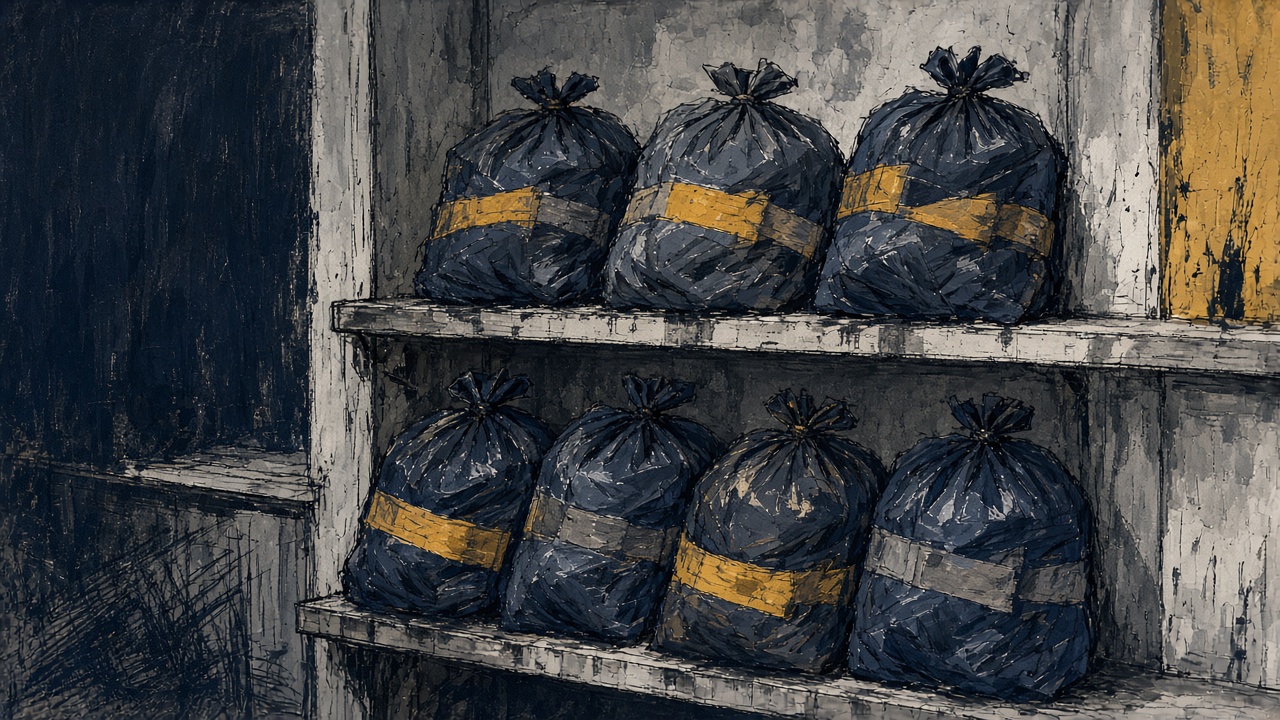
In Incheon, a 20-liter official household trash bag costs 620 won in Gyeyang and 870 won in Yeonsu and Ongjin county. Cross the border into Seoul and the same volume line on the shelf reads 490 won in all 25 districts, from Gangnam to Gangdong. The plastic is thin. The ink is municipal. The price gap is the story.
The sticker that is not for plastic
The Incheon metropolitan government publishes a single table of volume-based bag prices, updated through July 2026. Gyeyang (listed as Geondan) charges 620 won for a 20-liter household bag. Yeonsu, where Songdo sits, charges 870 won. Ongjin county, a chain of islands west of the peninsula, charges 870 won as well. Seoul’s price portal shows 490 won for a 20-liter home bag in every gu, with Gangnam and Gangdong both at that level in the municipal table.
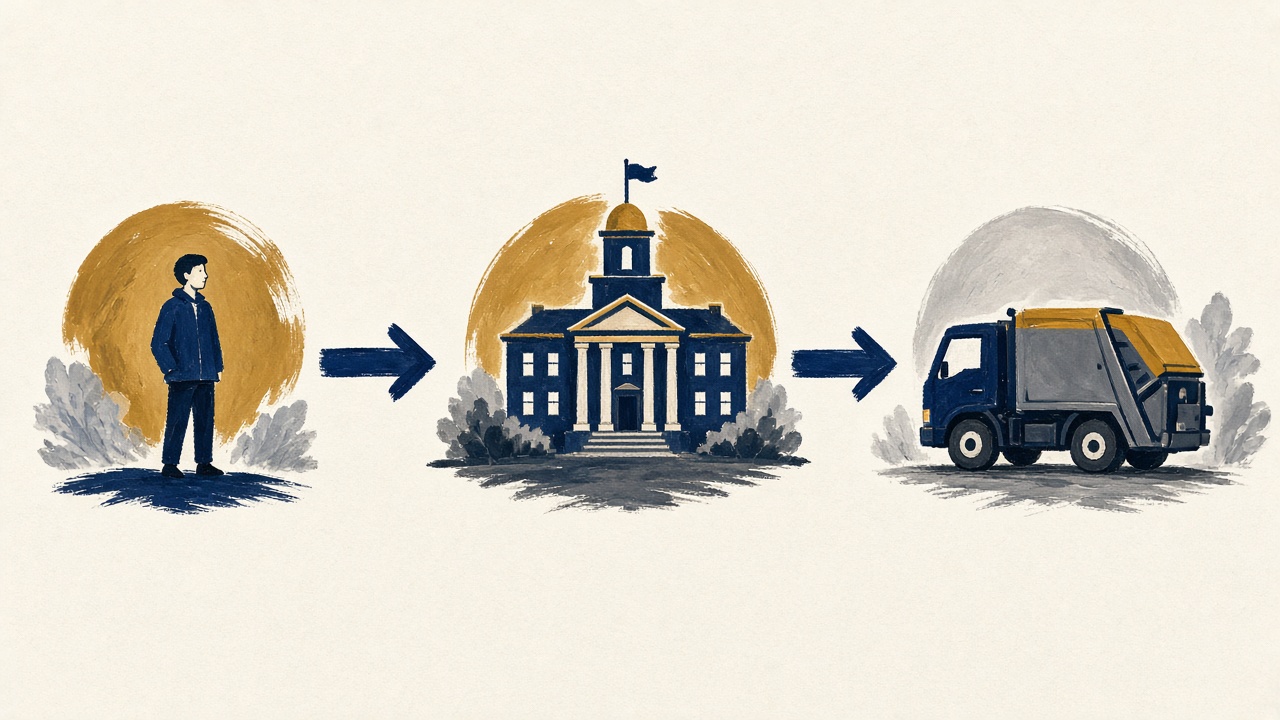
Residents often assume the convenience store keeps a markup. The markup is not the model. Since 1995 the country has billed household waste through prepaid standard bags whose price is set by ordinance. You are not buying polyethylene. You are prepaying collection, transport, and disposal for whatever is inside once the bag hits the curb.
The question people ask at the register is simpler than the answer: why does moving a few subway stops change the sticker when the bag still says 20 liters? The answer lives in contracts each district signs for burn plants, landfill cells, and ferry routes, not in the wholesale cost of plastic resin.
When the monthly bill became a bag
Korea did not always charge trash this way. Flat collection fees covered household waste until the volume-based system rolled out nationwide on 1 January 1995, according to the National Archives exhibition on daily life records. The same exhibition traces the policy back to April 1994 pilots. Seoul had tested the idea earlier, piloting the fee in April 1994 in three contrasting neighborhoods: Jung-gu’s commercial blocks, Seongbuk-gu’s detached houses, and Songpa-gu’s apartment towers.
The formal policy name, the garbage collection fee volume system, encodes the logic. Under the polluter-pays principle, the Archives exhibition states, the fee makes dischargers pay the cost of treating the waste they produce so that total disposal falls. Implementation replaced the old monthly bill with bag sales. Bags could only be used in the region printed on them, a rule the Ministry of Environment summarized in its Seoul Solution case study.
이 제도는 오염자 부담 원칙하에 국민 전체를 대상으로 쓰레기 배출에 따른 처리 비용을 배출자에게 부담케 하여 쓰레기 배출을 억제하려는 제도이다.
A post-rollout survey of 1,000 households, cited on the same case-study page, found 98 percent of respondents comfortable with the system within months. The most popular sizes were 10 liters, then 5 liters, then the 20-liter bag this piece follows.
Before the switch, households paid a flat sanitation fee whether they filled one sack or five. After the switch, every bag was a marginal unit of waste. Cities could raise revenue without a visible tax vote because the price printed on the bag was the fee increase. That political economy still shapes how often mayors revise the table.
What the law sells you
The Waste Control Act assigns responsibility to local government. The English text hosted by Japan’s Ministry of the Environment states that the head of each si, gun, or gu “shall be responsible for the collection, transportation, and disposal of household wastes discharged within his/her jurisdiction.” Article 14 allows fees to be collected by selling volume-based bags under municipal ordinance, as translated on Koreanics from the Korean statute.
Household waste producers, in turn, must separate waste they cannot handle themselves and follow local rules on storage and disposal. The Environment Minister may recommend differential rates tied to quantity when cities set those service charges. None of this reads like a retail transaction because it is not one. The city is both regulator and billing department.
Local heads may also commission private collectors to haul waste on their behalf, again by ordinance. The bag revenue must cover those contracts plus the tip fee at the plant. When national politicians debate “waste policy,” they are rarely debating plastic graphics. They are debating whether the next won of increase belongs in the 20-liter row or in a separate food-waste meter.
Where the won go after you tie the knot
Open the national standard dataset for volume-based bag prices on data.go.kr and the columns explain what you are paying for. Each row lists province, city, bag type, disposal method, waste category, and user type before the price cells. “Disposal method” distinguishes incineration bags from landfill sacks. Seoul Seocho-gu lists a 490 won price for a 20-liter incineration household standard bag in the August 2026 extract. Incheon Michuhol-gu lists 750 won for the same class. Busan Buk-gu lists 680 won, Daejeon Daedeok 660 won, Changwon 700 won, and Cheonan 500 won.
Seoul’s metropolitan waste ordinance says disposal charges should reflect “costs and expenses for the installation and operation of waste disposal facilities.” That language matters when a gu still sells a separate landfill-marked sack. Gwangjin-gu’s landfill row in the national table prices a 20-liter special sack at 2,040 won, four times the 490 won incineration bag. The cheap bag is cheap because the city sends it to a plant tuned for that stream. The expensive sack buys a different endpoint.
The chart compares eight municipalities using incineration household rows from that dataset, with Ongjin’s 870 won taken from Incheon’s published table. Cheongsong county in Gyeongsangbuk-do lists 140 won for the same nominal bag class, while Ongjin lists 870 won. The spread is wider than the distance between Seoul and Busan on the map because the fee embeds haulage, plant contracts, and whether waste crosses water.
Compare Michuhol’s 750 won row with Seoul’s 490 won row and the gap is 53 percent for the same printed volume and the same disposal method column. Compare Busan Buk’s 680 won with Changwon’s 700 won and two coastal cities still diverge by 20 won because their plant amortization schedules differ. The national table is the closest thing Korea has to a public menu of those schedules.
One metro, three invoices
Incheon complicates the picture further. Its price page notes that some districts sell standard volume bags while others rely on dedicated container deposit slips for the same metropolitan area. Yeonsu and Ongjin share the 870 won top tier for 20-liter bags, yet Michuhol, closer to older urban cores, lists 750 won in the national dataset. Gyeyang’s 620 won tier sits between Seoul and the island price.
None of these numbers punish a household for producing more bags than its neighbor in a moral sense. They invoice different logistics networks inside one labor market. A Songdo apartment and a Gyeyang townhouse both pay Incheon taxes. They do not pay the same trash tariff because the bag price is a miniature municipal bond issue: revenue collected upfront to cover contracts the gu signed years earlier.
Incheon’s table even splits billing mechanics within the city. Some gu sell only standard volume bags. Others also accept dedicated container deposit slips for certain housing types. A resident who moves from a bag-only gu to a slip-only gu discovers that the billing instrument changes even though the metropolitan logo on the truck is the same.
The fines that outran the rule book
Because the bag is the billing instrument, enforcement treats the wrong container as dumping. In 2018, authorities detected 175,883 cases of illegal household waste disposal with fines totaling 12 billion won, according to English-language reporting on a Board of Audit and Inspection review. Cases involving non-standard bags numbered 77,136 and accounted for 7 billion won in fines, roughly 44 percent of all household dumping cases that year.
Yet the same reporting notes a 2016 interpretation by the Ministry of Government Legislation holding that disposal without official bags at legally designated sites is not always punishable under Article 8 of the act. Local governments continued issuing fines while the legal basis was contested. The administrative fine schedule on law.go.kr still lists discarding household waste in a vinyl or cloth bag among violations, with standard amounts of 200,000 won shown for that category in the enforcement decree table.
Supporters of the volume system point to the Archives framing: charging dischargers preserves fairness among users and keeps total waste in check. Critics during the 2020 audit argued that fining non-standard bags without airtight statutory language violates the principle that ordinances need higher-law backing. The 20-liter bag sitting in your pantry is subject to both arguments every time you run out and buy another sleeve.

Asia Economy quoted audit coverage this way: local governments “have been imposing fines totaling up to 7 billion KRW annually for disposing of waste without using designated volume-based waste bags, despite the lack of clear legal regulations punishing such acts.” The tension between polluter-pays enforcement and precise statutory language is unresolved in the paragraph, but it explains why residents feel penalized for a bag choice while lawyers argue about designated sites.
The name printed on the plastic
Return to the 20-liter bag itself. It is sold at supermarkets and corner shops, but the label names a district or city. Use a Seoul bag in Incheon and you have underpaid another city’s disposal ledger. Use a cheaper bag from a visit to your parents’ house in a lower-tier county and you have done the reverse. The national open-data portal lists 234 local governments feeding rows into the standard price file, each with its own incineration and landfill columns.
That is why the price changes at the city line. The border is not cosmetic. It marks where one head of a gu’s cost table ends and another’s begins. The bag looks like packaging. It functions as a receipt for a service you will never see: the truck, the weighbridge, the furnace or the landfill cell, priced one knot at a time.
The district name printed above the price is the other half of the label. It tells you which ledger will pay for whatever you knot inside.